23 October 2026
One of the most persistent challenges in a programming classroom is knowing what every student is doing at any given moment.
A teacher can spend an entire lesson moving from one raised hand to another. While helping one student locate a bug, several others become stuck, distracted or disengaged. The result often feels less like teaching and more like firefighting.
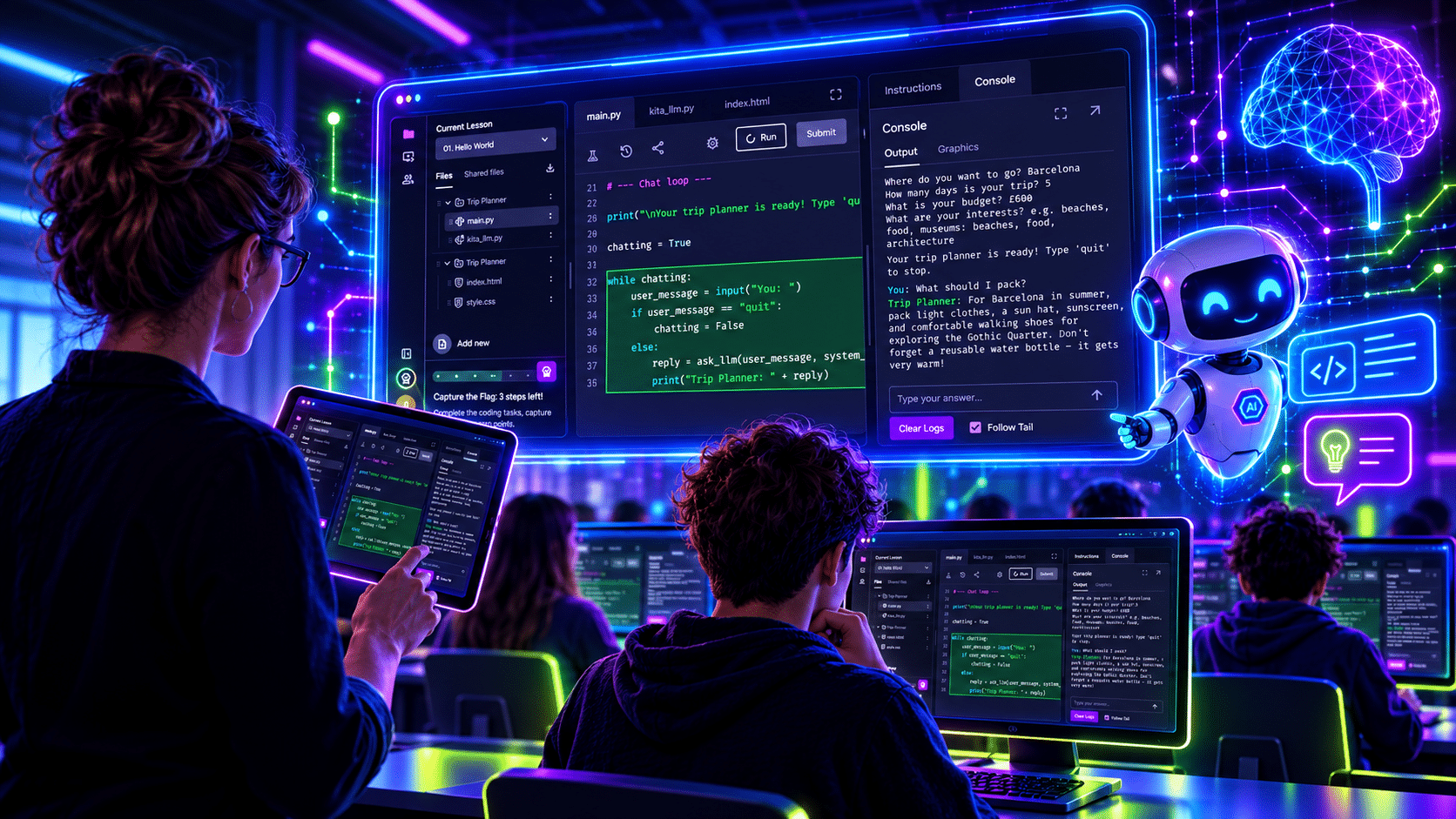
Modern classroom platforms like Kita increasingly address this problem by giving teachers a live view of student work. Instead of constantly walking around the room looking for issues, teachers can identify misconceptions earlier and intervene where support is most needed.
This matters because effective programming instruction depends on timely intervention. The earlier issues are identified, the easier they are to address. Platform monitoring tools can highlight when students are off-task, letting teachers identify who needs help before they ask.
When there is one of you and thirty of them, it is easy to find yourself fixing a logic error while the rest of the class drifts off-task. If only every student could have their own assistant, able to prompt them, ask questions and help them understand what they are doing. That’s where AI can make a difference, provided the agent is designed more like a teacher and less like a productivity tool, with safeguarding and pedagogy built in from the start rather than treated as afterthoughts. That is the approach taken by Kita.
Differentiation should not create extra work
Programming classes are a challenge because students progress at very different rates. Some learners require substantial scaffolding and guided practice. Others quickly complete the core task and need opportunities to move on to maintain challenge. Managing both groups can become difficult when resources and activities are distributed manually.
A more effective approach allows students to progress through different challenges at their own pace within the same learning environment. This supports personalised learning without creating additional administrative burden.
The strongest systems do not simply organise tasks. They make progression visible and allow teachers to direct students towards appropriate levels of challenge. The result is a classroom where pace differs between learners, but expectations remain high for everyone.
AI should support thinking, not replace it
Few educational technologies generate stronger opinions than artificial intelligence.
Many teachers worry, understandably, that AI will short-circuit the learning process by providing complete solutions before students have had time to think. Those concerns are valid and should influence how AI is used in schools.
The more useful question is not whether AI belongs in the classroom. It is how it should be used. The strength of AI in Kita is that it isn’t intended to increase productivity. It acts as a scaffold, not an answer machine. Instead of writing solutions, AI helps explain code, interpret error messages, clarify failed tests and guide learners through problems using carefully structured Socratic questioning.
This approach aligns closely with established teaching practice. When students ask for help, effective teachers rarely provide the answer immediately. They ask questions. They encourage reflection. They prompt learners to examine evidence and identify the next step themselves.
Used in this way, AI becomes an extension of good teaching rather than a replacement for it. The philosophy behind Kita reflects this principle, emphasising learning and understanding over cognitive offloading, while positioning AI as a guide that supports rather than replaces student thinking.
Reading code may become even more important
For many years, programming lessons have focused heavily on writing code. That will remain important, but the ability to read, understand and stress-test programs is becoming even more valuable.
As AI tools generate increasing amounts of code, students need the skills to define success criteria, evaluate, interpret and improve what they are given. They must understand what a program does, identify weaknesses and decide whether a proposed solution is appropriate.
This is one reason the TIME model implemented by Time2Code and embedded in Kita remains particularly relevant. Activities built around trying, investigating, modifying and evaluating develop the deep understanding students need before creating substantial programs independently.
A student who can read code critically is better prepared for an AI-assisted future than a student who relies entirely on generated solutions.
Assessment needs to become more manageable
Programming assessment is notoriously time-consuming. Reviewing dozens of code submissions, identifying strengths and weaknesses, and providing meaningful feedback can consume hours of teacher time. Yet high-quality feedback remains one of the most important influences on student progress.
Technology has an opportunity to make this process more efficient. When teachers can review submissions in a single interface, and use AI to help compare responses against clear criteria and generate draft feedback, the workload associated with assessment decreases significantly. Teacher oversight remains essential. Automated systems should assist professional judgement, not replace it.
Computational thinking still matters
Predictions about the end of programming appear regularly whenever a new technological breakthrough arrives. Yet history suggests otherwise. Spreadsheets did not eliminate the need to learn mathematics. Word processors did not remove the need to write. Calculators did not make numeracy redundant.
Similarly, advances in AI do not remove the need for computational thinking. Students still need to understand logic, decomposition, abstraction and algorithmic design. They still need to understand how digital systems work and how software is created. The tools may change. The underlying thinking remains essential.
The future of programming will depend on creativity and understanding. Success will come from helping students think critically, find solutions and understand what is presented to them so they can build meaningful projects.
The real opportunity is to help students understand technology deeply enough to work alongside it, question it and use it creatively.
Want to find out more about Kita?
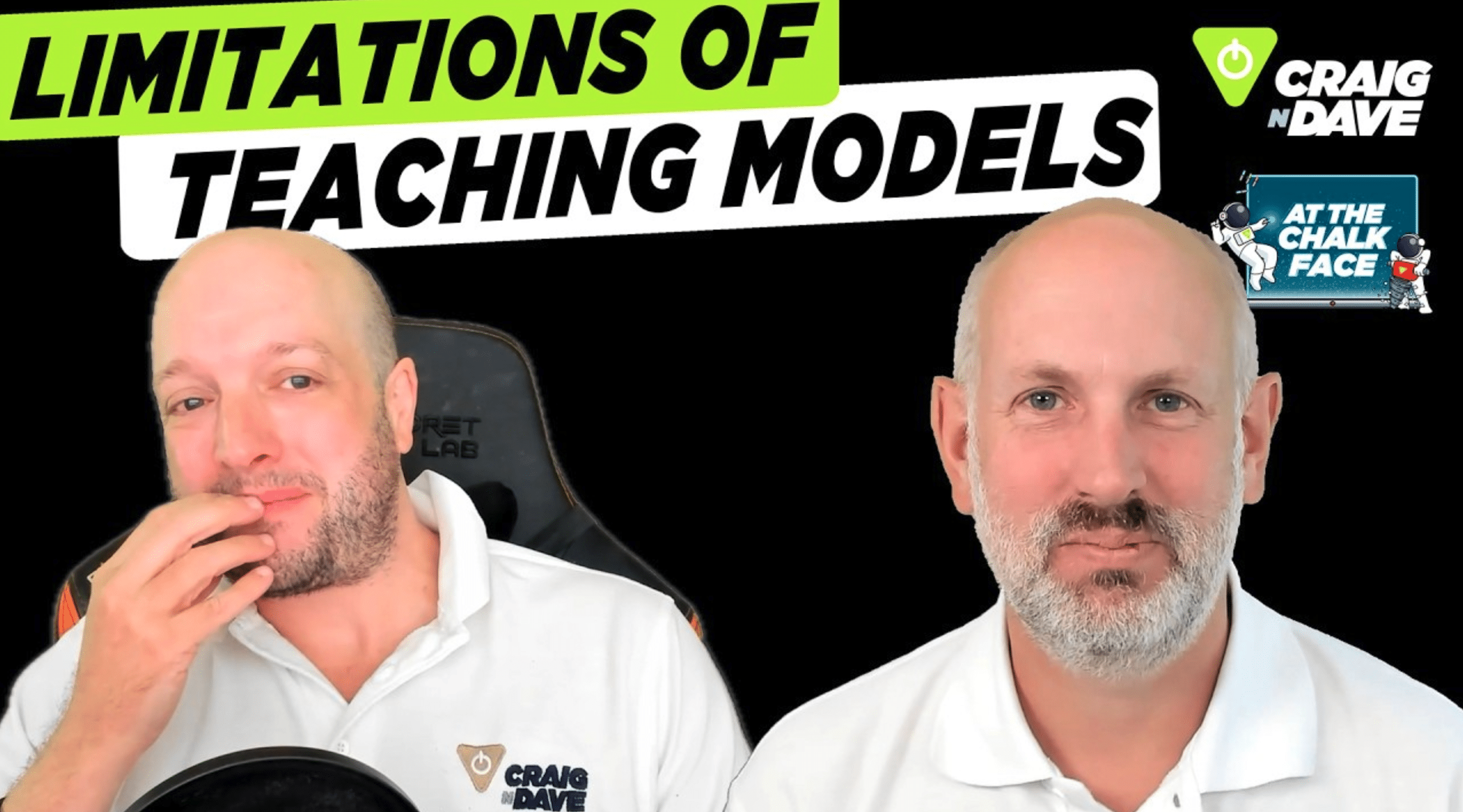
Visit the Kita website to learn more about the platform, or catch the At the chalk face podcast, where Craig and Dave chat with Heather Lyons from getkita.org about the platform and the future of AI and programming.