18 November 2026
When artificial intelligence meets humanity’s oldest artistic problem
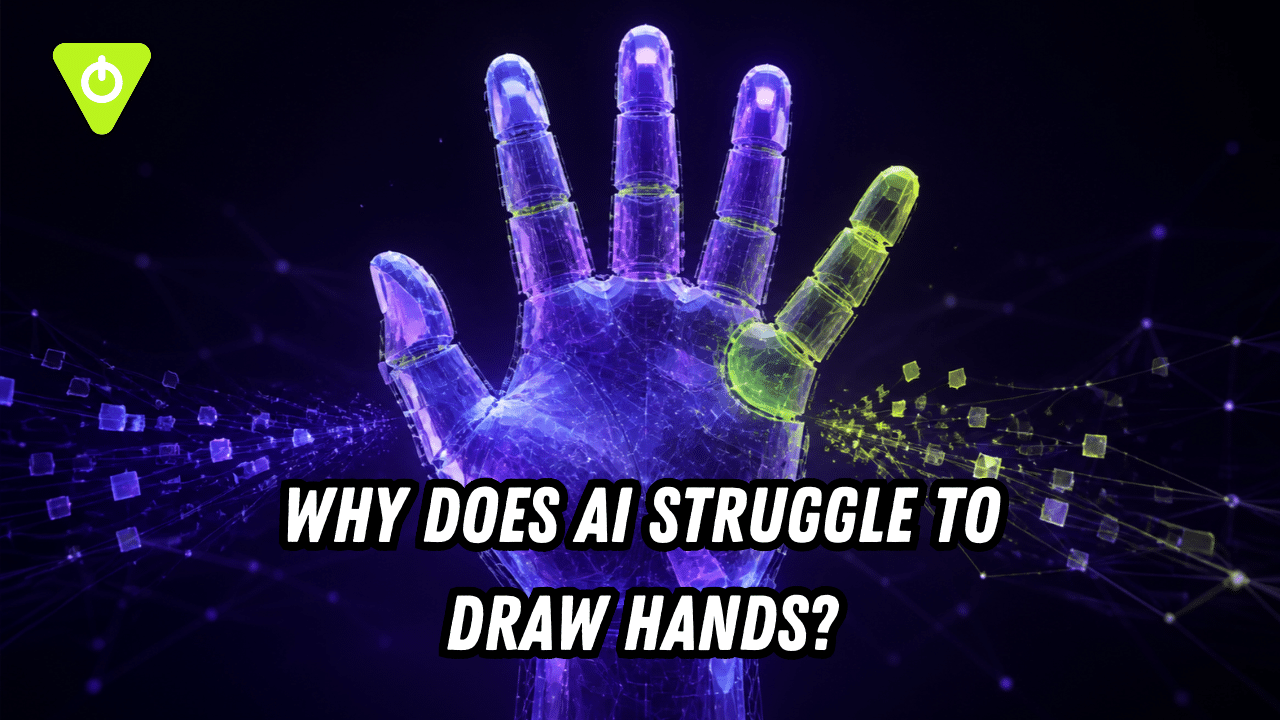
AI image generation has come a long way in recent years, producing stunningly realistic faces, landscapes, and artwork. But there’s one area where even the most advanced models still struggle: hands. From extra fingers to distorted joints, AI-generated hands often look… unsettlingly wrong.
So why are hands so difficult for artificial intelligence to get right?
Hands vs faces: why the difference matters in AI image generation
At a technical level, faces are relatively structured. Eyes, nose, and mouth tend to follow predictable positions, making them easier for machine learning models to learn and reproduce.
Hands, however, are a different story entirely. They are high-variation objects that can appear in countless positions:
- Open or closed
- Twisted or foreshortened
- Holding objects or interacting with other hands
- Partially hidden or overlapping
From a computer vision perspective, fingers are long, thin, and often overlapping – exactly the kind of complex visual data that confuses pattern-based AI models.
The training data problem in AI and computer vision
Another major challenge lies in the data itself. Many training images used in deep learning datasets:
- Crop out hands completely
- Blur or obscure them
- Hide them in pockets, sleeves, or behind objects
As a result, AI doesn’t learn a consistent, reliable representation of what a hand should look like. Instead, it builds a probabilistic guess – sometimes resulting in extra fingers, misplaced joints, or anatomically impossible structures.
In other words, the model isn’t understanding hands. It’s predicting them.
Why humans still have an advantage over AI
Unlike artificial intelligence, humans have lived experience. We understand how hands move because we physically use them every day. We know what feels “right” when a hand bends, grips, or rests naturally.
AI, by contrast, has no physical body. It relies purely on statistical patterns, which is why it can confidently generate something that looks almost correct… but slightly “off”.
A shared flaw between humans and machines
Interestingly, this isn’t just an AI problem. Historically, artists also avoided drawing hands due to their complexity and cost in portrait work. Centuries later, AI is doing something remarkably similar, just at scale and speed.
The difference? Humans hide their mistakes. AI adds an extra finger and carries on with complete confidence.
Final thoughts on AI image generation and realism
The struggle with hands highlights a bigger truth in computer science and AI: real-world complexity is incredibly difficult to model perfectly. Even the most advanced neural networks still rely on imperfect data and probabilistic prediction.
As AI continues to evolve, solving challenges like hand generation will be key to improving realism and trust in generated imagery.
Want to know more? Kat, our Craig’n’Dave Lesson Hacker, explains all.
For more Lesson Hacker videos, check out the Craig’n’Dave YouTube playlist HERE.
Visit our website to explore more cutting-edge tech news in the computer science world!