
Back

Why are LEDs so efficient?

The science behind modern lighting

29 July 2026

From space heaters to smart light sources

LEDs are everywhere today — but have you ever wondered why they’re so efficient compared to old-fashioned light bulbs? The answer lies in a clever shift in physics that completely changed how we generate light.

Incandescent Bulbs: Bright, but wasteful

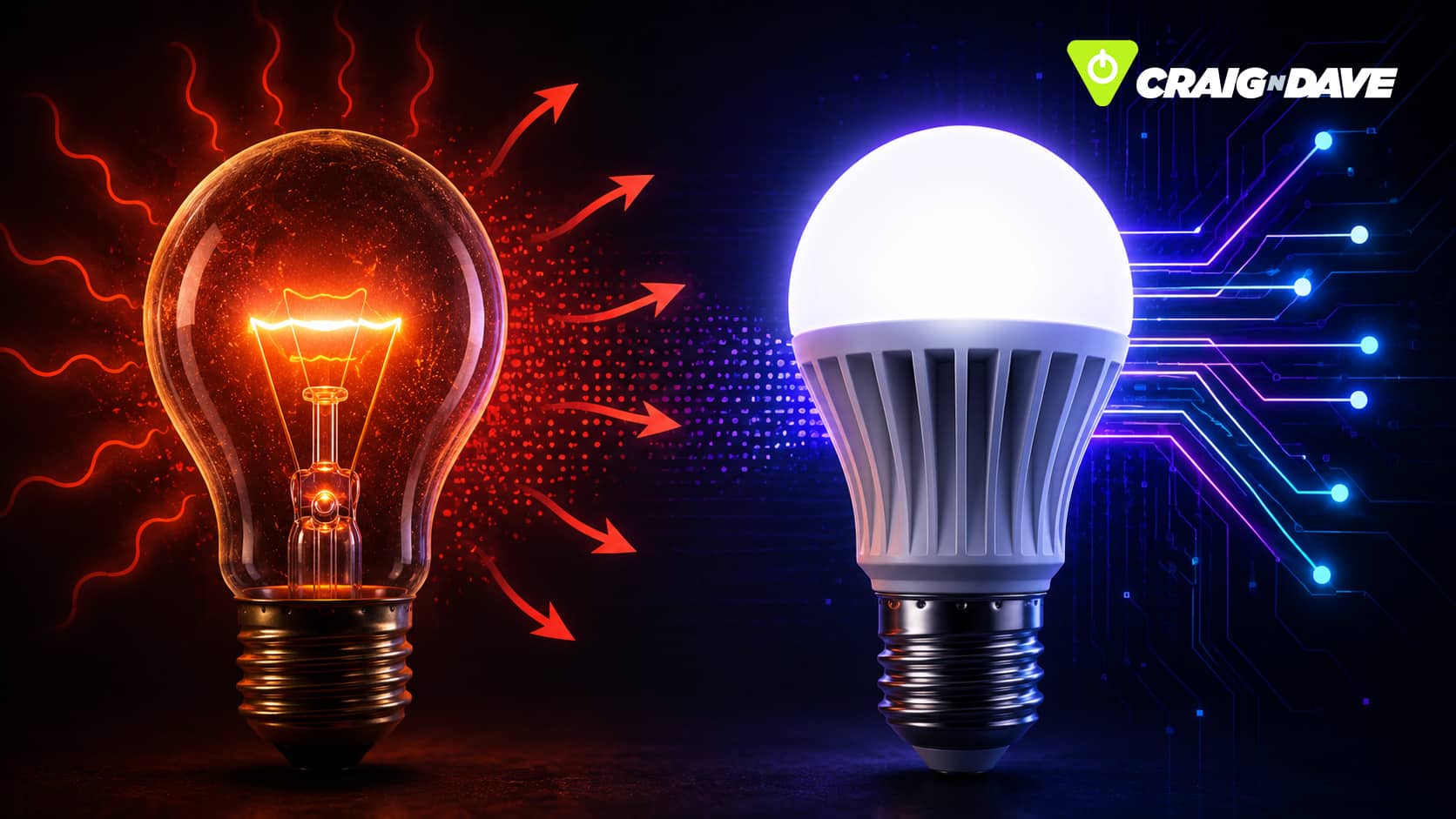
Traditional incandescent bulbs work by forcing electricity through a thin wire until it becomes so hot that it glows. That glow gives you light… but there’s a catch. Most of the energy is actually lost as heat.
In fact, around 90% of the energy in an incandescent bulb becomes heat rather than light. That’s why old desk lamps could warm a room, and why switching them off genuinely helped cool things down.

LEDs: Light without the heat problem

LEDs (Light Emitting Diodes) take a much smarter approach. Instead of heating metal, they use a semiconductor junction where electrons move between energy levels. When they drop to a lower energy state, they release energy as photons — in other words, light.

No extreme heat. No wasted energy. Just direct light output. This is why LEDs flip the efficiency ratio on its head: far more light, far less waste, and almost no heat compared to traditional bulbs.

From Christmas lights to smartphones

If you remember 1980s Christmas lights, you’ll know how unreliable and power-hungry they were. One bulb failed and the whole string went out. Modern LED versions are brighter, safer, and run on a fraction of the energy.

That same efficiency is why LEDs now power everything from TVs and smartphones to car headlights and streetlights. They’re fast, compact, energy-efficient, and can be packed into millions of pixels without overheating your screen.

Why LEDs took over the world

LEDs don’t just save energy — they last tens of thousands of hours, reduce electricity costs, and generate far less heat. In short, they’re simply better engineering.

Once you realise lighting doesn’t need to involve something dangerously close to melting point, old technology starts to feel wildly inefficient.

Want to know more? Kat, the Craig’n’Dave Lesson Hacker, explains all.

For more Lesson Hacker videos, check out the Craig’n’Dave YouTube playlist HERE.
Visit our website to explore more cutting-edge tech news in the computer science world!


Related posts

What is a VPN?

Ever wondered how a VPN really works? Think of it as a clever middleman that keeps your online activity private and your data safe.

12 August 2026

Should parents be sharing your life on social media?

“Sharenting”—where parents share their children’s lives online—might seem harmless, but it comes with risks like identity theft, cyberbullying, and impacts on self-esteem. Learn how families can share responsibly while keeping kids’ privacy safe.

10 August 2026

What Is Concurrency in Computing?

Concurrency is the clever trick your computer uses to juggle multiple tasks at once—without actually doing them simultaneously.
From web pages to deadlocks, discover how this behind-the-scenes magic keeps your digital world running (mostly) smoothly.

7 August 2026

Why are silicon wafers round when chips are square?

Ever wondered why silicon wafers are round when everything they power is square? It’s all down to the way we grow and slice silicon — a fascinating mix of physics, efficiency, and a touch of irony.

5 August 2026

What Is the Best Material for a Smartphone?

Your smartphone isn’t made from one perfect material — it’s a carefully engineered compromise of plastic, metal, glass, and ceramic. Each choice solves a problem… and creates another.

3 August 2026

AI torrenting may not be so legal after all

AI training is facing a legal reality check as courts draw the line between fair use and copyright infringement. We look at why data provenance and licensing are now critical in modern AI development.

31 July 2026

Why Pixar still chooses CPUs over GPUs

Pixar still relies on CPUs for their final film renders — not because they’re faster, but because accuracy beats speed when every photon counts. Discover why GPUs, despite their power, aren’t perfect for cinematic-quality frames.

29 July 2026

How does AI generate images?

AI image generation turns random noise into detailed visuals using powerful maths, diffusion models, and learned patterns from millions of images.
What looks like creativity is actually a step-by-step process of refining chaos into coherent, realistic (or surreal) artwork guided by your prompt.

28 July 2026

Can AI remember?

Why does AI feel like it forgets everything mid-conversation? Discover how new breakthroughs in long-term memory could transform AI from goldfish to genius.

27 July 2026