22 September 2026
Ever wondered how your computer can happily store a simple English letter, an emoji, a pound sign and characters from ancient languages – all without everything descending into complete chaos?
It might feel like witchcraft, but there’s some seriously clever computer science behind it.
It all started with ASCII
Back in the day, computers used ASCII (American Standard Code for Information Interchange). ASCII used 7 bits to represent 128 different characters, including English letters, numbers, punctuation and control codes.
Simple, right?
The problem came when people wanted to use characters that weren’t included in the original ASCII character set. Try typing an é, a £ symbol or characters from another language and things quickly became complicated. Various versions of “extended ASCII” appeared, but the same byte could represent different characters on different systems.
Cue: computer chaos.
Enter Unicode
The solution was Unicode, which aimed to give every character a unique number, known as a code point.
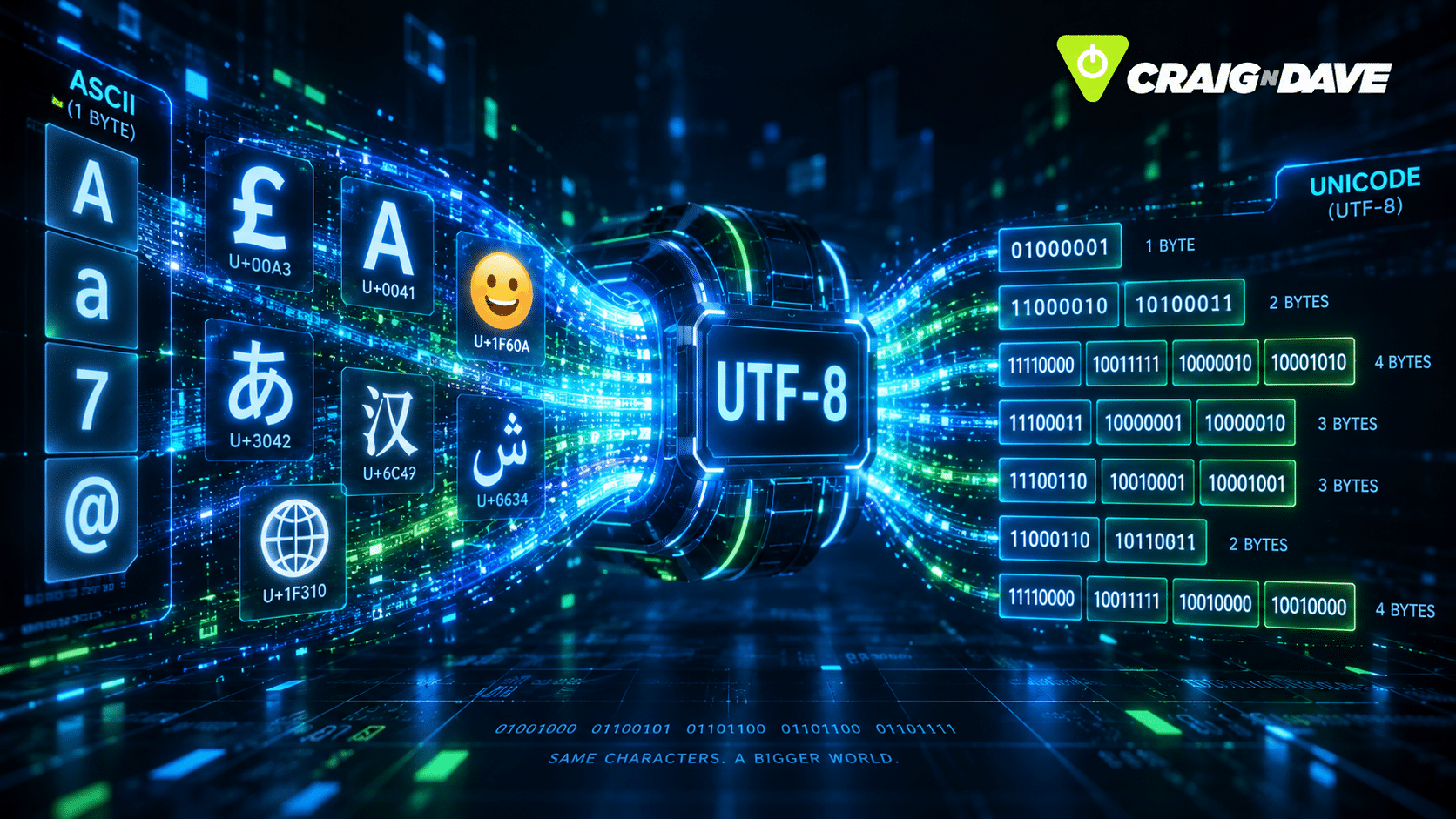
For example, the letter A is U+0041, while the pound symbol is U+00A3. Emojis and characters from languages around the world have their own code points too.
Unicode solved the problem of giving characters a consistent identity.
But there was still one important question: How do we actually store those code points as bytes?
UTF-8 does the clever bit
That’s where UTF-8 comes in. UTF-8 is a variable-length character encoding. A character can use between one and four bytes, depending on which character it is.
The really clever part is its backwards compatibility with ASCII. Characters in the original ASCII range (0–127) still use exactly one byte, just as they always did.
Characters outside that range use multiple bytes, with specific bit patterns indicating how many bytes belong to the character. This allows computers to recognise whether a byte starts a new character or continues an existing one.
It sounds complicated, but the result is beautifully efficient.
So, is UTF-8 actually witchcraft?
Thankfully, no.
UTF-8 is simply an incredibly elegant piece of computer science. It manages to remain compact for English text, support languages and symbols from around the world, handle emojis and remain compatible with decades of existing technology.
Not bad for a system that, at first glance, looks like someone made a deal with a very organised demon.
Want to see UTF-8 in action? Watch the full video to explore how character encoding really works.

And for more Computer Science resources, videos and teaching materials, visit the Craig’n’Dave website and discover more ways to bring Computer Science to life.