
3 August 2026
Why your smartphone is a compromise (not a masterpiece material)
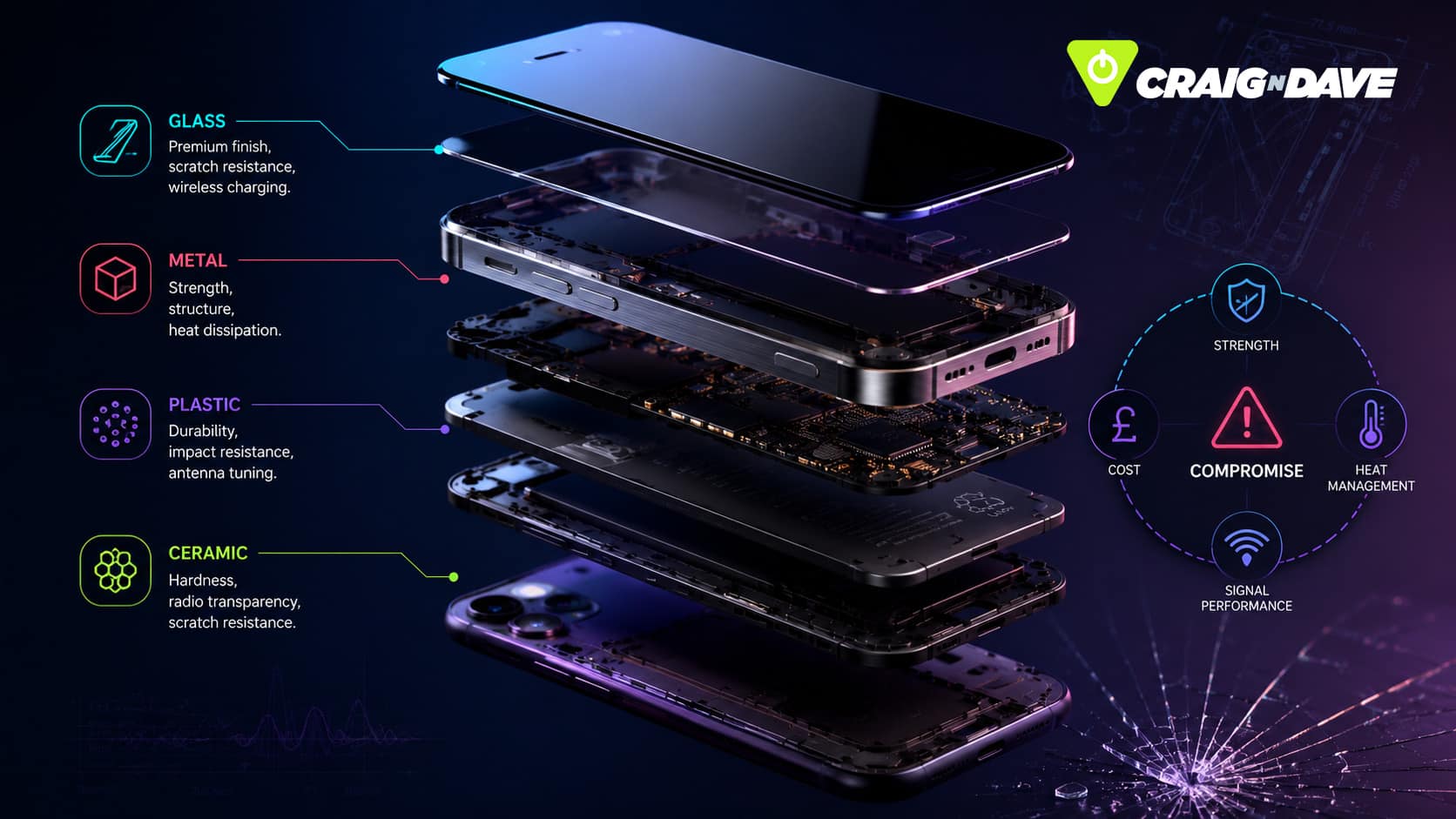
When you ask what the best material for a smartphone is, the honest answer is… There isn’t one. Modern smartphones are not built from a single “perfect” material, but from a carefully engineered compromise balancing durability, performance, cost, and aesthetics.
This is where materials science meets real-world physics — and a bit of marketing.
Plastic: The original tough guy
Early smartphones relied heavily on plastics like polycarbonate. Why? Because it’s light, cheap, and incredibly impact-resistant. In other words, it survives drops that would turn other materials into expensive regret.
The downside? It scratches easily, feels less premium, and doesn’t handle heat particularly well — not ideal for a device that constantly runs like a miniature computer in your pocket.
Metal: Premium feel, technical problems
Aluminium frames solved the “cheap plastic toy” problem almost overnight. Strong, rigid, and excellent at dissipating heat, metal-made phones feel instantly more premium.
But there’s a catch: metal interferes with radio signals. Wrap a phone in metal and you essentially build a mini Faraday cage. That’s why modern designs include those subtle antenna lines — a functional necessity that somehow became a design feature.
Glass: The luxury illusion
Glass arrived to bring style and functionality. Chemically strengthened glass (like Gorilla Glass) resists scratches and enables wireless charging.
But its weakness is dramatic. When glass fails, it doesn’t just crack — it commits fully to the spiderweb aesthetic. One drop and your “premium device” becomes modern abstract art.
Ceramic: The overachiever we rarely see
Ceramic sounds perfect on paper: hard, scratch-resistant, heat-stable, and transparent to radio waves.
So why isn’t every phone made of it? Manufacturing. It’s expensive, difficult to produce at scale, and prone to breaking during production — which tends to upset both engineers and accountants.
So what is your phone made of?
It’s a carefully designed sandwich. Metal for strength, glass for connectivity and charging, and plastic quietly doing the unseen work inside.
Your smartphone isn’t built from the best material. It’s built from the least-bad combination we’ve engineered so far. And then, of course, we all drop it on the kitchen floor to test that theory.
Watch the full Lesson Hacker video on our YouTube channel for the full breakdown.

For more Lesson Hacker videos, check out the Craig’n’Dave YouTube playlist HERE.
Visit our website to explore more cutting-edge tech news in the computer science world!