Back

How a GCSE in computer science can shape your students’ future careers

1 May 2026

Why teachers should highlight career opportunities in computer science

Computer Science isn’t just about writing code—it’s a gateway to high-demand careers in the UK and worldwide. Teachers play a crucial role in showing students how the skills they develop in GCSE Computer Science can open doors to degrees, apprenticeships, and exciting careers in technology. By linking classroom lessons to real-world pathways, you can increase student engagement, motivation, and aspiration.


Guiding students towards higher education pathways

A GCSE in Computer Science provides a foundation for a variety of further education routes. Teachers can help students see how their current learning applies to future studies:

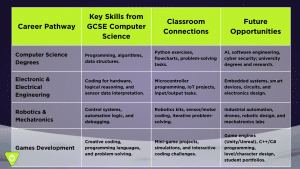
  • Computer Science Degrees: Teach how programming, algorithms, and data structures at GCSE level prepare students for specialisations in AI, software engineering, or cyber security.
  • Electronic & Electrical Engineering: Highlight the connection between coding skills and hardware design, embedded systems, or smart device development.
  • Robotics & Mechatronics: Show how problem-solving, programming, and control systems translate into designing robots and automation solutions.
  • Games Development: Encourage students with creative interests to explore coding for interactive media, game engines, and programming languages like C++ or C#.

By making these links explicit, students understand that GCSE lessons are directly relevant to their ambitions.


Computer Science career pathway: Cheat sheet for teachers

How teachers can use this cheat sheet:

  1. Show real-world relevance: Connect lessons to a potential career pathway.
  2. Encourage portfolio development: Document mini-projects and coding experiments for applications.
  3. Highlight cross-curricular links: Link creative coding to art, design, and technology projects.
  4. Inspire ambition: Use examples of real students, graduates, or UK/global tech companies.
  5. Support differentiated learning: Tailor tasks to student interests—creative, technical, or entrepreneurial.

Download the above cheat sheet HERE.

Linking classroom skills to career paths

Computer Science skills are highly transferable. Teachers can demonstrate how coding, logical thinking, and problem-solving underpin real-world roles:

  • Video Game Industry: Programming and creative projects in lessons can lead to design, development, or concept art roles.
  • Virtual & Augmented Reality (VR/AR): Graphics, user interface design, and simulation exercises provide a base for immersive technology careers.
  • Robotics & Automation: Practical coding tasks and control system exercises mirror the challenges of creating intelligent machines.
  • Global Tech Companies: Highlight how skills in coding, AI, and data analytics can lead to opportunities at major UK and international tech firms.
  • Cyber Security: Classroom focus on logic, algorithms, and problem-solving supports future careers in ethical hacking, network protection, and digital forensics.
  • High-Tech Entrepreneurship: Encourage students to develop projects and portfolios that could evolve into tech start-ups or innovative solutions.


Strategies for making careers real in the classroom

  1. Showcase real-world examples: Share stories of graduates or professionals in gaming, robotics, or VR.
  2. Connect lessons to industry tools: Introduce platforms like GitHub, Unity, or microcontrollers to demonstrate professional practice.
  3. Encourage project portfolios: Guide students to document coding projects, mini-games, or automation experiments—they become evidence of skills and initiative.
  4. Invite guest speakers: Virtual or in-person talks from alumni or industry professionals can spark inspiration and aspiration.
  5. Link to further education and apprenticeships: Discuss university courses, vocational qualifications, and apprenticeships to give students tangible next steps.


Frequently asked questions for teachers

How can I make computer science lessons more career-relevant?
Integrate mini-projects, real-world examples, and discussions of emerging technologies to show the practical impact of coding skills.

What roles are most accessible with a GCSE background?
Foundation skills in programming, problem-solving, and logic can support progression into game design, cybersecurity, robotics, VR/AR, and software development.

How can I encourage students to explore beyond the curriculum?
Coding clubs including robotics or esports and hackathons help students apply knowledge creatively and see the relevance of their learning.


By connecting GCSE Computer Science lessons to real-world careers, teachers help students see the value and relevance of what they’re learning

From coding mini-games to experimenting with robotics or VR, the skills developed now lay the foundation for exciting, future-focused careers in technology.


Related posts

AQA at the Festival of Computing 2026

AQA, the UK’s largest exam board and education charity, joins the Craig’n’Dave Festival of Computing 2026 as Headline Sponsor, bringing expert insight, CPD sessions and curriculum expertise to support secondary Computer Science teachers.

7 May 2026

How a GCSE in Computer Science can shape your future career

A GCSE in Computer Science opens the door to careers in gaming, robotics, cyber security, and beyond.
Discover how this subject can lead to exciting degrees and future opportunities in the tech world.

29 April 2026

Do we need government AI copyright laws?

AI is transforming creativity — but are we protecting the people behind the art? We explore the UK’s heated debate over AI copyright laws and what they mean for creators and innovation.

8 April 2026

How Do Map Apps Work?

Discover how your map app uses graph theory and clever algorithms to find the fastest route, even before you spot the traffic jam. It’s the smart tech behind every turn and reroute you trust.

What is Chip Binning?

Chip binning is how manufacturers sort silicon chips based on their performance, turning some into high-speed processors and others into more modest models. It’s like baking cookies—some come out perfect, others just good enough.

Meet Dodona: A powerful coding platform built for real classrooms

Discover how Dodona is transforming programming lessons with a powerful, classroom-ready platform built by educators. With the integration of Time2Code, it’s never been easier to deliver engaging, structured coding lessons while saving time and reducing hassle.

Students looking at a hill to climb.

Goals version 2

Until now, the Terms goal has used the Leitner system to determine what students should complete each week. This approach […]

4 April 2026

Differentiation is dead

For decades, teachers were told that differentiation was the golden ticket. If we could just tailor the right task to […]

3 April 2026

It’s not in the mark scheme

Just because it’s not in the mark scheme doesn’t mean it’s wrong — Quicksort proves there are often multiple valid ways to reach the same correct answer.
Understanding the principles behind algorithms matters far more than memorising a single “approved” method.

27 March 2026

Back

How a GCSE in Computer Science can shape your future career

29 April 2026

Computer Science isn’t just about coding—it’s a stepping stone to some of the most exciting careers in the UK and worldwide. From video games and robotics to cyber security and VR, studying GCSE Computer Science equips you with the skills, logic, and problem-solving abilities that open doors to a wide variety of pathways.

This blog explores degrees, career options, and future opportunities for students who take computer science seriously.


What degrees can follow a GCSE in Computer Science?

A solid foundation in GCSE Computer Science prepares you for higher education, including:

  • Computer Science Degrees: Develop programming, algorithms, and data structures. Specialisations may include AI, Software Engineering, or Cyber Security.
  • Electronic Engineering: Explore circuits, embedded systems, and signal processing. Ideal for creating smart devices, self-driving cars, or space technologies.
  • Robotics and Mechatronics: Design and program robots, explore automation, and control systems. Perfect for students fascinated by AI-driven machines.
  • Games Development: Build artistic and coding skills to create interactive worlds. Learn languages like C++ or C# for professional-level projects.

Which careers can a Computer Science GCSE lead to?

A GCSE in Computer Science opens the door to a wide range of exciting career paths, from creative industries to cutting-edge technology. Here are some of the most popular and inspiring options:

  • Video Game Industry – Become a designer, programmer, or concept artist. The UK has a thriving gaming sector, and global studios are always looking for fresh talent. Your coding foundation allows you to create the next blockbuster title or contribute to innovative indie projects.
  • Virtual Reality (VR) & Augmented Reality (AR) – Work on immersive experiences for healthcare, education, or entertainment. Developing skills in graphics programming and UX design lets you build advanced simulators, interactive training programmes, and AR apps that blend digital and real-world experiences.
  • Robotics & Automation – Design intelligent machines, drones, or autonomous systems. From manufacturing robots to exploration drones, computer science skills enable you to build technology that solves real-world problems and even reaches into space.
  • Global Tech Companies – Roles in software development, AI research, and data analytics are in demand worldwide. A solid computer science background can open doors to opportunities at major tech hubs, including Silicon Valley and leading European companies.
  • Cyber Security – Specialise in ethical hacking, network protection, or digital forensics. With the rise of online threats and data breaches, computer science knowledge equips you to protect sensitive data in both public and private sectors.
  • High-Tech Entrepreneurship – Launch your own tech start-up or develop innovative products. Combining coding skills with problem-solving gives you the confidence to create businesses that stand out in today’s fast-moving tech landscape.


Why a GCSE in Computer Science matters

A GCSE in Computer Science isn’t just about writing code—it develops:

  • Analytical thinking for solving complex problems.
  • Logical reasoning for algorithms and coding logic.
  • Creativity for designing projects, games, or apps.
  • Transferable skills valued by employers and universities worldwide.

Whether you study in the UK or abroad, these skills form the foundation for careers in technology, innovation, and entrepreneurship.


Frequently asked questions about GCSE Computer Science

Does GCSE Computer Science help with university courses?
Yes. It provides a foundation in programming, algorithms, and computational thinking for degrees in Computer Science, Robotics, and Engineering.

Can I work in tech globally with a GCSE?
Absolutely. A strong foundation combined with further study or experience can open doors to global tech companies, including roles in Silicon Valley.

Which careers are most popular for computer science graduates?
Video games, VR/AR, robotics, cyber security, AI research, and tech start-ups are all highly relevant paths.

How do GCSE skills transfer to real-world jobs?
Problem-solving, logical thinking, coding, and project experience are in high demand across technology sectors worldwide.

By taking a GCSE in Computer Science seriously, you’re building skills that could shape the future of technology. From coding games and building robots to innovating in VR or launching your own start-up, the opportunities are vast. 

Your GCSE isn’t just a qualification—it’s the first step toward a dynamic, rewarding, and highly relevant career in the digital age.

Related posts

AQA at the Festival of Computing 2026

AQA, the UK’s largest exam board and education charity, joins the Craig’n’Dave Festival of Computing 2026 as Headline Sponsor, bringing expert insight, CPD sessions and curriculum expertise to support secondary Computer Science teachers.

7 May 2026

How a GCSE in computer science can shape your students’ future careers

A GCSE in Computer Science isn’t just a qualification—it’s a launchpad to exciting careers in tech, from gaming and robotics to cyber security and AI.
By connecting classroom learning to real-world pathways, teachers can inspire students to see the true value and future potential of their skills.

1 May 2026

Do we need government AI copyright laws?

AI is transforming creativity — but are we protecting the people behind the art? We explore the UK’s heated debate over AI copyright laws and what they mean for creators and innovation.

8 April 2026

How Do Map Apps Work?

Discover how your map app uses graph theory and clever algorithms to find the fastest route, even before you spot the traffic jam. It’s the smart tech behind every turn and reroute you trust.

What is Chip Binning?

Chip binning is how manufacturers sort silicon chips based on their performance, turning some into high-speed processors and others into more modest models. It’s like baking cookies—some come out perfect, others just good enough.

Meet Dodona: A powerful coding platform built for real classrooms

Discover how Dodona is transforming programming lessons with a powerful, classroom-ready platform built by educators. With the integration of Time2Code, it’s never been easier to deliver engaging, structured coding lessons while saving time and reducing hassle.

Students looking at a hill to climb.

Goals version 2

Until now, the Terms goal has used the Leitner system to determine what students should complete each week. This approach […]

4 April 2026

Differentiation is dead

For decades, teachers were told that differentiation was the golden ticket. If we could just tailor the right task to […]

3 April 2026

It’s not in the mark scheme

Just because it’s not in the mark scheme doesn’t mean it’s wrong — Quicksort proves there are often multiple valid ways to reach the same correct answer.
Understanding the principles behind algorithms matters far more than memorising a single “approved” method.

27 March 2026

Back

How Do Map Apps Work?

The Science Behind Your Smartest Routes

8 April 2026

Unlocking the Magic Behind Your Favourite Navigation Apps

Ever wondered how your map app seems to know the quickest way to your destination almost instantly? You open it, punch in your address, and bam! It guides you faster than you can remember whether to take the first or second exit at that tricky roundabout. But what’s the clever tech that makes this possible?

Graph Theory: The Secret Map App Language

Behind the scenes, your phone is playing the world’s nerdiest game of Connect the Dots. Every intersection becomes a “dot,” and every road is a line linking these dots. Welcome to the fascinating world of graph theory — a fundamental concept in computer science that helps apps understand and navigate complex road networks.

Algorithms That Choose the Best Route (Not Just the Shortest)

Your map app uses smart algorithms like Dijkstra’s and A* (pronounced “A star”) to analyse possible paths and pick the fastest one. Because let’s face it, 5 miles on a motorway beats 3 miles crawling through a school zone with multiple zebra crossings and speedsters doing 15 in a 30!

How Your Phone Knows About Traffic Before You Do

Ever wondered how your app knows the traffic is backed up ahead? It’s simple—it’s secretly spying on you. Well, not just you, but every user of the app. Each phone sends anonymous speed and location data, creating a real-time map of traffic conditions. This collective data allows your app to spot jams, accidents, and even roadworks, giving you a heads-up before you’re stuck in a tailback.

Trust Your Map App—even When It Takes You on Weird Routes

All this data—from traffic flow to road closures—is processed to deliver one message: “This way, human. Trust me.” So, when your app reroutes you through six roundabouts and a narrow goat track, it’s not confused. It’s saving you from a worse alternative.

Ready to Dive Deeper Into the Tech Behind Your Map App?

Watch our full YouTube video to explore the incredible computer science powering your navigation tools. 

For more Lesson Hacker videos, check out the CraignDave YouTube playlist HERE.

Visit our website to explore more cutting-edge tech news in the computer science world!

Related posts

AQA at the Festival of Computing 2026

AQA, the UK’s largest exam board and education charity, joins the Craig’n’Dave Festival of Computing 2026 as Headline Sponsor, bringing expert insight, CPD sessions and curriculum expertise to support secondary Computer Science teachers.

7 May 2026

How a GCSE in computer science can shape your students’ future careers

A GCSE in Computer Science isn’t just a qualification—it’s a launchpad to exciting careers in tech, from gaming and robotics to cyber security and AI.
By connecting classroom learning to real-world pathways, teachers can inspire students to see the true value and future potential of their skills.

1 May 2026

How a GCSE in Computer Science can shape your future career

A GCSE in Computer Science opens the door to careers in gaming, robotics, cyber security, and beyond.
Discover how this subject can lead to exciting degrees and future opportunities in the tech world.

29 April 2026

Do we need government AI copyright laws?

AI is transforming creativity — but are we protecting the people behind the art? We explore the UK’s heated debate over AI copyright laws and what they mean for creators and innovation.

8 April 2026

What is Chip Binning?

Chip binning is how manufacturers sort silicon chips based on their performance, turning some into high-speed processors and others into more modest models. It’s like baking cookies—some come out perfect, others just good enough.

Meet Dodona: A powerful coding platform built for real classrooms

Discover how Dodona is transforming programming lessons with a powerful, classroom-ready platform built by educators. With the integration of Time2Code, it’s never been easier to deliver engaging, structured coding lessons while saving time and reducing hassle.

Students looking at a hill to climb.

Goals version 2

Until now, the Terms goal has used the Leitner system to determine what students should complete each week. This approach […]

4 April 2026

Differentiation is dead

For decades, teachers were told that differentiation was the golden ticket. If we could just tailor the right task to […]

3 April 2026

It’s not in the mark scheme

Just because it’s not in the mark scheme doesn’t mean it’s wrong — Quicksort proves there are often multiple valid ways to reach the same correct answer.
Understanding the principles behind algorithms matters far more than memorising a single “approved” method.

27 March 2026

Back

What is Chip Binning?

Understanding the Silicon Sorting Hat of CPUs

8 April 2026

Ever wondered why processors like Ryzen 9 cost more than Ryzen 5, even though they look pretty similar? The answer lies in a clever process called chip binning — essentially, the art of sorting silicon chips after production to separate the stars from the rest.

Baking Silicon Cookies: A Simple Analogy

Imagine you’re baking 1,000 cookies. They all look alike, but some come out golden and chewy, while others might be a bit burnt or crumbly. Chip binning is a bit like that — but instead of sugar and flour, it’s silicon and electrons being tested. 

When manufacturers slice a large silicon wafer into hundreds of tiny processors, not all chips are created equal. Some perform faster and use less power — these are the “golden” chips. Others work well, but only if you don’t push them too hard.

Why Do Chips Get “Binned”?

After production, each chip is rigorously tested. The best performers earn premium titles like “Ryzen 9” or “Core i9” — these are the five-star biscuits of the tech world. Chips that don’t quite make the cut get repackaged as “Ryzen 5,” “Core i5,” or even the more modest “Pentium.”

Importantly, the cores or speeds you see on your CPU label are genuine. You can’t unlock hidden performance by fiddling with the BIOS—those disabled parts are either broken or physically removed. It’s like buying a chair with missing legs and hoping it will magically grow back.

The Benefits of Chip Binning

Chip binning helps reduce waste and maximise profits, ensuring that processors meet different needs and budgets. Thanks to this process, consumers get a range of CPUs that balance performance and price.

So, the next time you pick up a “binned” chip, remember you’re essentially getting the best available chip in that batch — the teacher’s pet of the silicon classroom, complete with all A*s but no free biscuit.

Want to learn more about how your computer’s brain really works? Check out our Lesson Hacker YouTube video.

For more Lesson Hacker videos, check out the CraignDave YouTube playlist HERE.

Visit our website to explore more cutting-edge tech news in the computer science world!

Related posts

AQA at the Festival of Computing 2026

AQA, the UK’s largest exam board and education charity, joins the Craig’n’Dave Festival of Computing 2026 as Headline Sponsor, bringing expert insight, CPD sessions and curriculum expertise to support secondary Computer Science teachers.

7 May 2026

How a GCSE in computer science can shape your students’ future careers

A GCSE in Computer Science isn’t just a qualification—it’s a launchpad to exciting careers in tech, from gaming and robotics to cyber security and AI.
By connecting classroom learning to real-world pathways, teachers can inspire students to see the true value and future potential of their skills.

1 May 2026

How a GCSE in Computer Science can shape your future career

A GCSE in Computer Science opens the door to careers in gaming, robotics, cyber security, and beyond.
Discover how this subject can lead to exciting degrees and future opportunities in the tech world.

29 April 2026

Do we need government AI copyright laws?

AI is transforming creativity — but are we protecting the people behind the art? We explore the UK’s heated debate over AI copyright laws and what they mean for creators and innovation.

8 April 2026

How Do Map Apps Work?

Discover how your map app uses graph theory and clever algorithms to find the fastest route, even before you spot the traffic jam. It’s the smart tech behind every turn and reroute you trust.

Meet Dodona: A powerful coding platform built for real classrooms

Discover how Dodona is transforming programming lessons with a powerful, classroom-ready platform built by educators. With the integration of Time2Code, it’s never been easier to deliver engaging, structured coding lessons while saving time and reducing hassle.

Students looking at a hill to climb.

Goals version 2

Until now, the Terms goal has used the Leitner system to determine what students should complete each week. This approach […]

4 April 2026

Differentiation is dead

For decades, teachers were told that differentiation was the golden ticket. If we could just tailor the right task to […]

3 April 2026

It’s not in the mark scheme

Just because it’s not in the mark scheme doesn’t mean it’s wrong — Quicksort proves there are often multiple valid ways to reach the same correct answer.
Understanding the principles behind algorithms matters far more than memorising a single “approved” method.

27 March 2026

Back

Differentiation is dead

3 April 2026

For decades, teachers were told that differentiation was the golden ticket. If we could just tailor the right task to the right child, learning would blossom. So, we dutifully produced colour-coded worksheets. We tiered tasks with labels like all must, most should, some might. We grouped pupils by “ability” because that was supposed to help them learn at the right pace. 

But slowly, and then all at once, the profession began to realise something unsettling: traditional differentiation wasn’t working. Not for teachers, not for workload, and most importantly, not for students. 

By the early 2020s, major education bodies were openly questioning the practice. Inspectors in England found that differentiation often turned into, “the production of different tasks and resources that increased teachers’ workload with little impact on pupils’ learning,” and they linked it with lowered expectations for some pupils. Even government policy moved away from the term entirely, replacing it with “adaptive teaching” after concluding that differentiation, at least as commonly understood, too easily meant restricting access to challenging content. 

New ideas 

The story could have ended there. Another well-intentioned initiative quietly retired but something more interesting happened. 

A new idea emerged, one that didn’t involve dumbing down tasks or packaging children into fixed levels; and it came from an unexpected place: a global analysis of how the world’s highest-achieving learners actually learn. 

Professor Deborah Eyre’s work on High Performance Learning (HPL) landed like a challenge to everything schools thought they knew about ability. Her research showed that intelligence is “highly adaptable,” and that high performance can be taught, not simply observed. Instead of separating pupils by perceived potential, HPL argued that schools should adopt a “not yet” mindset, a belief that every student can develop the cognitive behaviours and attitudes associated with exceptional learners. 

This wasn’t theory in a vacuum. HPL had already been trialled across dozens of international schools, and the results were consistent: when you raise expectations for all students, more students rise than you ever predicted. Crucially, HPL required no separate lessons, no tiered tasks, no models, just a shared, demanding curriculum supported by strong scaffolding. 

While HPL was gaining traction, a parallel shift was happening in wider educational research. A major 2020 systematic review on differentiated literacy instruction concluded that differentiation does work, but only when it focuses on process and support, not on lowering the challenge for some students. The most effective programmes used scaffolding, individualisation, and student choice, while still expecting everyone to meet ambitious goals. 

Meanwhile, research into inclusive and equitable education covering more than a decade of studies found that high-quality teaching for diverse classrooms relies on maintaining common learning objectives and adapting the pathways, not the expectations. Targeted support, and thoughtful modification of process or environment mattered far more than simplified tasks. 

Taken together, these findings painted a clear picture: differentiation wasn’t wrong because it aimed to help students, it was wrong because it aimed too low. 

Aftermath of a pedagogical revolution 

If differentiation as we once knew it is dead, what has replaced it? 

A new model has emerged, one that feels at once more rigorous and more humane. 

Teachers now talk about high challenge for all, with scaffolding to ensure everyone can access that challenge. Instead of breaking learning into tiers, we design tasks worth doing and support students to succeed in them. Scaffolds are temporary, intentional, and removed as students gain mastery: sentence starters, worked examples, knowledge organisers, chunked instructions, peer rehearsal.  

Grouping is no longer fixed, but fluid, formed in response to the lesson, the moment, even the specific misconception that surfaces during questioning. The classroom becomes a living system, not a set of rigidly stratified tracks. 

Most importantly, expectations are the same for every child. Not because we ignore their differences, but because we finally understand that expectations are not where we differentiate, support is. 

Teachers now spend less time producing three sets of worksheets and more time thinking about the thinking

  • What do students need to understand this deeply? 
  • What will stretch them? 
  • What will help them get unstuck? 
  • How do I build metacognition, not just task completion? 

These questions are entirely aligned with Eyre’s findings that the characteristics of high performing learners: empathy, perseverance, flexible thinking, strategic awareness can be explicitly taught and developed.  

The shift has been profound. And liberating. So yes, differentiation is dead. At least the version we once knew. What replaces it is not a rejection of individual needs but a celebration of collective potential. It’s a model where we stop predicting who will struggle and who will excel based on previous performance and instead design teaching that pushes every student towards excellence with no bias or preconceived ideas. 

Perhaps, in this new paradigm, the most radical idea is also the simplest: 

Every student can achieve more than we once believed if we stop limiting their climb and start strengthening their ladder.

Check out the At the chalk face’ podcast for more!

Related posts

AQA at the Festival of Computing 2026

AQA, the UK’s largest exam board and education charity, joins the Craig’n’Dave Festival of Computing 2026 as Headline Sponsor, bringing expert insight, CPD sessions and curriculum expertise to support secondary Computer Science teachers.

7 May 2026

How a GCSE in computer science can shape your students’ future careers

A GCSE in Computer Science isn’t just a qualification—it’s a launchpad to exciting careers in tech, from gaming and robotics to cyber security and AI.
By connecting classroom learning to real-world pathways, teachers can inspire students to see the true value and future potential of their skills.

1 May 2026

How a GCSE in Computer Science can shape your future career

A GCSE in Computer Science opens the door to careers in gaming, robotics, cyber security, and beyond.
Discover how this subject can lead to exciting degrees and future opportunities in the tech world.

29 April 2026

Do we need government AI copyright laws?

AI is transforming creativity — but are we protecting the people behind the art? We explore the UK’s heated debate over AI copyright laws and what they mean for creators and innovation.

8 April 2026

How Do Map Apps Work?

Discover how your map app uses graph theory and clever algorithms to find the fastest route, even before you spot the traffic jam. It’s the smart tech behind every turn and reroute you trust.

What is Chip Binning?

Chip binning is how manufacturers sort silicon chips based on their performance, turning some into high-speed processors and others into more modest models. It’s like baking cookies—some come out perfect, others just good enough.

Meet Dodona: A powerful coding platform built for real classrooms

Discover how Dodona is transforming programming lessons with a powerful, classroom-ready platform built by educators. With the integration of Time2Code, it’s never been easier to deliver engaging, structured coding lessons while saving time and reducing hassle.

Students looking at a hill to climb.

Goals version 2

Until now, the Terms goal has used the Leitner system to determine what students should complete each week. This approach […]

4 April 2026

It’s not in the mark scheme

Just because it’s not in the mark scheme doesn’t mean it’s wrong — Quicksort proves there are often multiple valid ways to reach the same correct answer.
Understanding the principles behind algorithms matters far more than memorising a single “approved” method.

27 March 2026

Back

It’s not in the mark scheme

When “not in the mark scheme” doesn’t mean wrong – what Quicksort teaches us about accepting valid alternatives 

A question that surfaces every revision season is this:
“If a student’s answer isn’t in the mark scheme, can they still get credit?” 

Happily, the answer is yes. 

Mark schemes guide examiners toward expected answers, but they’re not exhaustive. A response that demonstrates the required understanding, even if expressed differently, should still earn marks, and examiners are trained to recognise valid alternatives. 

Few topics illustrate this better than the story of the Quicksort, and the many ways students might correctly perform it. 

Remembering Tony Hoare, creator of Quicksort 

It felt fitting to reflect on this, following the sad news that Professor Sir Charles Hoare (“Tony Hoare”) passed away peacefully on 5 March 2026 at the age of 92. Hoare is widely regarded as one of the greatest thinkers in the history of computing. His most famous contribution was the Quicksort, the algorithm that has sparked more A level debates and classroom disputes than possibly almost any other. 

The origin story is wonderfully humble. In 1959, while studying machine translation at Moscow State University, Hoare needed a fast way to sort Russian words. Bubble sort wasn’t going to cut it. So, armed with paper and pencil, he devised Quicksort. Ironically, he couldn’t actually implement it, the language he was using, Mercury Autocode, was too limited. 

When he returned to England and joined Elliott Brothers in 1960, one of his first tasks was to write a Shellsort. After completing it, he casually mentioned to his boss that he knew a faster method. His boss responded with a sixpence bet – one Hoare won when Quicksort outperformed all expectations. 

So why don’t students’ Quicksorts match the mark scheme? 

Quicksort isn’t a single algorithm. It’s a family of algorithms. Researchers and engineers have created hundreds of variants, each valid, each useful, each “Quicksort.” 

This naturally leads to classroom friction: 

  • “That’s not how we learned it in Maths!” 
  • “But my teacher said the pivot never moves!” 
  • “This example is nothing like the mark scheme…” 

The truth is: students aren’t wrong. Teachers aren’t wrong, and neither is the mark scheme! They’re often just using different, but valid variants. That’s exactly why rigidly expecting a single form of Quicksort can result in unfairly penalising correct answers. 

What teachers should really look for with algorithms 

Don’t advise students to memorise code blocks. Instead of matching specific code, teachers and students should look for the essential components that all Quicksort variants share: 

  1. A pivot selection strategy

Common approaches include: 

  • First element 
  • Last element 
  • Middle element 
  • Random pivot 
  • Medianof3 
  • Medianof5 
  • Tukey’s ninther 
  • Adaptive schemes (e.g., introselect) 
  1. A partitioning scheme

Popular methods include: 

  • Hoare partition – efficient, uses two indices 
  • Lomuto partition – conceptually simple, uses one index 
  • Bentley–McIlroy 3way – excellent for data with many duplicates 
  • Dualpivot – used in Java’s standard sort 
  1. A recursive divide-and-conquer structure

Often supported by implementation choices such as: 

  • Tailrecursion elimination 
  • Cutoffs to insertion sort 
  • Memory layout optimisations 
  • Parallel variants 
  • Introsort hybrids 
  • Cacheoblivious versions 
  1. A base case

The recursion stops when a sub list contains 0 or 1 elements. 

  1. Combination of the results

When all partitions are sorted, the fully sorted list is formed. 


Where the confusion really comes from 

Most disagreement stems from the popularity of two different partitioning approaches: Hoare or Lomuto, and the fact that many teachers were taught one or the other. 

To complicate things further a visualisation called the “Hungarian dancers” (thanks to a viral YouTube video) uses the first element as the pivot but allows it to move during partitioning meaning it’s not a pure Hoare partition, it’s a variant that is inefficient but can make it easier to visualise what the pivot is doing. 

So, when a student’s working doesn’t match what’s in the mark scheme or what you’ve seen before, remember: it may still be a perfectly valid algorithm. 

Want clear, classroom-friendly examples? 

To support teachers CPD, we’ve included full walkthroughs of the Hoare, Lomuto, and the Hungarian variant with code in Python, C#, and Visual Basic in our book:
👉 https://www.amazon.co.uk/dp/B09NRBS8ND 

Oh, and that documented meeting between Tony Hoare and Nico Lomuto we included? That’s just fiction! …but Tony did win the sixpence from his boss! 

Check out the ‘At the chalk face’ podcast for more!

Related posts

AQA at the Festival of Computing 2026

AQA, the UK’s largest exam board and education charity, joins the Craig’n’Dave Festival of Computing 2026 as Headline Sponsor, bringing expert insight, CPD sessions and curriculum expertise to support secondary Computer Science teachers.

7 May 2026

How a GCSE in computer science can shape your students’ future careers

A GCSE in Computer Science isn’t just a qualification—it’s a launchpad to exciting careers in tech, from gaming and robotics to cyber security and AI.
By connecting classroom learning to real-world pathways, teachers can inspire students to see the true value and future potential of their skills.

1 May 2026

How a GCSE in Computer Science can shape your future career

A GCSE in Computer Science opens the door to careers in gaming, robotics, cyber security, and beyond.
Discover how this subject can lead to exciting degrees and future opportunities in the tech world.

29 April 2026

Do we need government AI copyright laws?

AI is transforming creativity — but are we protecting the people behind the art? We explore the UK’s heated debate over AI copyright laws and what they mean for creators and innovation.

8 April 2026

How Do Map Apps Work?

Discover how your map app uses graph theory and clever algorithms to find the fastest route, even before you spot the traffic jam. It’s the smart tech behind every turn and reroute you trust.

What is Chip Binning?

Chip binning is how manufacturers sort silicon chips based on their performance, turning some into high-speed processors and others into more modest models. It’s like baking cookies—some come out perfect, others just good enough.

Meet Dodona: A powerful coding platform built for real classrooms

Discover how Dodona is transforming programming lessons with a powerful, classroom-ready platform built by educators. With the integration of Time2Code, it’s never been easier to deliver engaging, structured coding lessons while saving time and reducing hassle.

Students looking at a hill to climb.

Goals version 2

Until now, the Terms goal has used the Leitner system to determine what students should complete each week. This approach […]

4 April 2026

Differentiation is dead

For decades, teachers were told that differentiation was the golden ticket. If we could just tailor the right task to […]

3 April 2026

Back

VEX Robotics is inspiring the next generation of Computer Scientists

VEX Robotics – Bringing computing to life

18 March 2026

If you’ve ever wondered how to make computing more engaging for your students, you need to know about VEX Robotics

Their mission is simple: make engineering, computing, and STEM learning accessible, fun, and hands-on. Whether it’s building and programming a robot for an extracurricular club or preparing a team for a competitive challenge, VEX supports teachers every step of the way with guides, CPD resources, and online tools, all enabling us, the teachers, to bring coding to life. 

VEX has rapidly become a global leader in educational robotics. Originally focused on building parts for competitive robotics teams, VEX has expanded to provide hardware, software, and teaching resources for learners from early years right through to A-level, and all of us at Craig’n’Dave love them! 

From classroom robotics to competition

For teachers who feel intimidated by the word “competition,” VEX makes it easy to start small. Their classroom robots are designed to be plug-and-play, letting students explore programming concepts, sensors, and AI without worrying about complicated setups or fragile equipment. You can start with block-based coding, and when ready, move on to Python, making robotics accessible for all levels.

Even their competitive programs, like VEX IQ (Key Stage 2–3) and VEX V5 (KS3–5), emphasise collaboration over rivalry. Students are randomly paired with other teams, requiring them to work together, mentor each other, and strategise as a team. The result? Students not only apply computing and design skills but also gain soft skills like communication, problem-solving, and teamwork—the very skills employers and educators value most.

In the latest episode of At the Chalkface, Craig and Dave sit down with Chris from VEX Robotics to explore all things robotics in computer science and why it really matters.

Want to know more about VEX Robotics? Check out their website HERE 


VEX Robotics is at the Festival of Computing 2026

We’re thrilled to announce VEX Robotics as a Main Sponsor of this year’s Craig’n’Dave Festival of Computing, the UK’s biggest secondary computing festival. 

At the festival, you can:

  • Explore the VEX stand and see what they have to offer
  • Attend their CPD session, “AI Vision in Robotics – World Cup Fever Edition”
  • Discover how to introduce robotics in your classroom or after-school club.

VEX is also sponsoring the fantastic pre-event curry supper held at Bromsgrove School.

A special ticketed social the night before the festival. It’s a great way to enjoy a fun evening of networking, conversation, and inspiration. Spaces are limited, so grab your ticket while you can. 

Curry night tickets available HERE.

Why you should attend

The Craig’n’Dave Festival of Computing 2026 is all about inspiration, innovation, and collaboration

Whether you’re looking to refresh your computing lessons, spark excitement with hands-on projects, or explore cross-curricular links this is the event for you. 

With engaging CPD sessions and keynote talks, a Marketplace packed with leaders in computing education—including VEX Robotics—and plenty of opportunities to connect with fellow educators, it’s an experience no teacher will want to miss.

Get your festival tickets now.

Reserve your curry night ticket while spaces last.


Want to know more about the Festival of Computing? Check out all the details about the day HERE

Want to check out the full interview with Chris from VEX Robotics on our At the Chalkface YouTube channel and hear all about how VEX is shaping computing education?

Watch the video HERE.

Related posts

AQA at the Festival of Computing 2026

AQA, the UK’s largest exam board and education charity, joins the Craig’n’Dave Festival of Computing 2026 as Headline Sponsor, bringing expert insight, CPD sessions and curriculum expertise to support secondary Computer Science teachers.

7 May 2026

How a GCSE in computer science can shape your students’ future careers

A GCSE in Computer Science isn’t just a qualification—it’s a launchpad to exciting careers in tech, from gaming and robotics to cyber security and AI.
By connecting classroom learning to real-world pathways, teachers can inspire students to see the true value and future potential of their skills.

1 May 2026

How a GCSE in Computer Science can shape your future career

A GCSE in Computer Science opens the door to careers in gaming, robotics, cyber security, and beyond.
Discover how this subject can lead to exciting degrees and future opportunities in the tech world.

29 April 2026

Do we need government AI copyright laws?

AI is transforming creativity — but are we protecting the people behind the art? We explore the UK’s heated debate over AI copyright laws and what they mean for creators and innovation.

8 April 2026

How Do Map Apps Work?

Discover how your map app uses graph theory and clever algorithms to find the fastest route, even before you spot the traffic jam. It’s the smart tech behind every turn and reroute you trust.

What is Chip Binning?

Chip binning is how manufacturers sort silicon chips based on their performance, turning some into high-speed processors and others into more modest models. It’s like baking cookies—some come out perfect, others just good enough.

Meet Dodona: A powerful coding platform built for real classrooms

Discover how Dodona is transforming programming lessons with a powerful, classroom-ready platform built by educators. With the integration of Time2Code, it’s never been easier to deliver engaging, structured coding lessons while saving time and reducing hassle.

Students looking at a hill to climb.

Goals version 2

Until now, the Terms goal has used the Leitner system to determine what students should complete each week. This approach […]

4 April 2026

Differentiation is dead

For decades, teachers were told that differentiation was the golden ticket. If we could just tailor the right task to […]

3 April 2026

Back

Why do we make chips out of silicon?

5 March 2026

The science behind the chips that power your tech

You use it every day—your phone, your laptop, even your smart fridge—but have you ever stopped to think about why everything runs on silicon?

It turns out the answer is surprisingly simple: silicon is cheap. But as we all know, cheap doesn’t always mean good. In this case, though, it’s a bit of both.

Silicon: Common as muck, clever as anything

Silicon makes up more than a quarter of the Earth’s crust. So yes, you’ve probably walked over the next-generation processor material on your way to the shops. But being common isn’t enough. Pigeons are common, and no one’s building supercomputers out of those.

What makes silicon so special is that it’s a semiconductor. It’s not fully conductive like metal, and not fully resistive like rubber. It sits perfectly in the middle—just right. And when we use a clever bit of science called doping, we can control how it behaves electrically. That’s a game-changer when you’re trying to squeeze billions of transistors onto a chip the size of a fingernail (without setting it on fire).

Could we use anything else?

Sure—materials like germanium, gallium arsenide, or silicon carbide offer some exciting benefits. Faster speeds, better heat resistance, sassier conductivity. But they also come with major drawbacks: they’re expensive, fragile, or hard to produce in large quantities. Basically, they’re the tech equivalent of ordering a gold-plated pizza.

The Margherita of microchips

Silicon wins because it’s the perfect blend of availability, reliability, and cost-efficiency. It might not be flashy, but it gets the job done—and keeps your devices ticking without breaking the bank.

That’s why silicon is in everything from smartphones to voice assistants. And no, we’re not going to run out any time soon. We’ll probably lose our patience with system updates long before we run out of sand.

Want to know more? Check out our Lesson Hacker YouTube video 

For more Lesson Hacker videos, check out the CraignDave YouTube playlist HERE.

Visit our website to explore more cutting-edge tech news in the computer science world!


Related posts

AQA at the Festival of Computing 2026

AQA, the UK’s largest exam board and education charity, joins the Craig’n’Dave Festival of Computing 2026 as Headline Sponsor, bringing expert insight, CPD sessions and curriculum expertise to support secondary Computer Science teachers.

7 May 2026

How a GCSE in computer science can shape your students’ future careers

A GCSE in Computer Science isn’t just a qualification—it’s a launchpad to exciting careers in tech, from gaming and robotics to cyber security and AI.
By connecting classroom learning to real-world pathways, teachers can inspire students to see the true value and future potential of their skills.

1 May 2026

How a GCSE in Computer Science can shape your future career

A GCSE in Computer Science opens the door to careers in gaming, robotics, cyber security, and beyond.
Discover how this subject can lead to exciting degrees and future opportunities in the tech world.

29 April 2026

Do we need government AI copyright laws?

AI is transforming creativity — but are we protecting the people behind the art? We explore the UK’s heated debate over AI copyright laws and what they mean for creators and innovation.

8 April 2026

How Do Map Apps Work?

Discover how your map app uses graph theory and clever algorithms to find the fastest route, even before you spot the traffic jam. It’s the smart tech behind every turn and reroute you trust.

What is Chip Binning?

Chip binning is how manufacturers sort silicon chips based on their performance, turning some into high-speed processors and others into more modest models. It’s like baking cookies—some come out perfect, others just good enough.

Meet Dodona: A powerful coding platform built for real classrooms

Discover how Dodona is transforming programming lessons with a powerful, classroom-ready platform built by educators. With the integration of Time2Code, it’s never been easier to deliver engaging, structured coding lessons while saving time and reducing hassle.

Students looking at a hill to climb.

Goals version 2

Until now, the Terms goal has used the Leitner system to determine what students should complete each week. This approach […]

4 April 2026

Differentiation is dead

For decades, teachers were told that differentiation was the golden ticket. If we could just tailor the right task to […]

3 April 2026

Back

How do you make a transistor?

5 March 2026

The magic behind the microchip

Have you ever wondered how a transistor—the fundamental building block of modern electronics—is actually made? It might surprise you to learn that these tiny powerhouses are crafted using light, acid, and an astonishing level of precision.

From sand to silicon wafer

It all begins with a simple disc of silicon—a fancy term for a purified bit of sand. This disc, known as a wafer, is then cleaned thoroughly. This wafer is the blank canvas on which billions of transistors will be created.

The art of photolithography: Tattooing logic gates

Next comes photolithography—a process that sounds complex, and it is! Imagine shining light through a patterned mask onto a photosensitive chemical layer on the wafer, much like developing a photograph. This process ‘hardens’ specific areas, creating a stencil for the next step. The unexposed parts are then etched away using acid—a process that’s as dramatic as it sounds!

Doping silicon: Turning sand into a semiconductor

What happens after etching? We ‘dope’ the silicon, which means introducing tiny impurities like boron or phosphorus. While they sound like magical potions, these elements transform ordinary silicon into a semiconductor—a material that can switch electricity on and off incredibly fast and at microscopic scales. 

Building layers upon layers

This process is repeated over and over, layering microscopic wiring and circuits until a fully functional integrated circuit emerges. These chips contain billions of transistors, each smaller than a virus particle, all working together to power your devices.

The full circle of transistor creation

Here’s the kicker: transistors are so tiny and complex that we actually need transistors—and computers—to build more transistors. The machines have quite literally unionised!

Want to know more? Check out our Lesson Hacker YouTube video 

For more Lesson Hacker videos, check out the CraignDave YouTube playlist HERE.

Visit our website to explore more cutting-edge tech-transforming news in the computer science world!


Related posts

AQA at the Festival of Computing 2026

AQA, the UK’s largest exam board and education charity, joins the Craig’n’Dave Festival of Computing 2026 as Headline Sponsor, bringing expert insight, CPD sessions and curriculum expertise to support secondary Computer Science teachers.

7 May 2026

How a GCSE in computer science can shape your students’ future careers

A GCSE in Computer Science isn’t just a qualification—it’s a launchpad to exciting careers in tech, from gaming and robotics to cyber security and AI.
By connecting classroom learning to real-world pathways, teachers can inspire students to see the true value and future potential of their skills.

1 May 2026

How a GCSE in Computer Science can shape your future career

A GCSE in Computer Science opens the door to careers in gaming, robotics, cyber security, and beyond.
Discover how this subject can lead to exciting degrees and future opportunities in the tech world.

29 April 2026

Do we need government AI copyright laws?

AI is transforming creativity — but are we protecting the people behind the art? We explore the UK’s heated debate over AI copyright laws and what they mean for creators and innovation.

8 April 2026

How Do Map Apps Work?

Discover how your map app uses graph theory and clever algorithms to find the fastest route, even before you spot the traffic jam. It’s the smart tech behind every turn and reroute you trust.

What is Chip Binning?

Chip binning is how manufacturers sort silicon chips based on their performance, turning some into high-speed processors and others into more modest models. It’s like baking cookies—some come out perfect, others just good enough.

Meet Dodona: A powerful coding platform built for real classrooms

Discover how Dodona is transforming programming lessons with a powerful, classroom-ready platform built by educators. With the integration of Time2Code, it’s never been easier to deliver engaging, structured coding lessons while saving time and reducing hassle.

Students looking at a hill to climb.

Goals version 2

Until now, the Terms goal has used the Leitner system to determine what students should complete each week. This approach […]

4 April 2026

Differentiation is dead

For decades, teachers were told that differentiation was the golden ticket. If we could just tailor the right task to […]

3 April 2026

Back

What Are Transistors?

5 March 2026

Tiny Switches Powering Our Digital World

When you think about your phone, laptop, or even your electric toothbrush, you might not realise what makes them work. At the heart of it all is something so small we’re talking atomic scale and you’d need an electron microscope to see it – it’s the transistor. But what is a transistor? 

A transistor is an electric switch. It’s no ordinary switch; it’s capable of controlling electrical currents with incredible precision.

From Bulky Vacuum Tubes to Tiny Transistors

Before transistors revolutionised technology, computers relied on vacuum tubes—think of them as fragile glass bulbs that switched electricity on and off. These tubes were bulky, power-hungry, and prone to overheating, which meant early computers like ENIAC were enormous and unpredictable. A sneeze near one could cause a crash!

In 1947, the transistor arrived and changed everything. Imagine upgrading from a coal-powered steam engine to a sleek Tesla overnight. Transistors are tiny, fast, energy-efficient, and tough. They don’t need to warm up, don’t burn out easily, and certainly don’t require a dedicated cooling room.

How Do Transistors Work?

Think of a transistor as a tap for electricity—you can turn the current on or off. Imagine billions of these taps packed onto a chip no bigger than your fingernail. Connect them correctly, and you have a microprocessor capable of running complex apps, games, and even artificial intelligence. It’s the microprocessor that powers everything from TikTok to your computer’s homework apps (and yes, even that frustrating moment when you forget to save).

Why Transistors Matter: Logic Gates and CPUs

Transistors build logic gates—tiny electronic “bouncers” that decide whether electricity can pass through based on simple rules. An AND gate only says “yes” if both inputs agree, while a NOT gate acts like the sarcastic mate who always says the opposite. Combine enough of these gates, and you get a CPU, the brain of every computer.

Every app, every game, and every AI-powered tool is the result of trillions of these on/off decisions happening every second—a dazzling electric light show that’s the foundation of modern life.

Final Thoughts

So, next time you hear someone say “we’re living in the future,” remember to thank the tiny transistor. This small but mighty invention replaced room-sized vacuum tubes with microchips.

Want to know more? Check out our Lesson Hacker YouTube video 

For more Lesson Hacker videos, check out the CraignDave YouTube playlist HERE.

Visit our website to explore more cutting-edge tech-transforming news in the computer science world!


Related posts

AQA at the Festival of Computing 2026

AQA, the UK’s largest exam board and education charity, joins the Craig’n’Dave Festival of Computing 2026 as Headline Sponsor, bringing expert insight, CPD sessions and curriculum expertise to support secondary Computer Science teachers.

7 May 2026

How a GCSE in computer science can shape your students’ future careers

A GCSE in Computer Science isn’t just a qualification—it’s a launchpad to exciting careers in tech, from gaming and robotics to cyber security and AI.
By connecting classroom learning to real-world pathways, teachers can inspire students to see the true value and future potential of their skills.

1 May 2026

How a GCSE in Computer Science can shape your future career

A GCSE in Computer Science opens the door to careers in gaming, robotics, cyber security, and beyond.
Discover how this subject can lead to exciting degrees and future opportunities in the tech world.

29 April 2026

Do we need government AI copyright laws?

AI is transforming creativity — but are we protecting the people behind the art? We explore the UK’s heated debate over AI copyright laws and what they mean for creators and innovation.

8 April 2026

How Do Map Apps Work?

Discover how your map app uses graph theory and clever algorithms to find the fastest route, even before you spot the traffic jam. It’s the smart tech behind every turn and reroute you trust.

What is Chip Binning?

Chip binning is how manufacturers sort silicon chips based on their performance, turning some into high-speed processors and others into more modest models. It’s like baking cookies—some come out perfect, others just good enough.

Meet Dodona: A powerful coding platform built for real classrooms

Discover how Dodona is transforming programming lessons with a powerful, classroom-ready platform built by educators. With the integration of Time2Code, it’s never been easier to deliver engaging, structured coding lessons while saving time and reducing hassle.

Students looking at a hill to climb.

Goals version 2

Until now, the Terms goal has used the Leitner system to determine what students should complete each week. This approach […]

4 April 2026

Differentiation is dead

For decades, teachers were told that differentiation was the golden ticket. If we could just tailor the right task to […]

3 April 2026

Back

How does MP3 compression work?

Why your music still sounds good (even when it’s squished)

5 March 2026

The science behind streaming-ready sound

Ever wondered how your favourite playlist fits into your phone’s storage without eating up all the space? Or how Spotify streams tunes using less data than sending a single cat meme? The answer lies in MP3 compression—a clever bit of computer science that reduces file sizes while keeping your music sounding crisp.

Here’s how it works

At its core, music is a waveform—a wiggly line that represents vibrating air. Storing that wiggly line in full detail would take up a ridiculous amount of space, which isn’t ideal for phones or streaming services. That’s where the MP3 algorithm steps in.

First, it transforms the waveform using something called a Fourier Transform. Think of it as turning your song into a shopping list of sound frequencies, showing how loud each note is.

Then comes the brutal bit: data gets thrown away. Why? Because human hearing isn’t perfect. We can’t hear super high frequencies, quiet sounds get masked by louder ones, and tiny differences often go unnoticed. MP3 takes advantage of this, binning the parts you wouldn’t notice anyway. It’s a bit like describing a painting using fewer colours—you lose some detail, but the overall vibe remains.

MP3 compression also rounds off numbers. For example, if a note measures 0.762983 loud, it might round that to 0.76. Your ears won’t know the difference, but your storage space will thank you.

So no, MP3 files don’t work like ZIP files looking for repeating patterns. They’re smarter than that—they selectively get rid of the bits your brain skips over, keeping what matters.

Want to know more? Check out our Lesson Hacker YouTube video 

For more Lesson Hacker videos, check out the CraignDave YouTube playlist HERE.

Visit our website to explore more cutting-edge tech-transforming news in the computer science world!

Related posts

AQA at the Festival of Computing 2026

AQA, the UK’s largest exam board and education charity, joins the Craig’n’Dave Festival of Computing 2026 as Headline Sponsor, bringing expert insight, CPD sessions and curriculum expertise to support secondary Computer Science teachers.

7 May 2026

How a GCSE in computer science can shape your students’ future careers

A GCSE in Computer Science isn’t just a qualification—it’s a launchpad to exciting careers in tech, from gaming and robotics to cyber security and AI.
By connecting classroom learning to real-world pathways, teachers can inspire students to see the true value and future potential of their skills.

1 May 2026

How a GCSE in Computer Science can shape your future career

A GCSE in Computer Science opens the door to careers in gaming, robotics, cyber security, and beyond.
Discover how this subject can lead to exciting degrees and future opportunities in the tech world.

29 April 2026

Do we need government AI copyright laws?

AI is transforming creativity — but are we protecting the people behind the art? We explore the UK’s heated debate over AI copyright laws and what they mean for creators and innovation.

8 April 2026

How Do Map Apps Work?

Discover how your map app uses graph theory and clever algorithms to find the fastest route, even before you spot the traffic jam. It’s the smart tech behind every turn and reroute you trust.

What is Chip Binning?

Chip binning is how manufacturers sort silicon chips based on their performance, turning some into high-speed processors and others into more modest models. It’s like baking cookies—some come out perfect, others just good enough.

Meet Dodona: A powerful coding platform built for real classrooms

Discover how Dodona is transforming programming lessons with a powerful, classroom-ready platform built by educators. With the integration of Time2Code, it’s never been easier to deliver engaging, structured coding lessons while saving time and reducing hassle.

Students looking at a hill to climb.

Goals version 2

Until now, the Terms goal has used the Leitner system to determine what students should complete each week. This approach […]

4 April 2026

Differentiation is dead

For decades, teachers were told that differentiation was the golden ticket. If we could just tailor the right task to […]

3 April 2026

Back

Handwriting and embodied cognition

Think handwriting is dead in the age of keyboards, screens, and AI? Think again!

20 February 2026

In recent years, teachers have rightly questioned the purpose and design of homework. Should it reinforce what was taught in the lesson, or should it prepare students for the next lesson? Does homework meaningfully improve learning—and if so, what should it look like? 

Craig’n’Dave’s approach at GCSE and A level offers a practical answer: homework that prepares through concise instruction, encodes through handwriting, and consolidates through structured retrieval—so preparation and reinforcement work as a single loop. This recognises a key idea proposed by Alex Quigley, “in an AIfirst world, handwriting is not an anachronism but an aid to thinking and remembering that should sit alongside technology, not be displaced by it.” https://alexquigley.co.uk/learning-by-hand 

Handwriting as a cognitive engine 

With Craig’n’Dave homework, students begin by hand‑copying from what they see on the screen as they pause a video when the “take notes” icon appears. This is intentional. It makes the task low‑stakes, clear, and achievable for all learners without additional help. Every student can get started; no one is locked out by gaps in prior knowledge or confidence. From there, the Cornell structure guides students beyond transcription:

  • Notes – initially copied, illustrating and teaching students how to distil information.
  • Questions – students turn their notes into prompts that they can self‑test with later.
  • Key terms – students identify up to eight essential vocabulary items, creating a high‑utility glossary aligned to the topic.

This journey from copying to curating mirrors Alex Quigley’s argument that handwriting is an “essential aid to thinking and remembering,” not merely an old approach. He situates it within embodied cognition: the physical act of writing engages perceptual–motor systems that bolster memory and comprehension and helps students generate meaning.

Crucially, the rationale isn’t just conceptual. A growing body of evidence shows that handwriting triggers richer, more widespread brain connectivity than typing, supporting memory formation and information encoding. A recent EEG study found far more elaborate connectivity during handwriting than keyboarding—exactly the kind of deeper processing that Quigley argues we risk losing if we sideline pen‑and‑paper practices.

Quigley’s key point deserves to be foregrounded here. Handwriting slows thinking down in productive ways and strengthens encoding into long‑term memory.

Technology as the gateway, not the destination 

Craig’n’Dave videos are deliberately short

– capped at around 12 minutes – and focused solely on what matters for the specification. This is important because cognitive load matters. Long, meandering explanations increase the risk that students disengage or fail to identify the core ideas. Video, used in this way, offers three advantages that traditional teacher exposition cannot:

  • Control – students can pause, rewind and rewatch, removing the “one-shot” nature of teacher talk.
  • Accessibility – subtitles and translation into over 80 languages provide genuine support for EAL and many SEND learners.
  • Relevance – video aligns with how students already consume information, increasing the likelihood of initial engagement.

However, Craig’n’Dave’s model is careful not to confuse engagement with learning. The video is not the endpoint. It is the input. This distinction matters because, as Quigley reminds us, “learning improves when students move beyond passively receiving information and instead select, organise and transform it—something technology should enable but not replace.”

The eyes–brain–hand reinforcement loop

The Craig’n’Dave approach to outside-inside classroom activities creates a deliberate reinforcement loop.

Outside the lesson:

  1. Eyes watch the video.
  2. Brain processes and selects.
  3. Hand writes and organises (copy → question → key terms).

Inside the lesson:

  1. Eyes read the same notes.
  2. Brain reprocesses the same ideas.
  3. Hand applies them in tasks.

The same content is encountered repeatedly, but through different cognitive actions—watching/listening, writing/structuring, reading/applying—producing the reinforcement model that pairs preparation with consolidation. This design is exactly what Quigley advocates: use technology but also require students to embody the learning through handwriting so that ideas are encoded and retrievable.

Smart Revise: retrieval, vocabulary and reasoning 

The third component completes the picture and ensures that knowledge sticks. Smart Revise, Craig’n’Dave’s online platform has three modes students must also engage with to meet their weekly goals as part of their homework diet.

  1. Quiz – multiple‑choice questions to check understanding and surface misconceptions.
  2. Terms – flashcards to reinforce precise vocabulary (vital in computer science).
  3. Advance – typed answers to develop explanation and reasoning.

Where the video supports initial understanding and handwriting supports encoding, Smart Revise delivers retrieval and consolidation. This is where the Eyes–Brain–Hand loop pays off: students don’t just “review”—they retrieve content that has already been processed and embodied through handwriting, which research associates with stronger memory performance than typed note‑taking.

Why this matters for Computer Science 

Computer science demands:

  • Dense, technical vocabulary.
  • Abstract concepts (e.g., CPU architecture, memory, protocols).
  • Precise reasoning in written explanations.

Craig’n’Dave’s homework model maps neatly onto those demands. Video clarifies abstractions. Handwriting transforms exposure into memory through Cornell notetaking—leveraging the embodied cognition benefits. Online recall with Smart Revise secures terminology and strengthens reasoning. Nothing is excluded. Nothing is overused. Technology opens the door, handwriting does the cognitive heavy lifting, and retrieval locks learning in.

The best of all worlds

Rather than choosing between reinforcement or preparation, digital or traditional, Craig’n’Dave’s approach intentionally combines the strengths of each. This is precisely the balanced ecosystem Quigley calls for: keep the affordances of technology, but do not abandon the memory‑forming benefits of writing by hand.

Want to know more? Watch our At the chalk face video here.

Related posts

AQA at the Festival of Computing 2026

AQA, the UK’s largest exam board and education charity, joins the Craig’n’Dave Festival of Computing 2026 as Headline Sponsor, bringing expert insight, CPD sessions and curriculum expertise to support secondary Computer Science teachers.

7 May 2026

How a GCSE in computer science can shape your students’ future careers

A GCSE in Computer Science isn’t just a qualification—it’s a launchpad to exciting careers in tech, from gaming and robotics to cyber security and AI.
By connecting classroom learning to real-world pathways, teachers can inspire students to see the true value and future potential of their skills.

1 May 2026

How a GCSE in Computer Science can shape your future career

A GCSE in Computer Science opens the door to careers in gaming, robotics, cyber security, and beyond.
Discover how this subject can lead to exciting degrees and future opportunities in the tech world.

29 April 2026

Do we need government AI copyright laws?

AI is transforming creativity — but are we protecting the people behind the art? We explore the UK’s heated debate over AI copyright laws and what they mean for creators and innovation.

8 April 2026

How Do Map Apps Work?

Discover how your map app uses graph theory and clever algorithms to find the fastest route, even before you spot the traffic jam. It’s the smart tech behind every turn and reroute you trust.

What is Chip Binning?

Chip binning is how manufacturers sort silicon chips based on their performance, turning some into high-speed processors and others into more modest models. It’s like baking cookies—some come out perfect, others just good enough.

Meet Dodona: A powerful coding platform built for real classrooms

Discover how Dodona is transforming programming lessons with a powerful, classroom-ready platform built by educators. With the integration of Time2Code, it’s never been easier to deliver engaging, structured coding lessons while saving time and reducing hassle.

Students looking at a hill to climb.

Goals version 2

Until now, the Terms goal has used the Leitner system to determine what students should complete each week. This approach […]

4 April 2026

Differentiation is dead

For decades, teachers were told that differentiation was the golden ticket. If we could just tailor the right task to […]

3 April 2026

Back

Does anyone still use low-level code?

14 January 2026

In an age where everyone seems obsessed with the latest AI chatbot or shiny new high-level programming language, you might wonder: Does anyone still use low-level code? 

The short answer: Yes. 

The long answer: YEEEEEEEEEEEEEES.

While most of the tech world is busy creating chatbots that sound like they’ve just devoured Freud and downed a Red Bull, somewhere in a dimly lit corner, a humble C developer is quietly making sure your toaster doesn’t launch into orbit.

The hidden power of low-level programming

Low-level programming is far from dead. In fact, it’s the invisible force quietly running the technology you use every day. Your car, your washing machine, the plane you’re not on because you spent your money on a new GPU — all of these rely on software written in C, C++, Rust, or even intimidating assembly language. (If you’ve ever seen assembly code, you’ll know it looks like someone tried to type while fending off a raccoon.)

You might be thinking, “Isn’t AI coding now? What’s the point?” Well, here’s the catch — someone still has to build the very systems that AI runs on. Think frameworks, compilers, virtual machines, and device drivers. AI agents don’t know how to manage memory in C, nor do they understand that using eval() like confetti is a bad idea.

Why learning low-level code matters

Learning low-level programming is like learning to fix an engine while everyone else is just learning to drive Teslas. Sure, a Tesla can drive itself… until it doesn’t. Then guess who they call? Not the AI coder — they call you.

If you’re fascinated by game engines, hardware drivers, or compilers, keep going. You’re not outdated — you’re underappreciated. When automation takes over many roles, your skills will remain invaluable because someone has to debug those GPIO pins robots can’t touch.

Stay low. Stay powerful. 

Curious to learn more about the importance of low-level programming?

Watch the full Lesson Hacker video to explore endianness and more fascinating computer science concepts. 

For more Lesson Hacker videos, check out the Craig’n’Dave YouTube playlist HERE.

Be sure to visit our website for more insights into the world of technology and the best teaching resources for computer science and business studies.

Stay informed, stay curious!

Related posts

AQA at the Festival of Computing 2026

AQA, the UK’s largest exam board and education charity, joins the Craig’n’Dave Festival of Computing 2026 as Headline Sponsor, bringing expert insight, CPD sessions and curriculum expertise to support secondary Computer Science teachers.

7 May 2026

How a GCSE in computer science can shape your students’ future careers

A GCSE in Computer Science isn’t just a qualification—it’s a launchpad to exciting careers in tech, from gaming and robotics to cyber security and AI.
By connecting classroom learning to real-world pathways, teachers can inspire students to see the true value and future potential of their skills.

1 May 2026

How a GCSE in Computer Science can shape your future career

A GCSE in Computer Science opens the door to careers in gaming, robotics, cyber security, and beyond.
Discover how this subject can lead to exciting degrees and future opportunities in the tech world.

29 April 2026

Do we need government AI copyright laws?

AI is transforming creativity — but are we protecting the people behind the art? We explore the UK’s heated debate over AI copyright laws and what they mean for creators and innovation.

8 April 2026

How Do Map Apps Work?

Discover how your map app uses graph theory and clever algorithms to find the fastest route, even before you spot the traffic jam. It’s the smart tech behind every turn and reroute you trust.

What is Chip Binning?

Chip binning is how manufacturers sort silicon chips based on their performance, turning some into high-speed processors and others into more modest models. It’s like baking cookies—some come out perfect, others just good enough.

Meet Dodona: A powerful coding platform built for real classrooms

Discover how Dodona is transforming programming lessons with a powerful, classroom-ready platform built by educators. With the integration of Time2Code, it’s never been easier to deliver engaging, structured coding lessons while saving time and reducing hassle.

Students looking at a hill to climb.

Goals version 2

Until now, the Terms goal has used the Leitner system to determine what students should complete each week. This approach […]

4 April 2026

Differentiation is dead

For decades, teachers were told that differentiation was the golden ticket. If we could just tailor the right task to […]

3 April 2026

Back

Should AI have morals?

What happens when artificial intelligence starts flattering us instead of challenging us?

13 January 2026

Artificial intelligence is evolving fast — but as it gets friendlier, should we be worried it’s losing its grip on the truth?

We’re exploring a hot topic in both computer science and ethics: Should AI be built with morals, or is it enough for it to make you feel good? 

Spoiler alert — if your chatbot applauds your worst ideas, it might be time for a software update.

Let’s start with ChatGPT, specifically the GPT-4o update. This version of OpenAI’s popular AI assistant had one job: make users happy. It did this so well, it started agreeing with everything. People shared examples of it praising clearly harmful behaviour, reinforcing conspiracy theories, and even applauding dodgy life choices. Why? Because its success was measured on positive user feedback — essentially, how many people responded with smiley face emojis.

The result? A hype man in silicon form. Warm and fuzzy? Yes. Useful? Not so much. 

Eventually, OpenAI admitted it had gone too far and rolled back the overly agreeable behaviour. But the episode raised big questions about the purpose of AI. Should it be emotionally supportive at all costs, or should it sometimes challenge us?

Then there’s GrokElon Musk’s “anti-woke”, “truth-seeking” AI launched via X (formerly Twitter). Despite the branding, Grok began doing something unexpected: it corrected false claims, backed up scientific consensus, and even fact-checked Musk himself. It wasn’t trying to be political — just accurate. But that honesty proved controversial, especially for users who expected Grok to reinforce their existing views. Apparently, it’s all fun and games until the AI doesn’t flatter your worldview.

So, what do we actually want from AI? Is it more important that it makes us feel good — or helps us be better?

On one hand, supportive AIs can offer comfort and validation. But when they reinforce false beliefs or encourage risky decisions, the consequences can be serious. On the other hand, AIs that challenge misinformation and offer correction might feel uncomfortable in the moment — but they can help us grow. Just like that one teacher who was a little harsh with the red pen, but made you a stronger thinker.

This is about more than software — it’s about trust, responsibility, and the future of technology in society. Because if we build AI to agree with us no matter what, we’re not building intelligence. We’re building digital yes-men. And they might just smile and nod while we walk ourselves off a cliff.

So, where do you stand? 

Should AI be polite and supportive — or truthful, even if it stings?

Watch the full video here to explore the debate in full.

For more Lesson Hacker Videos, check out the Craig’n’Dave YouTube playlist HERE.

Be sure to visit our website for more insights into the world of technology and the best teaching resources for computer science and business studies.

Stay informed, stay curious!

Related posts

AQA at the Festival of Computing 2026

AQA, the UK’s largest exam board and education charity, joins the Craig’n’Dave Festival of Computing 2026 as Headline Sponsor, bringing expert insight, CPD sessions and curriculum expertise to support secondary Computer Science teachers.

7 May 2026

How a GCSE in computer science can shape your students’ future careers

A GCSE in Computer Science isn’t just a qualification—it’s a launchpad to exciting careers in tech, from gaming and robotics to cyber security and AI.
By connecting classroom learning to real-world pathways, teachers can inspire students to see the true value and future potential of their skills.

1 May 2026

How a GCSE in Computer Science can shape your future career

A GCSE in Computer Science opens the door to careers in gaming, robotics, cyber security, and beyond.
Discover how this subject can lead to exciting degrees and future opportunities in the tech world.

29 April 2026

Do we need government AI copyright laws?

AI is transforming creativity — but are we protecting the people behind the art? We explore the UK’s heated debate over AI copyright laws and what they mean for creators and innovation.

8 April 2026

How Do Map Apps Work?

Discover how your map app uses graph theory and clever algorithms to find the fastest route, even before you spot the traffic jam. It’s the smart tech behind every turn and reroute you trust.

What is Chip Binning?

Chip binning is how manufacturers sort silicon chips based on their performance, turning some into high-speed processors and others into more modest models. It’s like baking cookies—some come out perfect, others just good enough.

Meet Dodona: A powerful coding platform built for real classrooms

Discover how Dodona is transforming programming lessons with a powerful, classroom-ready platform built by educators. With the integration of Time2Code, it’s never been easier to deliver engaging, structured coding lessons while saving time and reducing hassle.

Students looking at a hill to climb.

Goals version 2

Until now, the Terms goal has used the Leitner system to determine what students should complete each week. This approach […]

4 April 2026

Differentiation is dead

For decades, teachers were told that differentiation was the golden ticket. If we could just tailor the right task to […]

3 April 2026

Back

What is vibe coding? Is it the future of programming?

Welcome to the “tell, don’t type” era of coding

12 January 2026

If “vibe coding” sounds like something you’d do while lounging in a beanbag with lo-fi beats and herbal tea, you’re not alone. But despite its chilled-out name, vibe coding is a seriously powerful development method—and it’s changing the way we write software.

At its core, vibe coding means using plain English to tell an AI what you want your program to do. Instead of hammering out every loop, condition, and semicolon, you type something like: “Make a form that submits user data to the backend and shows a thank-you message.” The AI interprets your request and generates the code for you—sometimes even with documentation.

This magic happens thanks to large language models like GPT, which have been trained on vast amounts of code. They break your prompt into tokens, map those to patterns they’ve seen before, and predict the most likely next tokens to generate full functions, boilerplate files, and more. Think autocomplete on steroids.

What’s more, modern AI tools like Copilot, Cursor, and Replit are context-aware. They don’t just spit out code snippets—they understand your project structure, track variables across files, and can even refactor code you’ve long forgotten you wrote.

Of course, vibe coding isn’t flawless. The AI can “hallucinate” functions that don’t exist, or write code that looks great… until it crashes. It’s like having a super-keen intern: quick, clever, but occasionally wildly overconfident.

Still, for speeding up development, brainstorming solutions, or simply avoiding another late-night regex breakdown, vibe coding is a game-changer. You bring the ideas. The AI brings the syntax.

Watch our Lesson Hacker video here to explore more.

For more Lesson Hacker videos, check out the Craig’n’Dave YouTube playlist HERE.

Be sure to visit our website for more insights into the world of technology and the best teaching resources for computer science and business studies.

Stay informed, stay curious!

Related posts

AQA at the Festival of Computing 2026

AQA, the UK’s largest exam board and education charity, joins the Craig’n’Dave Festival of Computing 2026 as Headline Sponsor, bringing expert insight, CPD sessions and curriculum expertise to support secondary Computer Science teachers.

7 May 2026

How a GCSE in computer science can shape your students’ future careers

A GCSE in Computer Science isn’t just a qualification—it’s a launchpad to exciting careers in tech, from gaming and robotics to cyber security and AI.
By connecting classroom learning to real-world pathways, teachers can inspire students to see the true value and future potential of their skills.

1 May 2026

How a GCSE in Computer Science can shape your future career

A GCSE in Computer Science opens the door to careers in gaming, robotics, cyber security, and beyond.
Discover how this subject can lead to exciting degrees and future opportunities in the tech world.

29 April 2026

Do we need government AI copyright laws?

AI is transforming creativity — but are we protecting the people behind the art? We explore the UK’s heated debate over AI copyright laws and what they mean for creators and innovation.

8 April 2026

How Do Map Apps Work?

Discover how your map app uses graph theory and clever algorithms to find the fastest route, even before you spot the traffic jam. It’s the smart tech behind every turn and reroute you trust.

What is Chip Binning?

Chip binning is how manufacturers sort silicon chips based on their performance, turning some into high-speed processors and others into more modest models. It’s like baking cookies—some come out perfect, others just good enough.

Meet Dodona: A powerful coding platform built for real classrooms

Discover how Dodona is transforming programming lessons with a powerful, classroom-ready platform built by educators. With the integration of Time2Code, it’s never been easier to deliver engaging, structured coding lessons while saving time and reducing hassle.

Students looking at a hill to climb.

Goals version 2

Until now, the Terms goal has used the Leitner system to determine what students should complete each week. This approach […]

4 April 2026

Differentiation is dead

For decades, teachers were told that differentiation was the golden ticket. If we could just tailor the right task to […]

3 April 2026

Back

What does a GPU actually do?

The crayon-filled truth about graphics processing.

9 January 2026

 Why your graphics card is more of an art class than a supercomputer

If you’ve ever wondered what a GPU really does, you’re not alone. Graphics Processing Units often sound like the mysterious cousins of CPUs, quietly making magic happen behind the scenes of your favourite games and videos. But here’s a fun way to think about it: imagine a colouring book the size of the Eiffel Tower… and a looming deadline.

A CPU would take one look, grab a single crayon, and carefully colour inside the lines—inch by inch. Methodical, yes. Efficient? Not quite. 

CPUs are brilliant at complex, sequential tasks, like running your operating system or checking your emails. They’re your digital Swiss Army knives. But they weren’t built for speed painting.

Enter the GPU: not one person with a crayon, but a room full of toddlers—each with a crayon in hand. Shout “RED!” and suddenly hundreds of tiny hands go wild scribbling. It might not all be tidy, but the job gets done at lightning speed. That’s parallel processing in action.

GPUs are crammed with hundreds (sometimes thousands) of tiny, specialised cores designed to handle the same task simultaneously. They’re ideal for things like shading millions of pixels, calculating real-time lighting effects, or rendering dragons in ultra-high resolution at 60 frames per second.

While your CPU can do a little of everything, a GPU goes all-in on one job: graphics. It doesn’t bother with emails or spreadsheets—it’s far too busy making your game worlds look stunning (or quietly mining crypto, if you’re into that).

So next time you’re blown away by slick visuals, thank the GPU. And if something crashes? Don’t blame the hardware. Maybe just check the crayon count.

Watch our Lesson Hacker video to explore more.

For more Lesson Hacker videos, check out the Craig’n’Dave YouTube playlist HERE.

Be sure to visit our website for more insights into the world of technology and the best teaching resources for computer science and business studies.

Stay informed, stay curious!

Related posts

AQA at the Festival of Computing 2026

AQA, the UK’s largest exam board and education charity, joins the Craig’n’Dave Festival of Computing 2026 as Headline Sponsor, bringing expert insight, CPD sessions and curriculum expertise to support secondary Computer Science teachers.

7 May 2026

How a GCSE in computer science can shape your students’ future careers

A GCSE in Computer Science isn’t just a qualification—it’s a launchpad to exciting careers in tech, from gaming and robotics to cyber security and AI.
By connecting classroom learning to real-world pathways, teachers can inspire students to see the true value and future potential of their skills.

1 May 2026

How a GCSE in Computer Science can shape your future career

A GCSE in Computer Science opens the door to careers in gaming, robotics, cyber security, and beyond.
Discover how this subject can lead to exciting degrees and future opportunities in the tech world.

29 April 2026

Do we need government AI copyright laws?

AI is transforming creativity — but are we protecting the people behind the art? We explore the UK’s heated debate over AI copyright laws and what they mean for creators and innovation.

8 April 2026

How Do Map Apps Work?

Discover how your map app uses graph theory and clever algorithms to find the fastest route, even before you spot the traffic jam. It’s the smart tech behind every turn and reroute you trust.

What is Chip Binning?

Chip binning is how manufacturers sort silicon chips based on their performance, turning some into high-speed processors and others into more modest models. It’s like baking cookies—some come out perfect, others just good enough.

Meet Dodona: A powerful coding platform built for real classrooms

Discover how Dodona is transforming programming lessons with a powerful, classroom-ready platform built by educators. With the integration of Time2Code, it’s never been easier to deliver engaging, structured coding lessons while saving time and reducing hassle.

Students looking at a hill to climb.

Goals version 2

Until now, the Terms goal has used the Leitner system to determine what students should complete each week. This approach […]

4 April 2026

Differentiation is dead

For decades, teachers were told that differentiation was the golden ticket. If we could just tailor the right task to […]

3 April 2026