Back

How a GCSE in computer science can shape your students’ future careers

1 May 2026

Why teachers should highlight career opportunities in computer science

Computer Science isn’t just about writing code—it’s a gateway to high-demand careers in the UK and worldwide. Teachers play a crucial role in showing students how the skills they develop in GCSE Computer Science can open doors to degrees, apprenticeships, and exciting careers in technology. By linking classroom lessons to real-world pathways, you can increase student engagement, motivation, and aspiration.


Guiding students towards higher education pathways

A GCSE in Computer Science provides a foundation for a variety of further education routes. Teachers can help students see how their current learning applies to future studies:

  • Computer Science Degrees: Teach how programming, algorithms, and data structures at GCSE level prepare students for specialisations in AI, software engineering, or cyber security.
  • Electronic & Electrical Engineering: Highlight the connection between coding skills and hardware design, embedded systems, or smart device development.
  • Robotics & Mechatronics: Show how problem-solving, programming, and control systems translate into designing robots and automation solutions.
  • Games Development: Encourage students with creative interests to explore coding for interactive media, game engines, and programming languages like C++ or C#.

By making these links explicit, students understand that GCSE lessons are directly relevant to their ambitions.


Computer Science career pathway: Cheat sheet for teachers
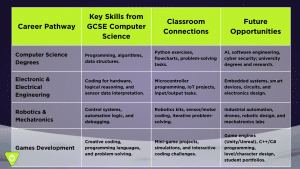
How teachers can use this cheat sheet:

  1. Show real-world relevance: Connect lessons to a potential career pathway.
  2. Encourage portfolio development: Document mini-projects and coding experiments for applications.
  3. Highlight cross-curricular links: Link creative coding to art, design, and technology projects.
  4. Inspire ambition: Use examples of real students, graduates, or UK/global tech companies.
  5. Support differentiated learning: Tailor tasks to student interests—creative, technical, or entrepreneurial.

Download the above cheat sheet HERE.

Linking classroom skills to career paths

Computer Science skills are highly transferable. Teachers can demonstrate how coding, logical thinking, and problem-solving underpin real-world roles:

  • Video Game Industry: Programming and creative projects in lessons can lead to design, development, or concept art roles.
  • Virtual & Augmented Reality (VR/AR): Graphics, user interface design, and simulation exercises provide a base for immersive technology careers.
  • Robotics & Automation: Practical coding tasks and control system exercises mirror the challenges of creating intelligent machines.
  • Global Tech Companies: Highlight how skills in coding, AI, and data analytics can lead to opportunities at major UK and international tech firms.
  • Cyber Security: Classroom focus on logic, algorithms, and problem-solving supports future careers in ethical hacking, network protection, and digital forensics.
  • High-Tech Entrepreneurship: Encourage students to develop projects and portfolios that could evolve into tech start-ups or innovative solutions.


Strategies for making careers real in the classroom

  1. Showcase real-world examples: Share stories of graduates or professionals in gaming, robotics, or VR.
  2. Connect lessons to industry tools: Introduce platforms like GitHub, Unity, or microcontrollers to demonstrate professional practice.
  3. Encourage project portfolios: Guide students to document coding projects, mini-games, or automation experiments—they become evidence of skills and initiative.
  4. Invite guest speakers: Virtual or in-person talks from alumni or industry professionals can spark inspiration and aspiration.
  5. Link to further education and apprenticeships: Discuss university courses, vocational qualifications, and apprenticeships to give students tangible next steps.


Frequently asked questions for teachers

How can I make computer science lessons more career-relevant?
Integrate mini-projects, real-world examples, and discussions of emerging technologies to show the practical impact of coding skills.

What roles are most accessible with a GCSE background?
Foundation skills in programming, problem-solving, and logic can support progression into game design, cybersecurity, robotics, VR/AR, and software development.

How can I encourage students to explore beyond the curriculum?
Coding clubs including robotics or esports and hackathons help students apply knowledge creatively and see the relevance of their learning.


By connecting GCSE Computer Science lessons to real-world careers, teachers help students see the value and relevance of what they’re learning

From coding mini-games to experimenting with robotics or VR, the skills developed now lay the foundation for exciting, future-focused careers in technology.
 

Related posts

Four Revision Techniques That Actually Work

Stop wasting time on ineffective revision. Learn four proven techniques that improve recall, confidence and exam performance.

8 July 2026

KS3 logo

How can Craig’n’Dave say their new KS3 resources are “curriculum 2028 ready”?

It’s a fair question, so we’d like to explain exactly what we mean. First and foremost, we do not have […]

The Year 7 dip: why enthusiasm fades – and how to rebuild it

Why do so many pupils lose their enthusiasm after Year 7? Explore the research behind the motivation dip and practical ways teachers can reignite it.

7 July 2026

The social media debate: What it really means for schools

As social media regulation looms, what will it mean for schools? Explore the challenges, risks and opportunities for education.

20 June 2026

Teacher looking at a laptop computer.

June 2026 update

The June 2026 update to Smart Revise introduces a range of quality-of-life improvements requested by teachers and students. These updates […]

Coding in the age of AI: Why it still belongs in the classroom

As AI transforms the way we write software, should we stop teaching students to code? This blog explores why coding is about far more than programming – developing the critical thinking, problem-solving and digital literacy skills that will matter more than ever in an AI-driven world.

19 June 2026

Pearson – shaping the future of computing education

We caught up with Tim Brady, Subject Advisor for Computer Science and Digital at Pearson, to explore the future of computing education, evolving assessment, and why Pearson is proud to support this year’s Craig’n’Dave Festival of Computing.

18 June 2026

Why Do So Many Teachers Leave Teaching?

Craig and Dave share the story of why they eventually stepped away from full-time teaching after years in the profession.

17 June 2026

Social media app icons on a phone.

What the proposed UK social media changes mean for Craig’n’Dave teachers

You may have seen recent news coverage about the UK Government’s plans to introduce a ban on social media use […]

Back

How a GCSE in Computer Science can shape your future career

29 April 2026

Computer Science isn’t just about coding—it’s a stepping stone to some of the most exciting careers in the UK and worldwide. From video games and robotics to cyber security and VR, studying GCSE Computer Science equips you with the skills, logic, and problem-solving abilities that open doors to a wide variety of pathways.

This blog explores degrees, career options, and future opportunities for students who take computer science seriously.


What degrees can follow a GCSE in Computer Science?

A solid foundation in GCSE Computer Science prepares you for higher education, including:

  • Computer Science Degrees: Develop programming, algorithms, and data structures. Specialisations may include AI, Software Engineering, or Cyber Security.
  • Electronic Engineering: Explore circuits, embedded systems, and signal processing. Ideal for creating smart devices, self-driving cars, or space technologies.
  • Robotics and Mechatronics: Design and program robots, explore automation, and control systems. Perfect for students fascinated by AI-driven machines.
  • Games Development: Build artistic and coding skills to create interactive worlds. Learn languages like C++ or C# for professional-level projects.

Which careers can a Computer Science GCSE lead to?

A GCSE in Computer Science opens the door to a wide range of exciting career paths, from creative industries to cutting-edge technology. Here are some of the most popular and inspiring options:

  • Video Game Industry – Become a designer, programmer, or concept artist. The UK has a thriving gaming sector, and global studios are always looking for fresh talent. Your coding foundation allows you to create the next blockbuster title or contribute to innovative indie projects.
  • Virtual Reality (VR) & Augmented Reality (AR) – Work on immersive experiences for healthcare, education, or entertainment. Developing skills in graphics programming and UX design lets you build advanced simulators, interactive training programmes, and AR apps that blend digital and real-world experiences.
  • Robotics & Automation – Design intelligent machines, drones, or autonomous systems. From manufacturing robots to exploration drones, computer science skills enable you to build technology that solves real-world problems and even reaches into space.
  • Global Tech Companies – Roles in software development, AI research, and data analytics are in demand worldwide. A solid computer science background can open doors to opportunities at major tech hubs, including Silicon Valley and leading European companies.
  • Cyber Security – Specialise in ethical hacking, network protection, or digital forensics. With the rise of online threats and data breaches, computer science knowledge equips you to protect sensitive data in both public and private sectors.
  • High-Tech Entrepreneurship – Launch your own tech start-up or develop innovative products. Combining coding skills with problem-solving gives you the confidence to create businesses that stand out in today’s fast-moving tech landscape.


Why a GCSE in Computer Science matters

A GCSE in Computer Science isn’t just about writing code—it develops:

  • Analytical thinking for solving complex problems.
  • Logical reasoning for algorithms and coding logic.
  • Creativity for designing projects, games, or apps.
  • Transferable skills valued by employers and universities worldwide.

Whether you study in the UK or abroad, these skills form the foundation for careers in technology, innovation, and entrepreneurship.


Frequently asked questions about GCSE Computer Science

Does GCSE Computer Science help with university courses?
Yes. It provides a foundation in programming, algorithms, and computational thinking for degrees in Computer Science, Robotics, and Engineering.

Can I work in tech globally with a GCSE?
Absolutely. A strong foundation combined with further study or experience can open doors to global tech companies, including roles in Silicon Valley.

Which careers are most popular for computer science graduates?
Video games, VR/AR, robotics, cyber security, AI research, and tech start-ups are all highly relevant paths.

How do GCSE skills transfer to real-world jobs?
Problem-solving, logical thinking, coding, and project experience are in high demand across technology sectors worldwide.

By taking a GCSE in Computer Science seriously, you’re building skills that could shape the future of technology. From coding games and building robots to innovating in VR or launching your own start-up, the opportunities are vast. 

Your GCSE isn’t just a qualification—it’s the first step toward a dynamic, rewarding, and highly relevant career in the digital age.

Related posts

Four Revision Techniques That Actually Work

Stop wasting time on ineffective revision. Learn four proven techniques that improve recall, confidence and exam performance.

8 July 2026

KS3 logo

How can Craig’n’Dave say their new KS3 resources are “curriculum 2028 ready”?

It’s a fair question, so we’d like to explain exactly what we mean. First and foremost, we do not have […]

The Year 7 dip: why enthusiasm fades – and how to rebuild it

Why do so many pupils lose their enthusiasm after Year 7? Explore the research behind the motivation dip and practical ways teachers can reignite it.

7 July 2026

The social media debate: What it really means for schools

As social media regulation looms, what will it mean for schools? Explore the challenges, risks and opportunities for education.

20 June 2026

Teacher looking at a laptop computer.

June 2026 update

The June 2026 update to Smart Revise introduces a range of quality-of-life improvements requested by teachers and students. These updates […]

Coding in the age of AI: Why it still belongs in the classroom

As AI transforms the way we write software, should we stop teaching students to code? This blog explores why coding is about far more than programming – developing the critical thinking, problem-solving and digital literacy skills that will matter more than ever in an AI-driven world.

19 June 2026

Pearson – shaping the future of computing education

We caught up with Tim Brady, Subject Advisor for Computer Science and Digital at Pearson, to explore the future of computing education, evolving assessment, and why Pearson is proud to support this year’s Craig’n’Dave Festival of Computing.

18 June 2026

Why Do So Many Teachers Leave Teaching?

Craig and Dave share the story of why they eventually stepped away from full-time teaching after years in the profession.

17 June 2026

Social media app icons on a phone.

What the proposed UK social media changes mean for Craig’n’Dave teachers

You may have seen recent news coverage about the UK Government’s plans to introduce a ban on social media use […]

Back

GCSE Results analysis 2025

9 September 2025

As the 2025 GCSE results land in students’ hands, the data paints a picture of a system still adjusting to post-pandemic norms, evolving grading standards, and shifting student interests. While the sciences continue to shine and core subjects like English and Maths remain challenging, one subject stands out for its complex narrative: Computer Science

The big picture: science Soars, core subjects struggle 

This year’s results reaffirm the dominance of the sciences. Chemistry leads with 91.5% of students achieving grade 4 or above and 46.1% reaching grade 7+, closely followed by Physics and Biology. These subjects continue to attract high-performing students and deliver strong outcomes. 

In contrast, English Language and Maths—the bedrock of the GCSE curriculum—remain among the most difficult for students: 

  • English Language: Only 59.7% of students achieved a grade 4 or above, and just 15.5% reached grade 7+. 
  • Maths: Slightly better, with 58.2% passing and 16.5% achieving top grades. 

These figures highlight persistent challenges, raising questions about whether the curriculum really is fit for purpose, teaching strategies, and student support. 

Computer Science: A subject misunderstood 

Computer Science tells a more nuanced story. On the surface, its results appear modest compared to other subjects: 

  • 69.2% of students achieved a grade 4 or above. 
  • 29.6% reached grade 7+. 

While these figures are below the average for many traditionally high-performing subjects, they represent a continued improvement from previous years. In 2024, following Ofqual’s decision to adjust grading standards at grades 9, 7, and 4, Computer Science saw a significant uplift—top grades rose to 28.3% and pass rates to 68.3%, both up nearly four percentage points from 2023. These gains have been sustained into 2025

However, the perception of Computer Science as a “hard” subject persists. When students and parents compare grade distributions across subjects, Computer Science can appear more punishing—despite its growing relevance and improved outcomes. This perception risks discouraging students from choosing it at GCSE level. 

Is Computer Science in decline? 

Anecdotal reports from teachers suggest that interest in Computer Science is waning. Some schools are evaluating their outcomes, the difficulty in recruiting teachers and concluding that it is no longer worth offering a GCSE. Entries for the subject have been steadily rising over the last few years, but in 2025 four thousand entries have been lost and we are back to the 2023 figures, leading some to ask whether this is the beginning of a sharper decline. 

Set against a backdrop Computer science graduates struggling to secure their first jobs (https://www.bbc.co.uk/news/articles/cm21dvg8l1go), the challenge is now to ensure the subject remains attractive and relevant to both potential teachers and students. Computer Science is improving in terms of outcomes – yet unless the grading profile becomes more competitive with other subjects, it may continue to be seen as a risky choice by students aiming for top grades. 

Conclusion: A call for balance 

The 2025 GCSE results reveal a system still finding its balance. While the sciences thrive and core subjects struggle, Computer Science stands at a crossroads. 

To ensure its continued success, we must celebrate its progress, support its teachers, and ensure that grading standards reflect both fairness and the subject’s unique challenges. Only then can we secure its place as a cornerstone of 21st-century education.

For more insights and to get the full story and watch our podcast on our YouTube channel At the chalk face. 


Related posts

Four Revision Techniques That Actually Work

Stop wasting time on ineffective revision. Learn four proven techniques that improve recall, confidence and exam performance.

8 July 2026

KS3 logo

How can Craig’n’Dave say their new KS3 resources are “curriculum 2028 ready”?

It’s a fair question, so we’d like to explain exactly what we mean. First and foremost, we do not have […]

The Year 7 dip: why enthusiasm fades – and how to rebuild it

Why do so many pupils lose their enthusiasm after Year 7? Explore the research behind the motivation dip and practical ways teachers can reignite it.

7 July 2026

The social media debate: What it really means for schools

As social media regulation looms, what will it mean for schools? Explore the challenges, risks and opportunities for education.

20 June 2026

Teacher looking at a laptop computer.

June 2026 update

The June 2026 update to Smart Revise introduces a range of quality-of-life improvements requested by teachers and students. These updates […]

Coding in the age of AI: Why it still belongs in the classroom

As AI transforms the way we write software, should we stop teaching students to code? This blog explores why coding is about far more than programming – developing the critical thinking, problem-solving and digital literacy skills that will matter more than ever in an AI-driven world.

19 June 2026

Pearson – shaping the future of computing education

We caught up with Tim Brady, Subject Advisor for Computer Science and Digital at Pearson, to explore the future of computing education, evolving assessment, and why Pearson is proud to support this year’s Craig’n’Dave Festival of Computing.

18 June 2026

Why Do So Many Teachers Leave Teaching?

Craig and Dave share the story of why they eventually stepped away from full-time teaching after years in the profession.

17 June 2026

Social media app icons on a phone.

What the proposed UK social media changes mean for Craig’n’Dave teachers

You may have seen recent news coverage about the UK Government’s plans to introduce a ban on social media use […]