28 July 2026
What happens when you type a prompt?
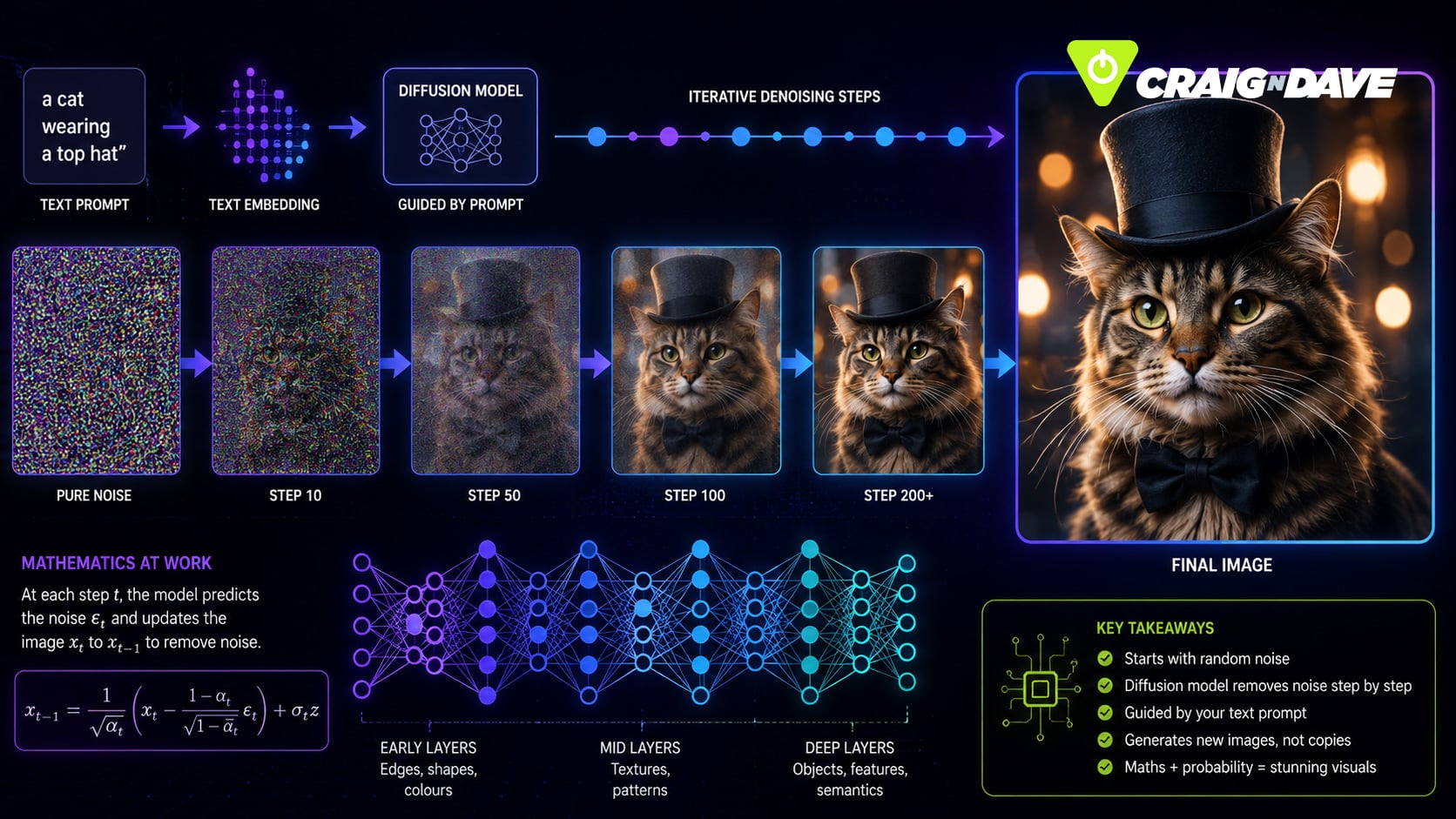
AI image generation might feel like magic, but it’s actually built on surprisingly logical maths. At its core, modern systems such as diffusion models work by answering a simple question billions of times: what should this pixel probably look like?
Instead of starting with a blank canvas, AI begins with pure noise — a chaotic static image. During training, the model studies millions of real images, then gradually corrupts them with noise. Its job is to learn how to reverse that process step by step, rebuilding clarity from chaos.
From text to pixels: how prompts are understood
When you type something like “a cat wearing a top hat”, the AI doesn’t “see” words the way humans do. Instead, a text embedding model converts your prompt into a mathematical representation in a high-dimensional space. This acts like a guiding map for the image generation process.
The diffusion model then uses this guidance while cleaning up the noise. At each stage, it asks what looks incorrect and adjusts the image slightly. Over hundreds or thousands of steps, vague shapes become defined objects — whiskers, textures, lighting, and even those oddly convincing (or slightly unsettling) human features.
Why AI images look different every time
Under the hood, neural networks analyse patterns at multiple levels. Early layers detect simple shapes like edges and colour blobs, while deeper layers interpret complex structures such as eyes, fabrics, or objects.
Importantly, AI doesn’t retrieve images from a database or copy existing artwork. It generates new outputs by sampling from learned probability distributions. That’s why even identical prompts produce different results.
A controlled amount of randomness is added at the start of the process. Too little, and outputs become repetitive. Too much, and things get surreal very quickly — sometimes brilliantly so.
The real “magic” behind AI image generation
AI isn’t imagining in the human sense. It’s performing highly sophisticated statistical reconstruction, refining noise into coherent images through repeated calculation. The real breakthrough is that this process can produce visuals that feel creative, original, and often astonishingly realistic.
Want to learn more? Watch our Lesson Hacker video HERE to see exactly how AI turns text into images step by step.
For more Lesson Hacker videos, check out the CraignDave YouTube playlist HERE.
Visit our website to explore more cutting-edge tech news in the computer science world!