31 July 2026
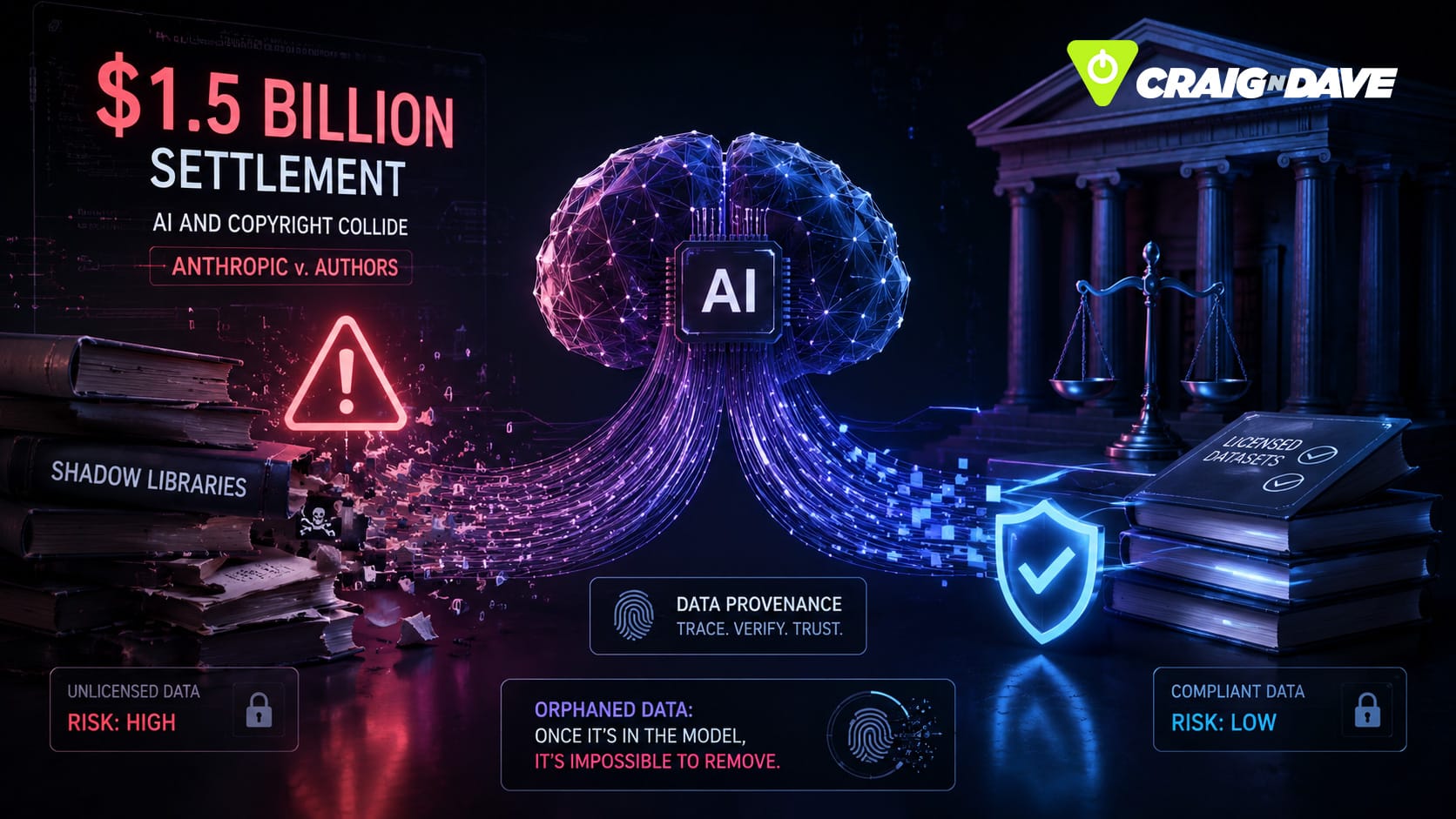
AI training is facing a legal reality check as courts begin drawing a clearer line between fair use and copyright infringement. The recent $1.5 billion Anthropic settlement has become one of the biggest warning signs yet for the AI industry, highlighting why data provenance, licensing, and transparency are now critical parts of modern AI development.
The legal reality check for AI training data
Artificial intelligence has developed at an incredible pace over the last few years, with companies racing to build larger and more capable models. But behind the rapid innovation sits a growing legal and ethical problem: where exactly did the training data come from?
The Anthropic case centres around allegations that copyrighted books from “shadow libraries” such as Books3 and LibGen were used during the training of large language models. These libraries contain huge collections of pirated books and copyrighted material, making them highly controversial sources of data.
For years, many AI companies operated in a space where data scraping and large-scale collection practices were rarely challenged in court. That situation is now beginning to change. Regulators, publishers, and copyright holders are increasingly questioning whether AI companies can freely use protected content without permission or payment.
The result is a major legal turning point for the entire AI industry.
Fair use vs infringement: Where’s the line?
One of the most important outcomes from recent court rulings in 2025 is the distinction between transformative use and outright copyright infringement.
In simple terms, courts are beginning to recognise that training an AI model on lawfully obtained material may qualify as fair use because the system is transforming information into statistical patterns rather than reproducing the original work directly.
However, the same protection does not apply when the source material itself has been illegally obtained.
A useful comparison is this:
Reading and learning from a book you purchased is generally acceptable. Building a massive archive of pirated PDFs to train commercial AI systems is something very different.
That distinction could shape the future of AI development for years to come.
The hidden problem: Orphaned data in AI models
One of the most difficult technical and legal challenges surrounding AI training data is the issue of orphaned data.
Once information is absorbed into a large language model, it becomes deeply embedded within the model’s weights and parameters. Unlike deleting a file from a computer, removing specific training data from an AI system is extremely difficult and, in many cases, practically impossible without retraining the model entirely.
A good way to think about it is like making a smoothie. Once every ingredient has been blended together, you cannot easily remove one individual component afterwards.
This creates long-term risks not only for AI developers but also for businesses using third-party AI tools. Even companies that never directly handled copyrighted data could still face complications if the underlying models were trained using questionable sources.
As a result, data sourcing is increasingly being treated like a supply-chain issue. Organisations now need confidence not only in what AI systems can do, but also in where their training data originated.
What this means for the future of AI
The AI industry is rapidly moving towards a more regulated and compliance-focused future.
We are already seeing growing demand for:
- Licensed datasets instead of scraped or unverified content
- Stronger data provenance tracking
- Transparent audit trails for training data
- Compliance-first AI governance frameworks
- Greater accountability from AI developers and providers
The “Wild West” phase of AI development is beginning to close. As regulation catches up with innovation, companies that prioritise transparency and lawful data practices are likely to be in a far stronger position moving forward.
The Anthropic case is a strong reminder that AI development is no longer operating in a legal grey area. Courts are beginning to separate legitimate innovation from careless data practices, and the message is becoming increasingly clear: how AI companies collect and manage training data matters just as much as the technology itself.
For developers, businesses, and educators, this marks a major shift in the future of artificial intelligence. Using legally obtained, traceable data may still support innovation under fair use, but relying on pirated or unlicensed content brings serious legal and ethical consequences. The challenge is made even more complex by the nature of AI models themselves — once data has been absorbed into a model, removing it is far from straightforward.
As AI continues to evolve, the industry is moving towards a more accountable future built around licensed datasets, transparent data sourcing, and stronger governance. The fast-moving “scrape first, ask later” approach is rapidly disappearing, replaced by a growing expectation that AI systems must be explainable, auditable, and legally compliant from the ground up.
The biggest lesson? AI is no longer just a technology challenge — it is now a copyright, governance, and trust challenge too.
Watch the full Lesson Hacker video on our YouTube channel for the full breakdown.

For more Lesson Hacker videos, check out the Craig’n’Dave YouTube playlist HERE.
Visit our website to explore more cutting-edge tech news in the computer science world!