
17 August 2026
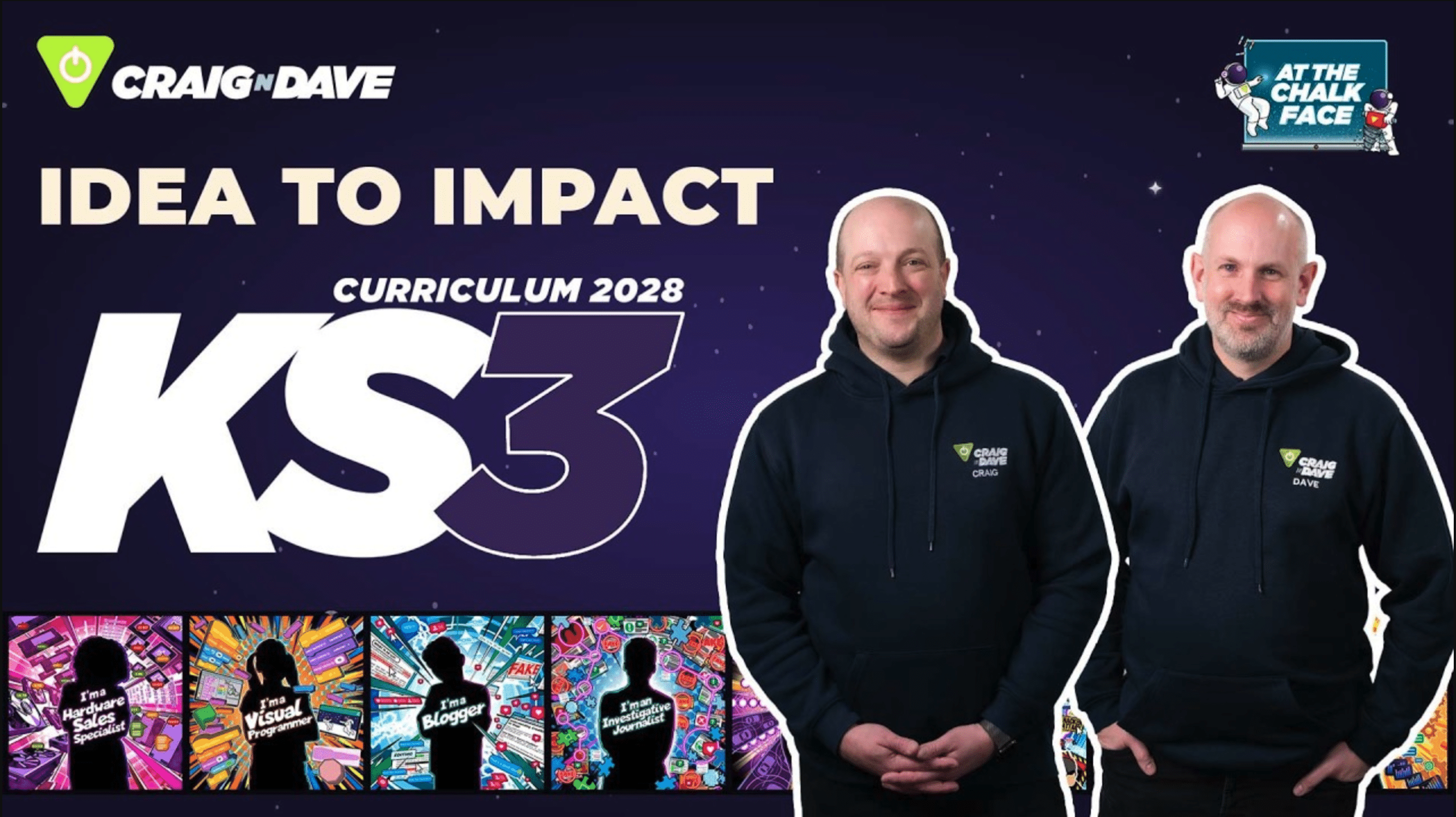
For years, Craig’n’Dave have been associated primarily with GCSE and A-level Computing. Many teachers have repeatedly asked the same question: when will there be a Key Stage 3 offer? The answer has finally arrived with the launch of a new KS3 Resource Centre, available for £299+VAT for 12 months’ access to downloadable resources. More significantly, however, this is not simply another scheme of work. It represents a deliberate response to a changing curriculum landscape and a growing debate about what Computing should look like in the years leading up to GCSE.
Why KS3, and why now?
With national curriculum reform underway and growing attention being given to artificial intelligence, digital citizenship and digital literacy, there was an opportunity to rethink what a modern computing curriculum might look like. Rather than waiting for every detail of future reforms to be finalised, we felt schools needed support now, particularly given the likelihood that today’s Year 7 students could be among the first to experience reformed qualifications.
This reflects a challenge many Computing teachers recognise. Curriculum design cannot simply stop while waiting for official documents. Departments still need coherent plans, engaging lessons and a clear vision for progression.
Starting with principles, not lesson resources
Perhaps the most revealing part of the development process is what happened before a single lesson was written. Instead of immediately creating teaching materials, we spent months developing an intent, implementation and impact framework. This resulted in 58 guiding principles that would shape every subsequent decision.
For experienced classroom teachers, this approach will sound familiar. The most successful curricula are rarely built around activities. They are built around beliefs about learning.
The discussion highlights an important lesson for departments undertaking their own curriculum reviews. Before deciding what students will learn, it is worth agreeing why they are learning it and how that learning should take place. The framework became a reference point whenever design decisions became difficult, helping maintain consistency across units and avoiding the gradual drift that often occurs when resources are developed over time.
What will feel familiar?
Despite the emphasis on innovation, there was a conscious decision not to reinvent classroom practice. The resulting structure will look reassuringly familiar to most Computing teachers:
- Teacher-led lessons with discussion, modelling and guided exploration.
- Clear lesson objectives and learning outcomes.
- Six-lesson units with possibilities to expand to longer terms.
- A blend of online, unplugged, individual, paired and group activities.
- Fully editable resources.
We were particularly conscious that many KS3 lessons are taught by non-specialist teachers. Rather than creating a framework that required extensive training to understand, we wanted something that could be picked up and taught with confidence from the outset.
That decision reflects a reality often overlooked in curriculum discussions. A brilliant curriculum that demands significant preparation time is not always a practical curriculum.
What makes this different?
While the structure may feel familiar, several features stand out.
The most distinctive is the decision to organise every unit around a career. Students are not simply learning about fake news, cybersecurity or image recognition. Instead, they adopt professional identities such as investigative journalist, cyber security consultant or computer vision engineer.
This is more than a cosmetic change. Each unit begins with a career-focused introduction, includes examples of people working in related fields and concludes with students receiving a career-themed outcome linked to their work.
Many Computing teachers will recognise the question that this approach attempts to answer: “Why are we learning this?”
Rather than treating careers education as an add-on, the curriculum weaves career relevance directly into the learning journey. Importantly, the focus is not on persuading every child to pursue a particular profession. Instead, it helps students understand where computing knowledge is applied in the real world.
Reducing workload without reducing expectations
Another notable feature is the focus on assessment.
One of the design principles was that marking should be meaningful rather than constant. Instead of generating assessable work in every lesson, students spend four lessons learning and exploring concepts before producing a final outcome in lesson five.
That final product becomes the piece of assessed work.
This reflects a concern shared by many teachers: the pressure to generate evidence can sometimes overshadow the learning itself. By concentrating assessment at key points, the scheme attempts to maintain accountability while reducing unnecessary workload.
Lesson six is then dedicated to reflection and improvement (DIRT). Students complete a knowledge quiz, review their work (or the work of a peer), identify areas for development and make improvements. The approach gives dedicated space to processes that are often squeezed into the final minutes of a lesson.
Teaching for curiosity and resilience
Rather than relying heavily on the traditional “I do, we do, you do” structure, many activities begin with exploration. Students are encouraged to investigate, discuss patterns and develop ideas before the teacher consolidates learning and addresses misconceptions.
The aim is not discovery learning for its own sake. Instead, it reflects a belief that students develop greater resilience when they are given opportunities to grapple with ideas before receiving formal explanations.
This is particularly relevant in Computing, where perseverance, debugging and problem-solving are central disciplinary habits. Teachers frequently talk about wanting students to become independent thinkers, yet curriculum design does not always create space for that independence to develop.
Literacy, vocabulary and inclusion
The scheme also places significant emphasis on literacy. Subject-specific vocabulary is explicitly identified and revisited throughout a unit, while knowledge retrieval forms an important part of the start of every lesson and the review process.
Equally noteworthy is the decision to avoid differentiation by task. Instead, the curriculum adopts an adaptive teaching approach. All students work towards the same objectives, with scaffolding and teacher intervention providing additional support where needed.
Whether teachers agree with that position or not, the decision is linked to a clearly articulated educational rationale rather than being included simply because it is fashionable.
Looking ahead
At launch, eight units are available, with further development planned over the coming years. The longer-term ambition is a comprehensive library from which schools can either follow a suggested pathway or construct their own bespoke curriculum.
Perhaps the most reassuring message for teachers is that we do not view the published materials as finished products. Curriculum reform will require adjustments, and we are committed to revisiting units as the national picture becomes clearer.
In a period when Computing education continues to evolve rapidly, that willingness to adapt may prove just as valuable as the resources themselves.
Finding out more
Teachers wishing to explore the new Key Stage 3 offer can find details, curriculum pathways and the accompanying intent, implementation and impact framework on the Craig’n’Dave website (craigndave.org). The KS3 Resource Centre currently provides access to the first eight units, with additional content planned.
Want to know more? Watch our video on ‘At the chalk face’ where we go over all the details.