
24 February 2026
One of the highlights of the Craig’n’Dave Festival of Computing each year is the sheer breadth and quality of CPD on offer – and 2026 is shaping up to be our strongest programme yet.
Across the day, teachers and leaders can choose from three dedicated CPD session slots, packed with practical classroom ideas, curriculum insight, assessment guidance, and forward-looking discussions around AI, policy and the future of Computing education.
Important booking note: CPD sessions are allocated on a first-come, first-served basis. Some sessions are almost full already, so if there’s something you really want to attend, we strongly recommend booking your ticket now.
Book your Festival of Computing ticket HERE.
View full CPD session details and choices HERE.
CPD session 1 (11:40 – 12:15)
The first CPD slot offers a wide mix of curriculum strategy, pedagogy, assessment and hands-on inspiration.
If Year 7 are doing the new GCSE, what should KS3 look like? – Becci Peters, Craig Sargent & David Hillyard
A timely and reassuring session for curriculum leaders navigating uncertainty. This talk focuses on building a purposeful, coherent KS3 curriculum that is defensible, engaging and robust – without second-guessing future GCSE reforms.
Integrating the NEA into the flow of theory – Martyn Colliver
Explore ways to weave NEA preparation naturally into day-to-day teaching, reducing last-minute pressure and improving student confidence.
Exploring the future of Computing and practical onscreen assessment – Tim Brady
A clear, jargon-free look at Pearson Edexcel’s practical onscreen Paper 2. See real examples, understand what supports student success, and join the conversation about where Computing assessment is heading next.
Ada Computer Science unlocked – Laura Holborow & Alex Parry
Discover new Web and SQL projects, class management tools and assessment features that support both NEA and extended classroom work across secondary and A level.
AI vision in robotics – World Cup fever edition! – Chris Calver
Football-themed robotics meets AI vision. A lively, practical session showing how sport and computing can combine to motivate learners (with a prize for goal of the day!).
The 10 commandments of good programming – Richard Pawson
Ten fundamental principles that underpin good programming at GCSE and A level – and how to teach them implicitly using Python, VB, C# and Java, without students learning bad habits first.
Hack-a-Tune: micro:bits, music and computing – Pete Dring
A creative, collaborative micro:bit orchestra exploring music, networking, cyber security and code – no kit or musical talent required.
Teaching programming with AI: what the research says – Jane Waite
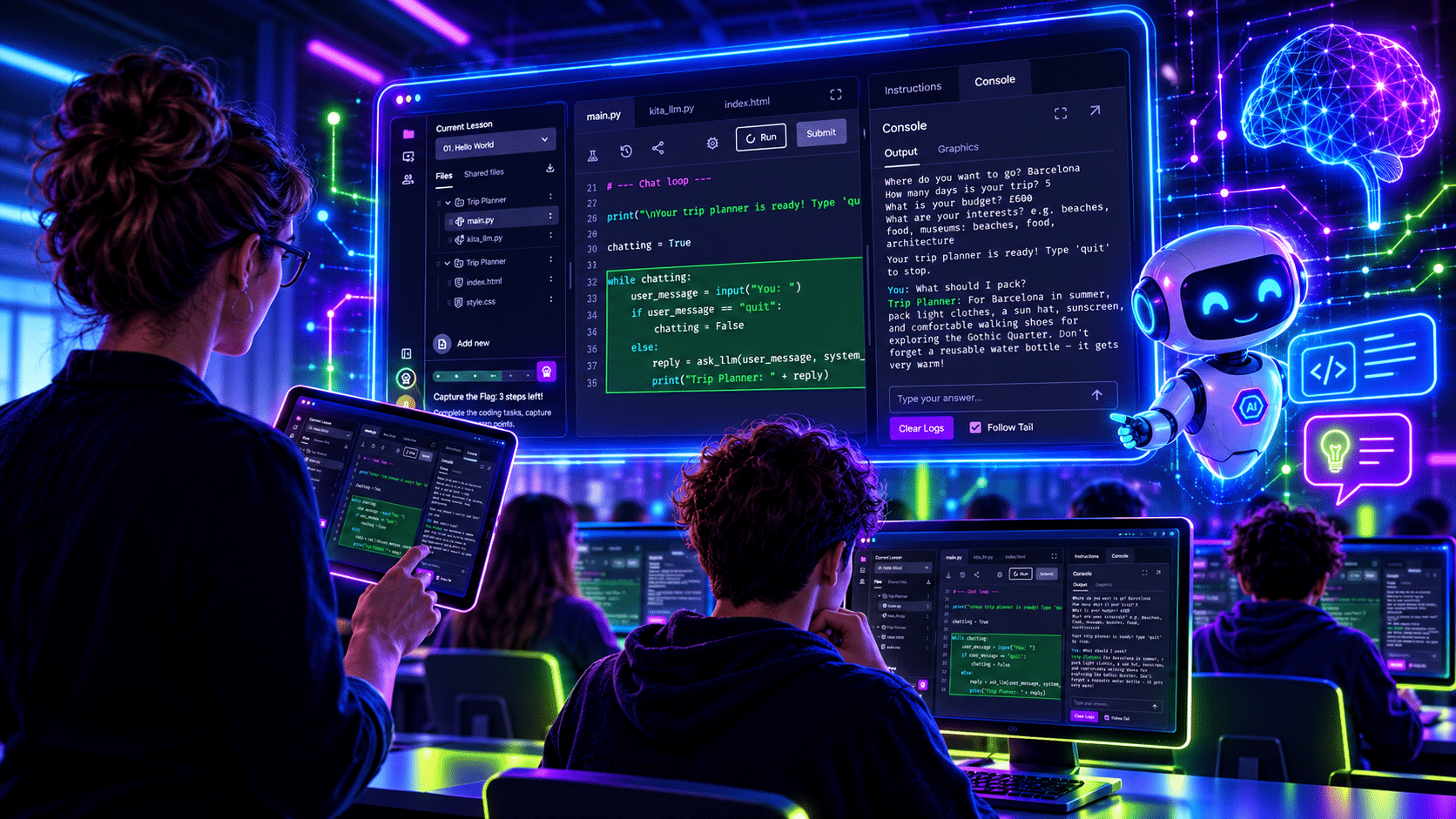
An interactive, research-informed look at how AI tools are changing programming education, with a focus on pedagogy, cognitive load and classroom practice.
Build it, train it, test it: machine learning in action – Tim Barette & Sarah Robinson
Hands-on approaches to introducing machine learning, AI literacy and ethics using accessible classroom tools.
Inspiring the next generation into technology careers – Becky Patel
Explore ways to motivate and guide learners towards future technology careers.
Physical computing in an AI world with micro:bit – Tom Doust
A look at how physical computing still has a vital place alongside AI-driven learning.
From policy to practice: building an AI safety net with EQAITE – Alan Harrison & Eleanor Overland
Discover the EQAITE framework for evaluating AI tools safely and effectively, with real-world case studies from schools.
CPD session 2 (12:30 – 13:15)
This session focuses on leadership, assessment, AI in practice and powerful classroom tools.
Meet the Smart Revise team – Craig Sargent, David Hillyard & Mark Plowman
See the latest Smart Revise developments, meet the lead developer and help shape what comes next.
A level NEA: downsizing and efficiency – Ceredig Cattanach-Chell
Practical guidance from OCR on streamlining NEAs, reducing workload and using the latest exemplars effectively.
Creating free, bespoke AI tools in Playlab.ai – Peter Marshman
Learn how to design custom AI tools tailored to your classroom needs.
Code Club in secondary schools – Rujeko Moyo & Helen Baron
Strategies for launching and sustaining Code Clubs using youth mentors, with practical resources you can take back to school.
Dodona: your online co-teacher – Matthias De Witte & Peter Dawyndt
See how this cloud-based programming platform supports confident learners, smart teaching and secure assessment.
Impact of AI in education – moving beyond the hype – Luke Harris
A grounded look at what’s genuinely working with AI in schools, and how to make informed, responsible decisions.
How to train your dragon: working effectively with SLT – Andy Colley
Practical advice on building productive relationships with senior leaders and strengthening your Computing department.
Create a 3D world in minutes – Rebecca Franks & Dr Tracy Gardner
A hands-on introduction to Flock XR, showing how inclusive, engaging 3D creation can fit into real classrooms.
Beyond “just ask another question”: building AI that can actually teach – Kat Morgan
Design AI tools with real pedagogical intelligence – from debugging buddies to cross-curricular classroom support.
Cyber security at key stage 3 – Nicolas Paul de Jong
Why early cyber security education matters, with an introduction to the Cyber Explorers platform.
Using the Computing Quality Framework – Simon Roberts
Explore how the CQF can support departmental development and improvement.
How the TechFirst scheme can support digital skills and AI learning – TechFirst (speaker TBC)
Learn how national initiatives can support AI and digital skills development in your school.
CPD session 3 (14:30 – 15:15)
The final CPD slot brings together exam insight, curriculum futures and classroom inspiration.
GCSE exam technique – Frances Sparrow
An analysis of four years of AQA exam data, highlighting common pitfalls and strategies to help students succeed.
Curriculum review and you! – Ceredig Cattanach-Chell
An update on OCR developments and what they mean for your curriculum planning.
Coding for climate action – Peter Marshman
Explore how computing can support sustainability and climate education.
Building computational thinking skills for every learner – Andrew Csizmadia & Harriet Page
Using unplugged tasks and Bebras challenges to develop problem-solving skills across secondary Computing.
How to create effective and engaging coding tasks – Harry Wake & Anna Wake
A practical toolkit for designing programming tasks that stretch, support and motivate students.
Using Smart Revise for effective learning from week one of Year 10 – Chris Sharples
Classroom-tested strategies for embedding effective learning habits early, with Smart Revise at the core.
Computing, AI and the new Ofsted framework – Dr Eleanor (Ellie) Overland
Understand how digital, computing and AI fit into the evolving inspection landscape.
Be ready for NC 2028 – Stuart Davison
A must-attend session on the move from Teach Computing to the DfE-funded Oak Computing Curriculum.
Misconceptions and errors in Computing – Paul Long
Identify common misconceptions and learn how students can answer exam questions in ways examiners reward.
Inspiring and engaging learners in Computing – Alan O’Donohoe
A high-energy session focused on curiosity, creativity and joy in the Computing classroom.
Understanding and planning student journeys in programming – Paul Curzon & Jane Waite
A deep dive into how students learn to program, and how making learning journeys explicit can improve teaching.
Don’t miss out
With so many high-quality sessions running in parallel, early booking really matters. Some CPD sessions are already filling up, and once a session is full, that’s it.
Secure your place at the Festival of Computing now: TICKETS
Explore and plan your CPD choices HERE.
We can’t wait to welcome you for a day packed with learning, ideas, and inspiration.