24 July 2026
The Screen That Thinks It’s Paper
E-ink is one of the most fascinating display technologies in modern computer science. Unlike LCD or OLED screens that emit light directly, e-ink is reflective, meaning it behaves more like paper than a traditional screen.
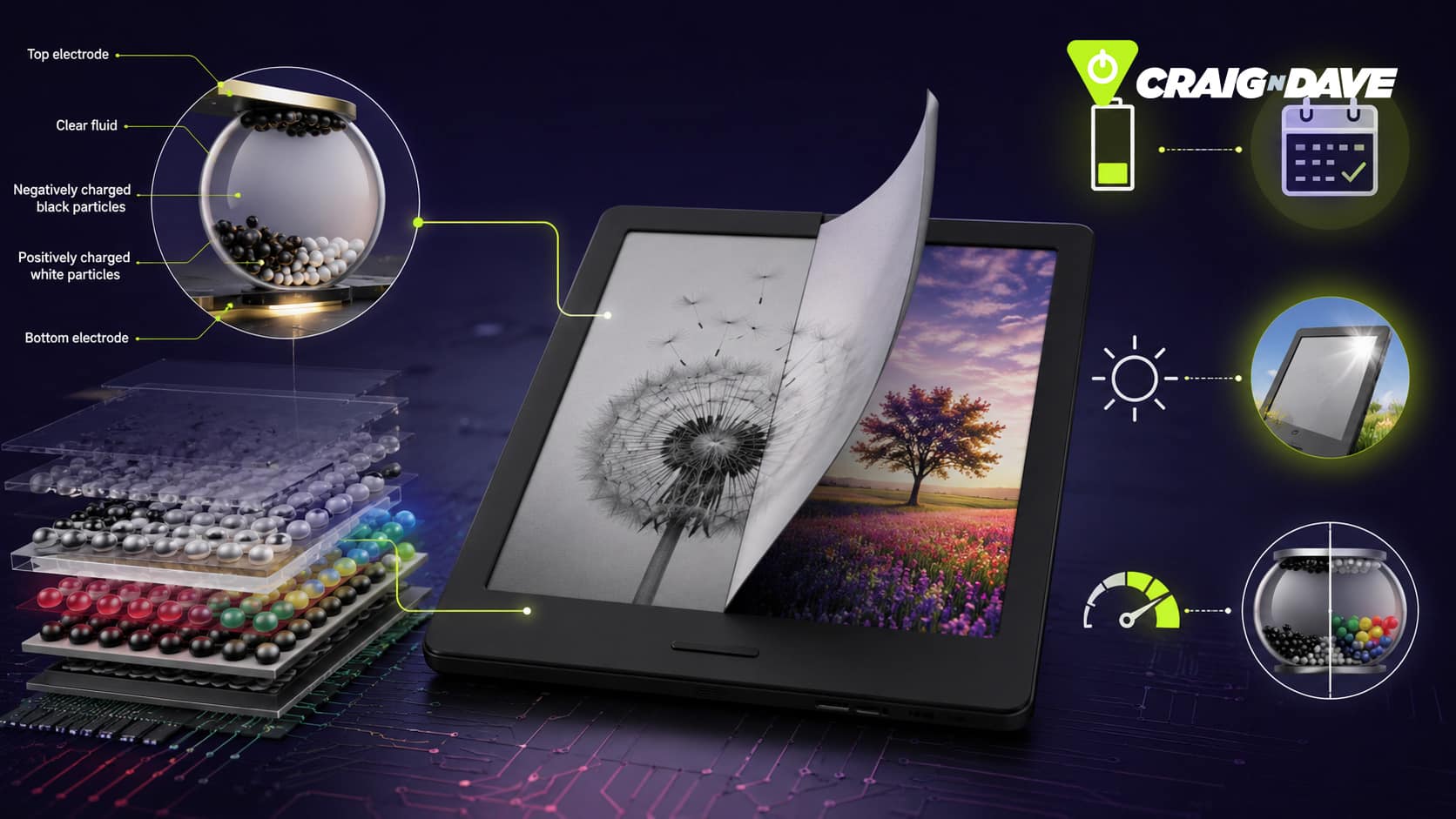
Instead of pixels lighting up, each one is a tiny capsule filled with fluid and charged black and white particles. Apply an electric field and the particles move—black to the top or white to the top. Once they’re in place, they stay there. No constant power draw. Just a static image that holds.
That’s why e-readers can last weeks on a single charge and remain perfectly readable in bright sunlight.
Bistability: The Secret Superpower
The key concept behind e-ink is bistability. Unlike LCDs, which refresh dozens of times per second, e-ink only uses energy when the image changes. This makes it incredibly power efficient—but also slow.
That slight delay is why page turns sometimes flash, and why e-ink is brilliant for reading but hopeless for video. It’s not broken—it’s just built for stillness, not speed.
Why Colour E-Ink Is So Difficult
Adding colour sounds simple, but in reality it’s a major engineering challenge.
There are two main approaches:
- Adding multiple coloured particles inside each capsule
- Using colour filters on top of a black-and-white layer
Both come with trade-offs. More particles means more complexity and control issues. Filters reduce brightness and sharpness—problematic for a display that relies on clarity and contrast.
A Physics and Manufacturing Problem
E-ink particles are relatively large at a microscopic level, which limits resolution and makes precise colour control difficult. Unlike OLED or LCD, which manipulate light directly, e-ink physically moves particles through fluid.
That means every improvement in colour adds cost, complexity, and manufacturing challenges—plus a few frustrated engineers staring into microscopes.
So Why the Delay?
Colour e-ink has taken so long because it has to balance three things at once: efficiency, readability, and visual quality. It must work in sunlight, consume almost no power, and still produce usable colour without losing its paper-like charm.
It’s improving—but slowly. Because e-ink doesn’t rush. It never has.
Want to see this explained in action? Watch our Lesson Hacker video on our YouTube channel.

For more Lesson Hacker videos, check out the CraignDave YouTube playlist HERE.
Visit our website to explore more cutting-edge tech news in the computer science world!