
29 July 2026
From space heaters to smart light sources
LEDs are everywhere today — but have you ever wondered why they’re so efficient compared to old-fashioned light bulbs? The answer lies in a clever shift in physics that completely changed how we generate light.
Incandescent Bulbs: Bright, but wasteful
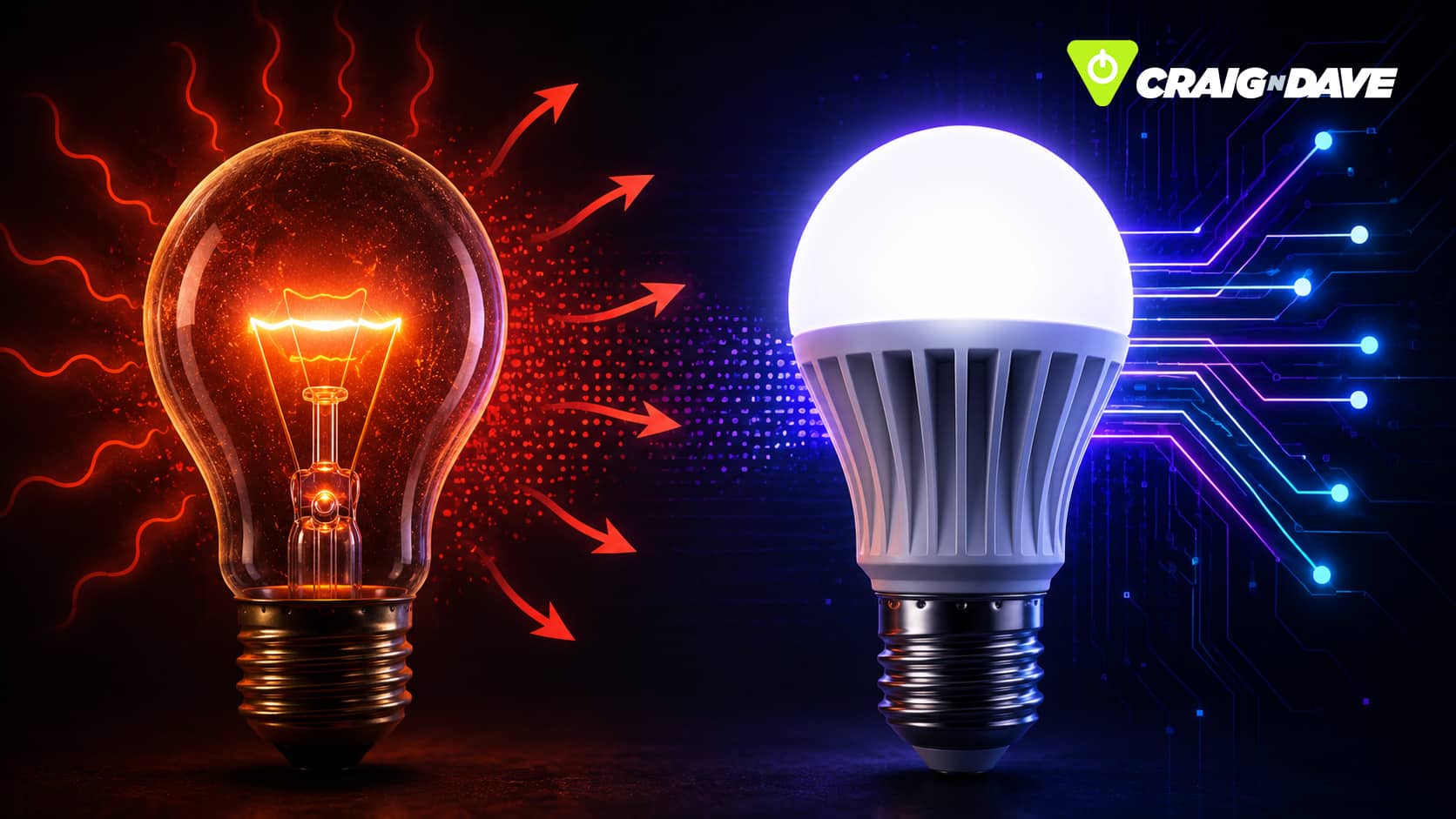
Traditional incandescent bulbs work by forcing electricity through a thin wire until it becomes so hot that it glows. That glow gives you light… but there’s a catch. Most of the energy is actually lost as heat.
In fact, around 90% of the energy in an incandescent bulb becomes heat rather than light. That’s why old desk lamps could warm a room, and why switching them off genuinely helped cool things down.
LEDs: Light without the heat problem
LEDs (Light Emitting Diodes) take a much smarter approach. Instead of heating metal, they use a semiconductor junction where electrons move between energy levels. When they drop to a lower energy state, they release energy as photons — in other words, light.
No extreme heat. No wasted energy. Just direct light output. This is why LEDs flip the efficiency ratio on its head: far more light, far less waste, and almost no heat compared to traditional bulbs.
From Christmas lights to smartphones
If you remember 1980s Christmas lights, you’ll know how unreliable and power-hungry they were. One bulb failed and the whole string went out. Modern LED versions are brighter, safer, and run on a fraction of the energy.
That same efficiency is why LEDs now power everything from TVs and smartphones to car headlights and streetlights. They’re fast, compact, energy-efficient, and can be packed into millions of pixels without overheating your screen.
Why LEDs took over the world
LEDs don’t just save energy — they last tens of thousands of hours, reduce electricity costs, and generate far less heat. In short, they’re simply better engineering.
Once you realise lighting doesn’t need to involve something dangerously close to melting point, old technology starts to feel wildly inefficient.
Want to know more? Kat, the Craig’n’Dave Lesson Hacker, explains all.

For more Lesson Hacker videos, check out the Craig’n’Dave YouTube playlist HERE.
Visit our website to explore more cutting-edge tech news in the computer science world!