29 July 2026
When Speed Isn’t Everything
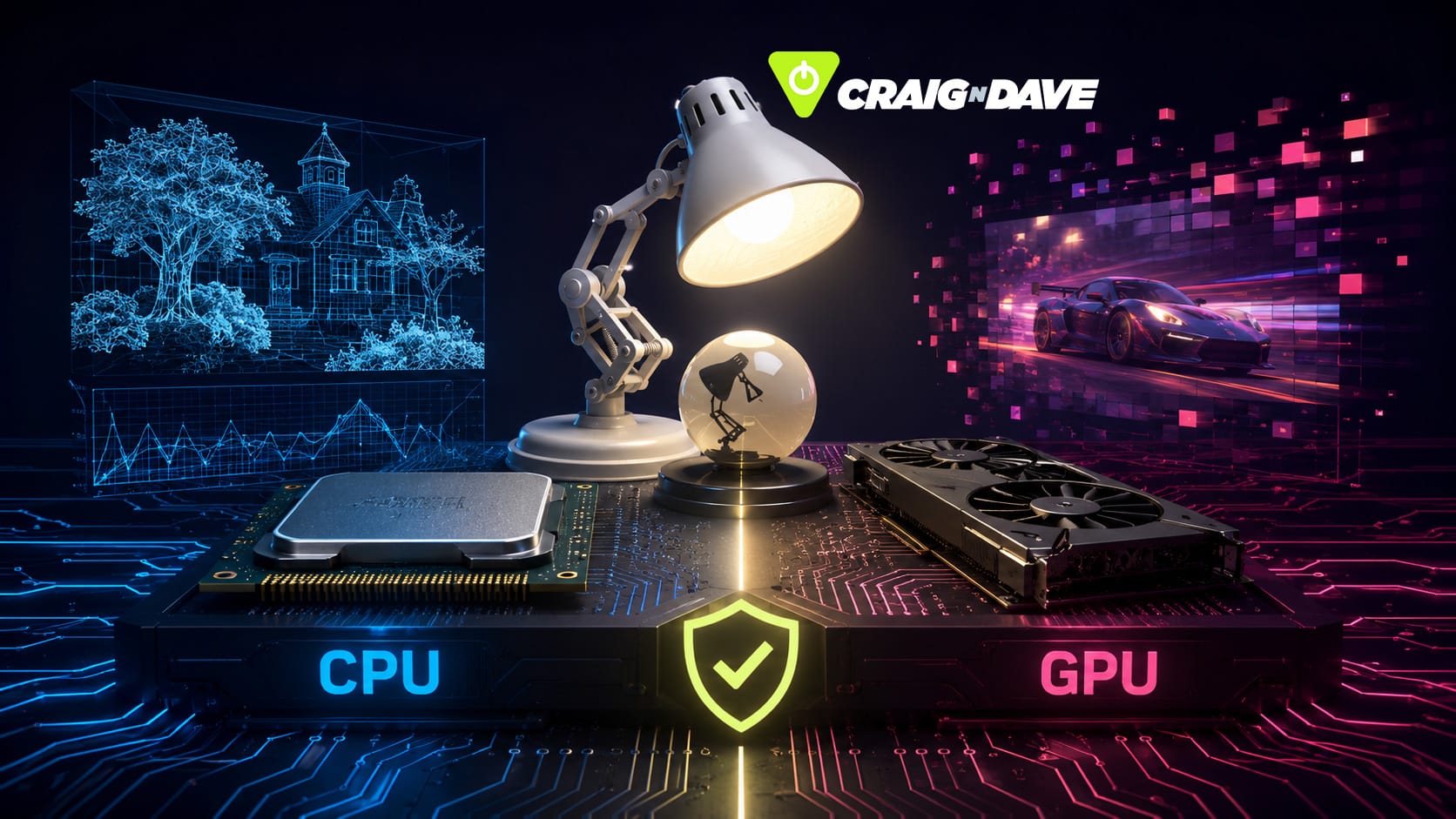
At first glance, it sounds crazy. Pixar creates some of the most visually stunning films in the world — movies that could melt a graphics card for breakfast. Surely they’d be all over GPUs, right? After all, GPUs are fast, parallel, and literally designed to draw pictures. Yet, for the final render of a Pixar film, the heavy lifting is still overwhelmingly done on CPUs.
The reason isn’t speed — it’s accuracy.
GPUs vs CPUs: Games vs Film
GPUs were born in the world of gaming, where the goal is to push out 60, 120, or even more frames per second. If a shadow is slightly off in one frame, no one notices because the next frame appears in just a few milliseconds. To achieve this, GPUs use approximations: reduced-precision maths, slightly lossy floating-point operations, and other “good enough” tricks that prioritise speed over perfect accuracy.
Film rendering is a completely different challenge. Pixar’s RenderMan performs physically based rendering, tracing how light bounces, scatters, reflects, refracts, and interacts with materials — all in accordance with real-world physics. A single frame can take hours to render, not milliseconds. Any tiny calculation error is baked into the frame, ready for viewers to pause, zoom, and scrutinise on a 4K screen. That minuscule numerical wobble can lead to flickering, noise, or inconsistent lighting — all visual issues that would ruin the cinematic experience.
Why CPUs Still Rule for Final Renders
CPUs may be slower, but they are predictable. They offer high-precision floating-point maths, massive caches, and robust handling of complex branching logic — exactly what film renderers rely on. Rendering a scene isn’t just about drawing millions of pixels; it involves millions of conditional decisions about ray interactions, materials, and energy propagation. CPUs excel at this kind of irregular, decision-heavy workload, even if they take more time.
Modern GPUs are catching up and are increasingly used for previews, lighting tests, and interactive look-development, where speed matters more than perfection. But when it comes to the final frames — the ones that will live forever on the big screen — Pixar still trusts massive CPU render farms, grinding away one exquisitely accurate photon bounce at a time.
Curious to see why Pixar relies on CPUs for its blockbuster films? Watch the full video HERE.
 For more fascinating insights into computer science, animation, and tech behind the scenes, visit CraignDave.org.