20 July 2026
The tiny checkbox with a big job
Every time you tick the familiar “I am not a robot” box online, it might feel like a small insult to your dignity. Surely robots can click boxes — they can drive cars and even compose music. So why does a simple checkbox seem to challenge our very existence?
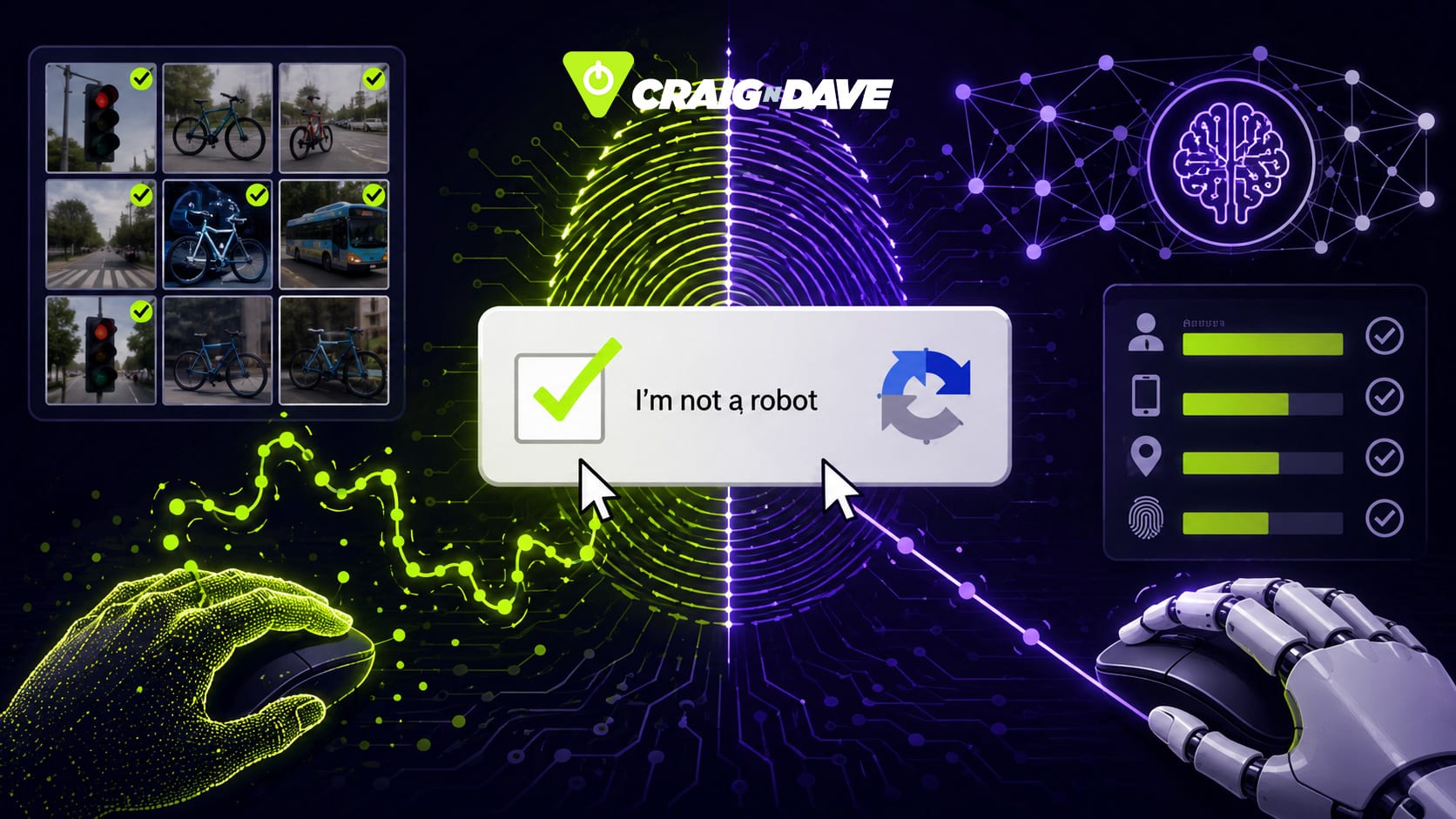
The truth is, that little square isn’t testing whether you can click — it’s observing how you click. Humans are delightfully messy: we overshoot targets, pause, wiggle the mouse, and sometimes hesitate for a moment of existential dread before finally hitting the box. Bots, on the other hand, move in perfectly straight lines at superhuman speed, trying to complete the task with robotic efficiency. Invisible scripts analyse cursor paths, timings, micro-hesitations, and device behaviours. If the interaction looks too perfect, the system thinks: “Robot vibes,” and you’re sent to the dreaded image test.
Enter CAPTCHA hell
CAPTCHAs — those grids of blurry images — are actually computer vision training disguised as security. You’re asked to select traffic lights, bicycles, or buses that appear half-hidden or distorted. Humans excel at recognising patterns in chaos, while early AI struggled. The system even compares your selections with those of other humans, effectively crowd-sourcing a reality check. Meanwhile, you debate whether that tandem bike counts as one or two.
Can AI beat CAPTCHAs?
Increasingly, yes. Modern neural networks can identify objects in CAPTCHAs far more accurately than humans, especially when fed enough examples. This is why newer systems have evolved beyond image puzzles, relying on behavioural biometrics, device fingerprints, risk scoring, and contextual signals like your IP reputation. Proving you’re human is no longer just about ticking a box — it’s about showing you’re a normal human doing normal human things on a normal device.
Humans are gloriously clumsy
Ironically, as AI gets better at mimicking us, websites may start testing behaviours that even humans find tricky. In the future, you might need to scroll in a slightly confused way or fail a simple maths problem to prove you’re human. Finally, our natural human quirks become a security feature — and one that bots can’t easily replicate.
Curious to see how this all works in practice and why your mouse movements matter more than you think? Watch the full video here.
For more fascinating computer science insights, teaching resources, and videos, visit CraignDave.