22 July 2026
Yes, it is—but it’s a lot more complicated than you remember.
If you remember your early computer science lessons, you might recall the simple mantra: fetch an instruction, decode it, execute it, repeat. That basic loop has been at the heart of CPUs since the 1970s—and surprisingly, it’s still there today. But modern processors have bulked up, gotten faster, and learned a few tricks along the way.
The classic rhythm of CPUs
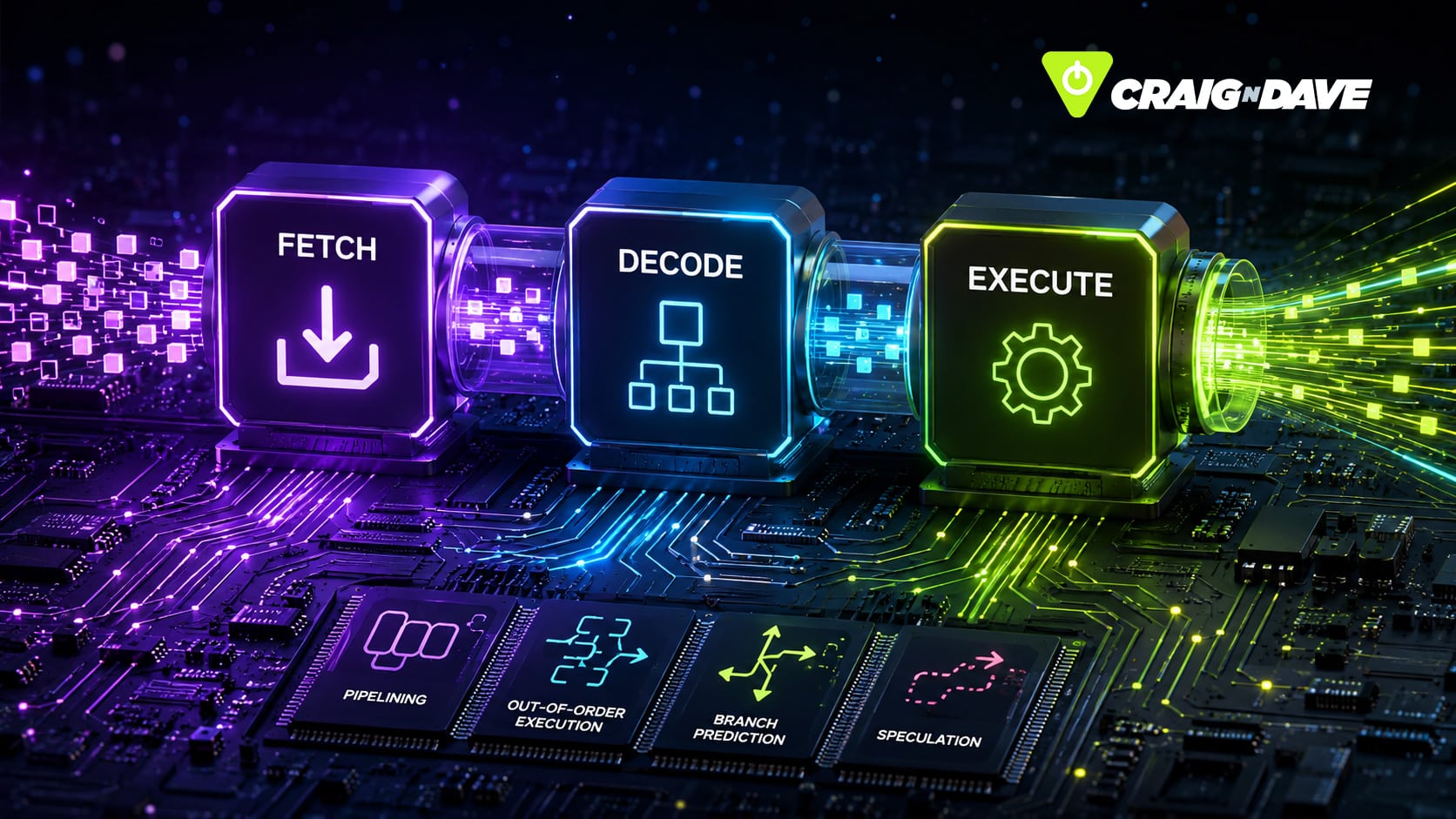
At its core, every CPU still follows the same three-step process: fetch an instruction from memory, decode it into an operation the processor understands, and execute it. Software assumes this rhythm, and physics hasn’t suggested a better alternative yet. Strip away the cores, branding, and flashy diagrams, and the familiar fetch–decode–execute cycle remains.
Pipelining: the relay race of instructions
What’s different now is speed and efficiency. Modern CPUs don’t sit politely and handle one instruction at a time. Instead, they fetch multiple instructions ahead, decode them in parallel, and try to execute as many as possible simultaneously. This is called pipelining. Picture a relay race where runners start early, pass the baton multiple times at once, and occasionally bump into each other—chaotic but effective.
Out-of-order execution and speculation
Things get even more “clever” (and a little chaotic) with out-of-order execution. CPUs don’t always follow the order your program wrote; they execute instructions as resources are available, as long as the final result is correct. Add branch prediction and speculative execution, and your processor is effectively guessing what comes next, executing instructions in advance, and discarding the ones it didn’t need. If done right, this adds speed. If done wrong, well… let’s just say it occasionally makes headlines.
The same old cycle, just supercharged
Underneath all the complexity, the fundamentals haven’t disappeared. Instructions are still fetched, decoded, and executed. Even GPUs, AI accelerators, and multi-core monsters rely on this cycle—they’ve just widened, deepened, parallelised, and turbocharged it. Today’s CPU is like an over-caffeinated octopus juggling thousands of tasks at once—but from the software’s perspective, it still looks like a simple three-step dance.
So yes, fetch, decode, execute is absolutely still a thing. It’s just gone to the gym, had some coffee, and learned a few new moves along the way.
Want to see this explained visually? Check out the full video on our CraignDave YouTube channel.

Explore more computer science insights, tutorials, and resources at CraignDave.