5 October 2026
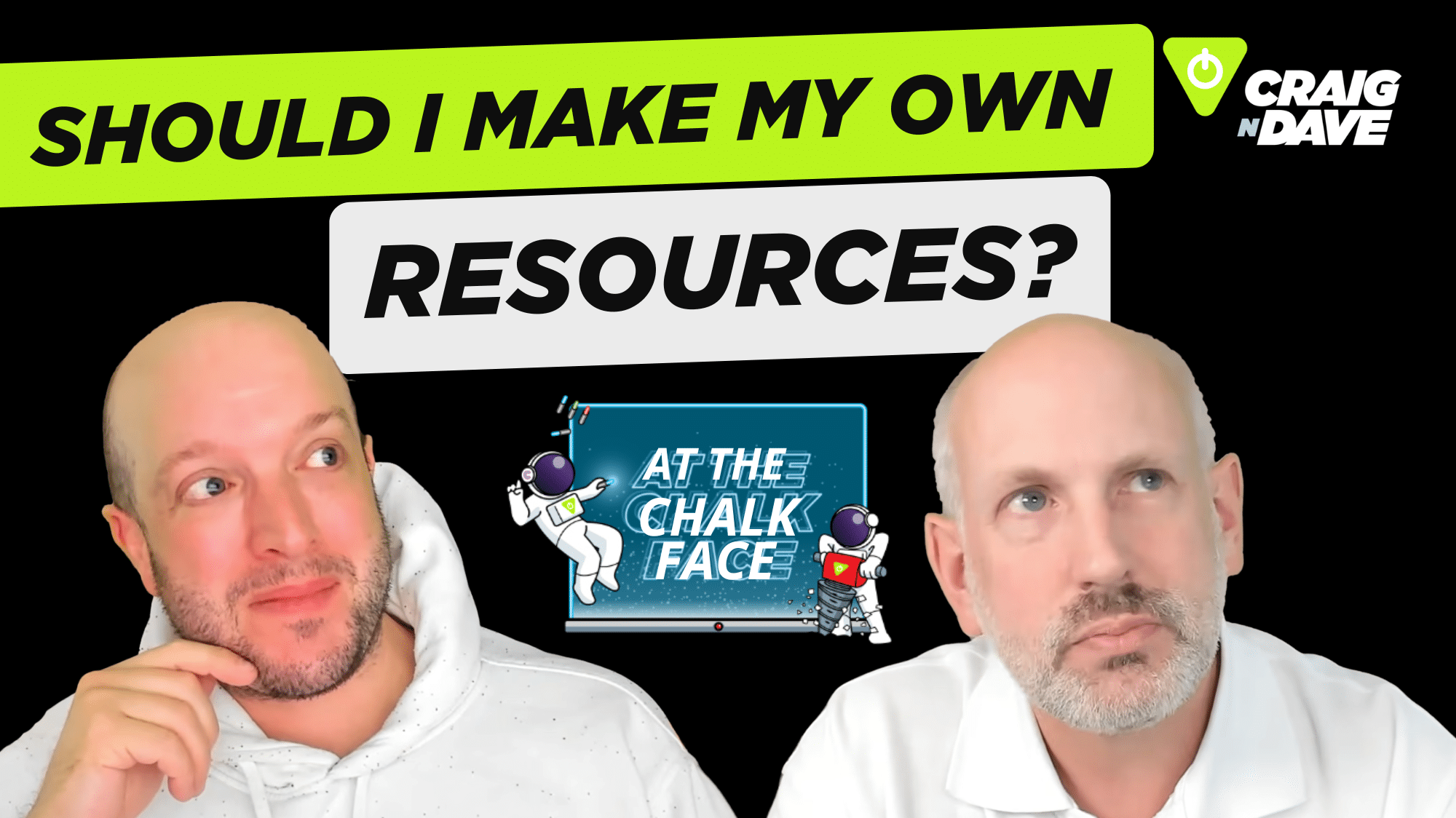
A trainee teacher recently asked a thoughtful question during a training session, “Should I be making my own resources?” It is a question that many teachers ask whether they are new to the profession or experienced and preparing for a new curriculum. The answer is rarely binary.
Why this question matters
Teaching has always been demanding. New teachers quickly discover that lesson planning, behaviour management, assessment, pastoral responsibilities and professional development compete for attention every day. It can often make you feel inadequate.
Sam Gibbs, Curriculum and development lead at Greater Manchester Education Trust captures this well:
“If the job feels difficult, this shouldn’t be taken as evidence that you’re terrible at teaching. That difficulty doesn’t ever really go away, which should be reassuring, because I think teaching is about embracing complexity and difficulty and finding your way through it.”
Teaching is a profession built on continuous improvement. There is always another lesson to refine, another explanation to strengthen and another approach to try. The challenge is not eliminating this complexity but managing it wisely. Remembering that what matters most is helping pupils learn.
The case for creating your own resources
Designing resources remains an important professional skill. When teachers create or adapt materials, they think carefully about sequencing and the needs of a particular class. The process encourages deeper subject knowledge and a stronger understanding of curriculum design. It also allows learning to be tailored to local contexts, current events and student interests.
Creating resources can be particularly valuable early in a teaching career. Building lessons from the ground up helps teachers understand how learning develops over time. It encourages reflection on why activities work, or don’t, and how each supports progress.
However, there is a cost. Developing high-quality resources takes considerable time. Many teachers discover that lessons are never truly finished. Small improvements become constant revisions, and a scheme of learning can absorb far more evenings, weekends and holidays than intended.
The benefits of off-the-shelf resources
Commercial resources exist because they solve a genuine problem. A high-quality resource can save hours of preparation time. Subject specialists, experienced teachers, designers and curriculum experts often contribute to published materials, producing resources that are often both visually appealing and more importantly, carefully structured.
Departments also benefit from consistency. Shared resources help ensure that classes receive comparable experiences and that curriculum coverage remains coherent across year groups. For teachers working outside their specialism, published materials can be particularly valuable. Few teachers would willingly spend hours designing lessons in an unfamiliar area when expert resources already exist.
Good resources also expose teachers to new ideas. An activity, explanation or sequence that works well elsewhere can spark improvements in your own classroom practice. The challenge is recognising that attractive resources do not automatically lead to effective learning. Some packages appear impressive but offer little pedagogical value beneath the design. Others may work well in one context but require significant adaptation in another.
Why extremes rarely work
Debates about resources often become unnecessarily polarised. One view suggests that teachers should create everything themselves because nobody understands their pupils better. Another assumes that purchasing a complete package removes the need for planning.
Neither position reflects reality. Teachers who create everything themselves risk spending enormous amounts of time reinventing materials that already exist. The pursuit of perfection can become endless, with resources continuously revised in search of marginal gains.
At the opposite extreme, teaching directly from a purchased resource without prior thought doesn’t always produce the best outcomes. Not because the resource itself is poor, but because implementation and delivery are equally important. Every class is different and even the time of day can make a big difference. Excellent resources still benefit from adaptation.
Planning matters more than ownership
A useful question is, “How well does this resource support learning, the approach and the outcomes I’m aiming to achieve?”
Students rarely care whether a slideshow, worksheet or activity originated from a classroom teacher, a publisher or a colleague. What matters is whether the material is clear, engaging and appropriate for the task.
A carefully selected resource that has been adapted thoughtfully often provides greater value than a completely original resource produced under severe time pressure. Many experienced teachers develop a practical workflow. They begin with a strong existing resource, then modify examples, add context, adjust explanations and build in scaffolding or differentiation. The result retains the efficiency of an off-the-shelf product while meeting the needs of a specific class.
In this sense, adaptation may be the most important skill of all.
Where AI fits into the picture
Artificial intelligence has added a new dimension to the discussion. AI lesson builders can generate presentations, worksheets and activities within minutes. The speed is impressive, but speed alone does not guarantee quality. Many AI-generated lessons look convincing at first glance. Closer inspection often reveals serious weaknesses. Explanations may not hit the mark, activities may lack practical classroom realism, and presentation choices may do little to support learning.
The issue is not that AI produces poor ideas. In fact, AI can be extremely useful for brainstorming activities, identifying misconceptions, suggesting examples, refactoring and developing ideas or acting as a critical friend during planning.
The real value comes from dialogue and reflection. Used well, AI can challenge assumptions and subject knowledge. Offer alternatives and help teachers think more deeply about lesson design. Used poorly, it can encourage teachers to accept generic materials without sufficient professional judgement. AI works best as an assistant rather than a replacement for expertise.
Collaboration is the hidden advantage
One of the most effective ways to improve resources is to stop working in isolation. Departmental collaboration and local networking allow teachers to share successful activities, test ideas and refine approaches collectively. Resources become stronger when colleagues contribute different perspectives and challenge each other’s assumptions.
No single teacher produces the perfect lesson. Collaboration allows resources to evolve through discussion, adaptation and classroom experience. For trainee teachers in particular, this should be reassuring. Creating resources does not mean starting with a blank page. Existing departmental materials, mentor feedback and shared planning all provide valuable foundations. Teaching is a collaborative profession. Resource development should reflect that reality.
A balanced conclusion
The question is not whether teachers should make their own resources or buy them. The better question is which resources are worth creating, which are worth purchasing and which are worth adapting.
Buy resources when they save substantial time, provide specialist expertise, have unique activities, fit a pedagogy you want to adopt or support consistency across a department. Create or heavily adapt resources when local context and differentiation require it.
Most importantly, avoid confusing workload with effectiveness. Spending every weekend creating lessons from scratch does not automatically make someone a better teacher. Strong planning remains essential, but sustainable planning is even more important. The goal is to deliver excellent learning experiences in the classroom while maintaining the capacity to do that well, day after day, year after year.
The strongest resource is rarely one that is entirely homemade or entirely purchased. More often, it is a well-chosen foundation shaped by professional judgement and thoughtful adaptation.
Want to know more? Check out our ‘At the chalk face’ video HERE.
A strong foundation for your classroom
Did you know we’ve created a whole range of Computer Science resources designed to make life easier for teachers? We’ve built them with real classrooms in mind, drawing on our own teaching experience to create clear, engaging and practical resources that are ready to use and easy to adapt.
From fully editable lessons and structured schemes of learning to engaging activities, extension tasks and resources to support different learners, our aim is simple: to save you time while helping you deliver great Computer Science lessons.
So, if you’re a trainee teacher starting out, an experienced teacher looking to reduce your workload, or a non-specialist looking for some extra support, you don’t have to start from a blank page.
Take a look at the Craig’n’Dave resources and see how they could work for you: Explore our resources