5 July 2026
The spooky “Good evening, Manchester!” moment
You’ve opened a website, and it greets you with “Good evening, Manchester!” and your first thought is: Right. Which one of you told them? Don’t worry—it’s not psychic powers, and your phone isn’t secretly spying on you. Unless you’ve been oversharing every thought on social media, it’s probably just IP geolocation—the tech equivalent of guessing someone’s postcode from the accent they mumble through a kebab.
IP addresses: Your digital return address
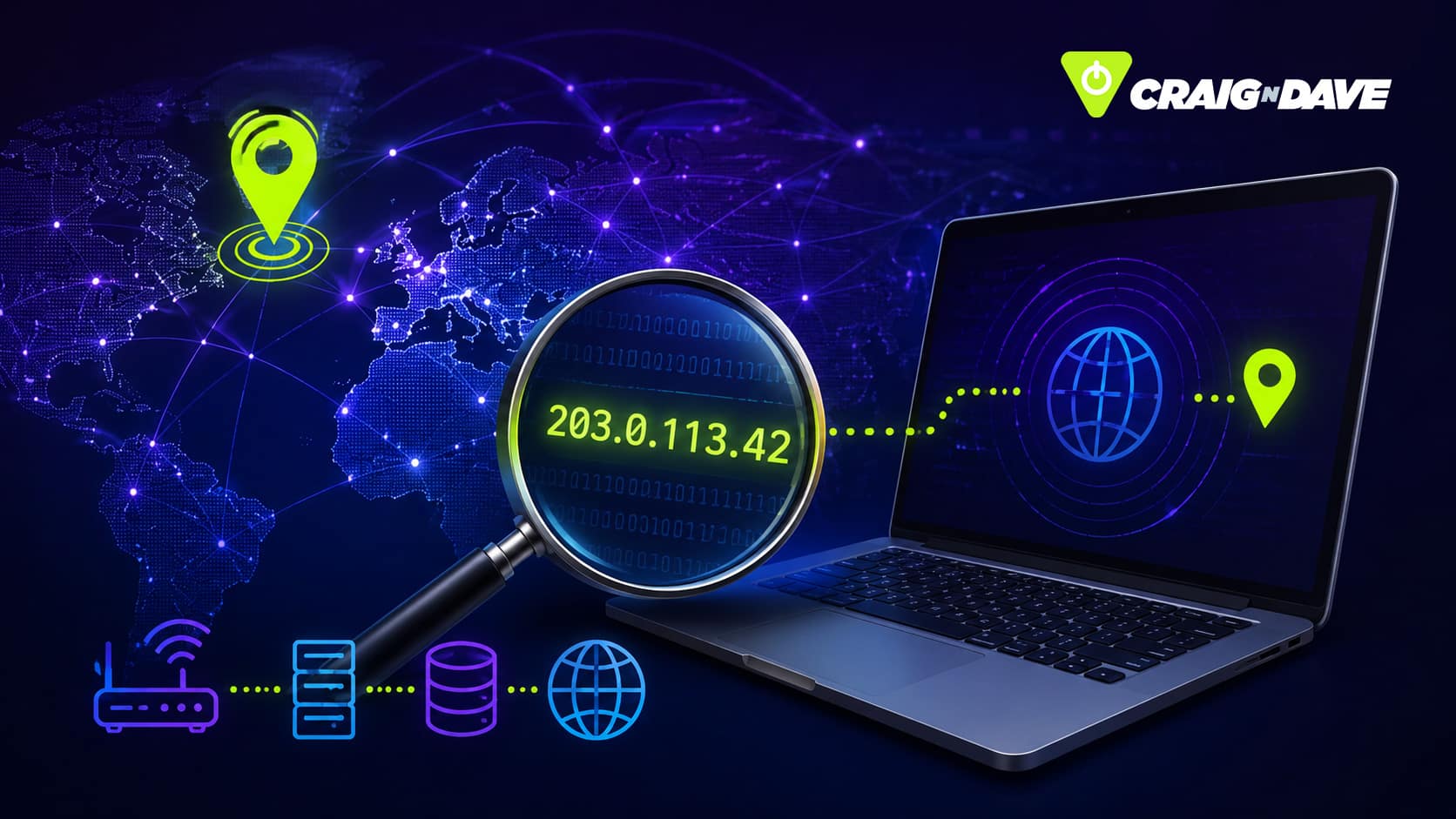
Every device connecting to the internet gets an IP address, a numeric label that works a bit like a return address on a letter (less charming, more colons if it’s IPv6). Internet providers assign these addresses in big regional blocks, and companies like MaxMind and IP2Location gather this data into huge databases mapping IP ranges to countries, cities, and sometimes even neighbourhoods.
So when you visit a website, it checks your IP against one of these databases and voilà—“Ah, this one’s from Leeds.” Not exactly Sherlock-level deduction, but surprisingly effective.
Why it’s not always perfect
IP geolocation isn’t 100% precise. Your village might be resolved to the nearest city, or worse, a default entry could place you in a random field in Kansas! Bad data can cause chaos—but it’s usually harmless.
And if you’re worried about your exact house number, rest easy. Websites would need your ISP’s internal records to get that, which are tightly guarded. Only a court order could lift that veil.
When accuracy improves
IP geolocation can be more precise if you use apps or services that access GPS, Wi-Fi positioning, or mobile networks—but only if you explicitly share that data. Otherwise, a plain IP lookup just gives a rough “local-ish vibe.”
Next time a website welcomes you by your city, don’t panic. It’s not magic, it’s not sinister surveillance, and there’s no crystal ball involved. It’s just your internet address doing the talking.
Want to know more? Watch our Lesson Hacker video on our YouTube channel.

For more Lesson Hacker videos, check out the CraignDave YouTube playlist HERE.
Visit our website to explore more cutting-edge tech news in the computer science world!