23 July 2026
Ever watched a drone hover perfectly in mid-air and wondered how it doesn’t just tip over like a table on uneven ground? The truth is fascinating — drones don’t balance by being still. They balance by panicking hundreds of times a second… and doing it with incredible precision.
Tiny Sensors, Big Job
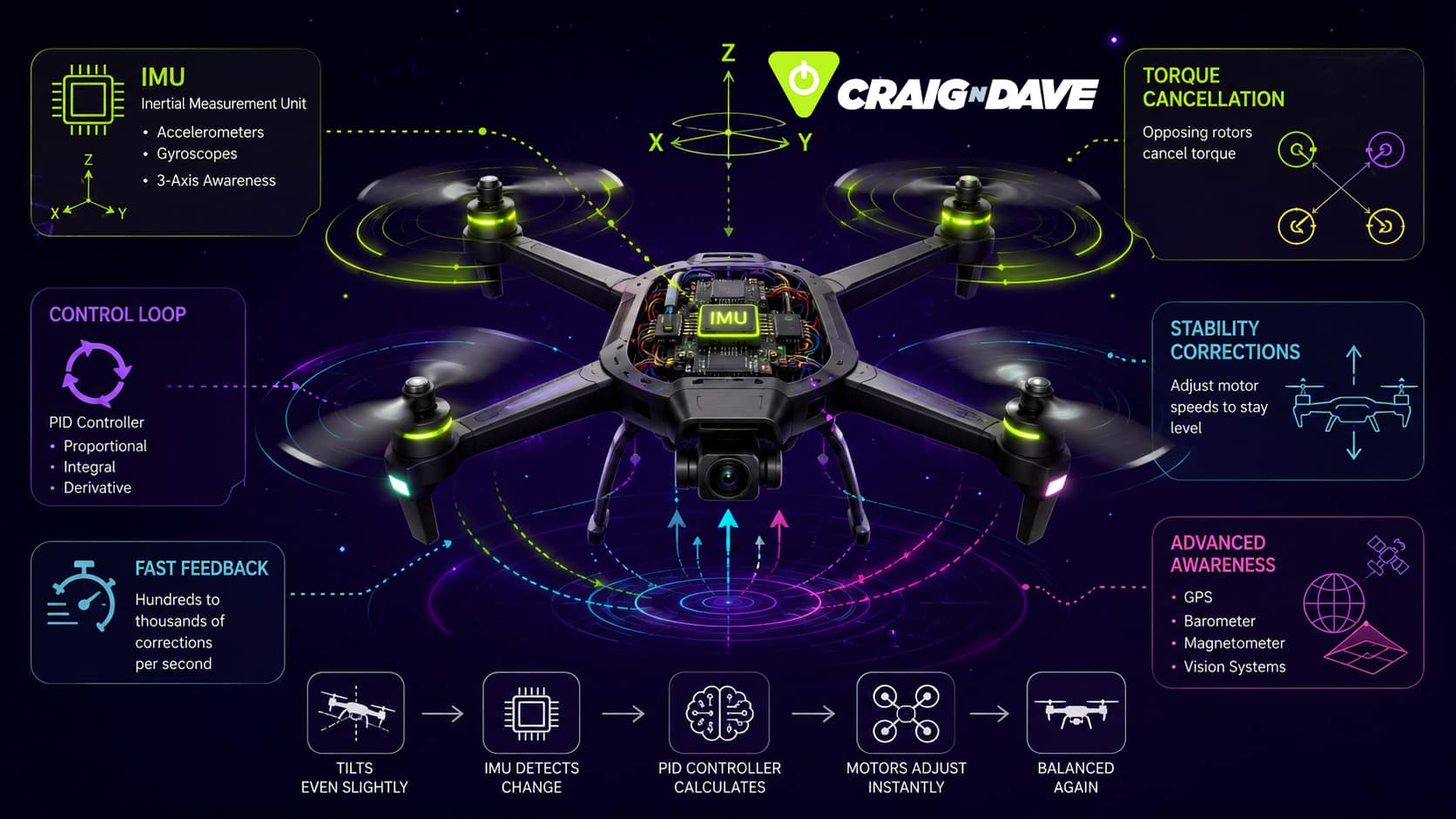
A quadcopter isn’t stable on its own. Left alone, it would immediately tip, accelerate sideways, and fall — obeying gravity in the most dramatic way. The secret lies inside: an Inertial Measurement Unit (IMU). This tiny device, packed with accelerometers and gyroscopes, measures linear acceleration and rotation across three axes. Essentially, the IMU is constantly asking, “Which way is down, and how fast are we messing this up?”
The Control Loop: Chaos with a Plan
The IMU feeds its measurements into a flight controller, usually using a PID controller — Proportional, Integral, Derivative.
This may sound technical, but it’s simply a way to answer three questions:
- How wrong are we now?
- How wrong have we been?
- How fast is it getting worse?
If the drone tilts even slightly forward, the controller speeds up the rear motors and slows the front ones. This tiny adjustment pushes it level again. And it doesn’t stop there — this process happens hundreds or thousands of times per second, far faster than any human pilot could react.
Torque Cancellation: Why Multiple Rotors Matter
Drones have multiple rotors to cancel out torque. Each spinning propeller wants to twist the drone in the opposite direction (thanks, Newton!). By pairing clockwise and counter-clockwise rotors, rotational forces cancel each other out. Want to yaw left? Speed up one diagonal pair and slow the other. Want to rise? Speed up all the motors equally.
Advanced Awareness: More Than Just Balance
GPS, barometers, magnetometers, and even vision systems give drones higher-level awareness — altitude, heading, and position relative to the ground. But these sensors are slower. The real magic of staying upright happens in the IMU and control loop: a relentless feedback cycle of overcorrecting tiny mistakes instantly.
Drones don’t hover by being steady — they hover by constantly falling and correcting faster than physics can react. What looks like effortless floating is actually hundreds of tiny “NOPE!” corrections every second. The result? A perfectly balanced drone and a glimpse into the brilliant engineering of modern flight.
Watch the full video HERE to see this balancing act in action.
Explore more tech insights and computer science fun at CraignDave.org