Back

Is reading necessary?

6 September 2025

Why reading belongs in the Computer Science classroom 

In a recent article, an English teacher shared how short, focused reading sessions—just five to seven minutes long—can reignite a love of reading in disengaged students. Inspired by research from Stanford University, Erin Miller trialled one-to-one reading interventions with her Key Stage 3 students and saw a noticeable shift in their attitudes toward reading. The simplicity of the approach is striking: minimal interruption, targeted support, and a consistent routine. But what does this have to do with computer science? 

Quite a lot, actually. 

Reading for pleasure: more than just literacy 

It’s tempting to think that once students can read well enough to access the curriculum, the job is done. But reading for pleasure goes far beyond basic literacy. It’s a gateway to: 

  • Vocabulary growth: Words like concatenate, iterate, and recursion are common in programming but rare in everyday speech. Students who read widely are more likely to encounter and internalise these terms, making it easier to grasp abstract computing concepts. 
  • Improved comprehension: Understanding problem statements or even debugging messages requires stronger reading skills. 
  • Higher academic performance: OECD’s PISA studies consistently show that students who read for pleasure outperform their peers—not just in literacy, but in maths and science too. 
  • Cultural capital: Reading builds background knowledge, not only providing an opportunity to cement the curriculum in the real world but also helping students engage more meaningfully with others and with the world around them. 
  • Is reading just for English teachers? 

Absolutely not. Just as every teacher has a role in developing digital citizens for our subject, every teacher—including in Computing—should be helping students become more literate. Whether it’s understanding ethical dilemmas in AI, exploring the history of computing, or simply following a tutorial, reading is foundational. 

Fitting it in: A curriculum challenge 

Yes, the curriculum is crowded. But reading doesn’t have to be a separate activity. It can be woven into existing routines: 

  • Replace a retrieval task with a short reading and reflection. 
  • Make a main task require students to read a paragraph before the activity can be undertaken. This might sound old-school, but it helps.  
  • Encourage students to read computing-related texts and share insights with peers. 

One practical idea is to use Alan Harrison’s How to Learn Computer Science at A level. Ask students to read a chapter and prepare to discuss something they found interesting. This not only builds subject knowledge but also fosters scholarly habits. 

For students with low literacy, reading can feel like a barrier rather than a gateway. So how do we support them without defaulting to overly simplified texts or assistive tools that risk becoming crutches? Scaffold don’t simplify. Pre-teach vocabulary, introducing key terms before reading. In computer science, words like algorithm or binary can be unpacked with visuals first. Chunk the text by using short, manageable passages. 

Does AI Make Reading Redundant? 

It’s true that AI can summarise texts instantly. But that’s not the point. Reading is about growth. AI can’t replicate the personal development that comes from wrestling with a challenging idea or discovering a new perspective. While tracking independent reading is harder in the age of AI, the benefits—confidence, curiosity, and competence—are worth the effort. 

Building Habits That Last 

Drawing on James Clear’s work on habit formation, we can help students make reading a regular part of their lives. Techniques like habit stacking (e.g., reading as part of homework) can make reading more automatic and enjoyable. This is where Craig’n’Dave resources help. Not only do students watch a video for homework, but the take-notes icon in the GCSE videos gives them a cue to read and write down what they see. 

Ultimately, reading isn’t a luxury, it’s a necessity. If you read more widely around a subject it is a vehicle for synthesising many abstract concepts taught in isolation in class, making it one of the most powerful tools we can give our students.

Related posts

The biggest curriculum shake-up in a decade – Part 3

Discover what the new Progress 8 and Attainment 8 changes really mean for curriculum planning — and why computing still sits in a tricky spot.
In part three of our CAR breakdown, we unpack the shifts, the challenges, and what they might mean for your department.

28 November 2025

Meet the Team Behind Craig’n’Dave

At Craig’n’Dave, we believe that every mission needs its explorers, problem-solvers, and visionaries. Behind the scenes, our team is working […]

26 November 2025

The biggest curriculum shake-up in a decade – PART 2

From shrinking teaching time to a brand-new GCSE, the latest curriculum review sets the stage for the biggest shake-up in computing education in a decade.

21 November 2025

The biggest curriculum shake-up in a decade

The biggest curriculum shake-up in a decade is here — and computing is right at the centre of it. From a brand-new GCSE to talk of AI qualifications, Craig and Dave break down what it all means for teachers and students.

14 November 2025

Smart Revise Wins Teach Secondary Award for Curriculum Improvement 2025

We are thrilled to announce that Smart Revise has been recognised with the Teach Secondary Award for Curriculum Improvement 2025! […]

10 November 2025

Student kicking a ball into a goal

Introducing Goals: smarter revision, clearer direction

The new Goals feature brings a powerful upgrade to Smart Revise, helping students not only understand their progress but also […]

8 November 2025

High expectations from the first minute

In Computing, every minute counts. Setting high expectations isn’t about demanding work or creating unnecessary pressure—it’s about clarity. It means […]

7 November 2025

High expectations and homework: A culture worth building 

High expectations are often spoken about in education but rarely unpacked in a way that feels practical and actionable. We […]

1 November 2025

What is a code pointer?

Demystifying stars, ampersands and memory mishaps. Pointers in programming can be baffling — all those stars and ampersands, but what do they actually mean?
We break down code pointers using sandwiches, and sticky notes, to make sense of it all.

28 October 2025

Back

Is Apple in hot water?

Is your data still safe in the UK?

2 September 2025

Apple just pulled a major privacy feature from the UK—and it wasn’t because they felt like it. The tech giant was asked by the UK government to weaken its encryption, effectively creating a backdoor to your iCloud data. Apple’s response? “Nah, we’ll just remove the whole feature instead.” But what does this mean for your privacy, and why is it such a big deal? Let’s break it down.

What is the snooper’s charter?

The Investigatory Powers Act (charmingly nicknamed the Snooper’s Charter) is a UK law that gives the government the right to demand access to encrypted data in the name of national security. Think terrorism, child abuse, and organised crime—the heavy stuff.

In theory, this law is about protecting the public. But in practice, it means the government can secretly force tech companies to create backdoors, making once-secure systems vulnerable. The problem? Encryption is designed so not even Apple can access your private data. The whole point is that your information is locked in a digital vault that only you have the key to.

Apple’s response: No vault for you

Rather than creating a secret backdoor, Apple took a different approach. They simply removed their C (ADP) feature from the UK altogether. ADP gave iCloud data an extra layer of encryption that even Apple couldn’t crack.

By pulling the feature, Apple essentially said, “If we can’t guarantee privacy, you can’t have it.” It’s a bold move—one that’s left privacy advocates cheering and the UK government fuming.

Why does this matter?

If you were using ADP in the UK, it’s now gone. Your iCloud data is no longer as secure as it was. But the impact goes beyond just Apple users.

If the UK government wins its legal battle to force Apple (and potentially other companies) to add backdoors, it could set a global precedent. Governments worldwide might demand the same, making everyone’s data—from journalists and activists to everyday users—more vulnerable. And once a backdoor exists, it’s not just governments that will exploit it. Hackers, cybercriminals, and shady data brokers will be lining up too.

What can you do?

If you’re concerned about your privacy, you might want to look into alternative encrypted storage solutions. Or, if the UK keeps pushing for more data access, you may have to resort to smuggling USB sticks across the Channel like some kind of 21st-century data bootlegger.

Want to dive deeper?

This is just a glimpse into the ongoing battle between governments and tech companies over your privacy. 

Watch the full video on our Craig’n’Dave YouTube channel.

For more insights, resources, and lesson content, head over to our website: craigndave.org.

Stay informed, stay secure, and stay tuned.

Related posts

The biggest curriculum shake-up in a decade – Part 3

Discover what the new Progress 8 and Attainment 8 changes really mean for curriculum planning — and why computing still sits in a tricky spot.
In part three of our CAR breakdown, we unpack the shifts, the challenges, and what they might mean for your department.

28 November 2025

Meet the Team Behind Craig’n’Dave

At Craig’n’Dave, we believe that every mission needs its explorers, problem-solvers, and visionaries. Behind the scenes, our team is working […]

26 November 2025

The biggest curriculum shake-up in a decade – PART 2

From shrinking teaching time to a brand-new GCSE, the latest curriculum review sets the stage for the biggest shake-up in computing education in a decade.

21 November 2025

The biggest curriculum shake-up in a decade

The biggest curriculum shake-up in a decade is here — and computing is right at the centre of it. From a brand-new GCSE to talk of AI qualifications, Craig and Dave break down what it all means for teachers and students.

14 November 2025

Smart Revise Wins Teach Secondary Award for Curriculum Improvement 2025

We are thrilled to announce that Smart Revise has been recognised with the Teach Secondary Award for Curriculum Improvement 2025! […]

10 November 2025

Student kicking a ball into a goal

Introducing Goals: smarter revision, clearer direction

The new Goals feature brings a powerful upgrade to Smart Revise, helping students not only understand their progress but also […]

8 November 2025

High expectations from the first minute

In Computing, every minute counts. Setting high expectations isn’t about demanding work or creating unnecessary pressure—it’s about clarity. It means […]

7 November 2025

High expectations and homework: A culture worth building 

High expectations are often spoken about in education but rarely unpacked in a way that feels practical and actionable. We […]

1 November 2025

What is a code pointer?

Demystifying stars, ampersands and memory mishaps. Pointers in programming can be baffling — all those stars and ampersands, but what do they actually mean?
We break down code pointers using sandwiches, and sticky notes, to make sense of it all.

28 October 2025

Back

A new year and another new initiative

1 September 2025

The concept of learning styles—the idea that individuals learn better when taught in their preferred sensory modality (e.g., visual, auditory, kinesthetic)—has been widely popular in education. However, despite its appeal, the theory has been largely debunked by empirical research. Here’s a breakdown of the origins, popularity, and scientific critique: 

 Origins and Popularity 

  • Early Theories: The idea of learning styles can be traced back to educational psychology in the 20th century. One of the most influential models was the VARK model (Visual, Auditory, Reading/Writing, Kinesthetic), developed by Neil Fleming in the 1990s. 
  • Appeal: It resonated with educators and learners because it emphasised personalisation and seemed intuitive—people often feel they have a preferred way of learning. 

Scientific Research and Debunking 

  • Key Issue: The central claim is that matching teaching styles to a student’s preferred learning style improves learning outcomes. This is known as the “meshing hypothesis.” 
  • Major Review: In 2008, a comprehensive review by Pashler et al. in Psychological Science in the Public Interest concluded that:  There is no adequate evidence base to justify incorporating learning styles assessments into general educational practice.” 

Findings

  • Studies that properly tested the meshing hypothesis (i.e., using randomised controlled trials and measuring actual learning outcomes) did not find support for it. 
  • People may have preferences, but teaching to those preferences does not improve learning
  • Content matters more: The best modality often depends on the subject matter (e.g., diagrams for geometry, audio for music), not the learner. 

What Actually Works 

  • Cognitive science supports strategies like: 
  • Spaced repetition 
  • Retrieval practice 
  • Interleaving (mixing different topics or skills) 
  • Dual coding (combining words and visuals) 
  • These methods are evidence-based and improve learning across the board, regardless of “style.” 

Why It Still Persists 

  • Confirmation bias: People remember when their preferred style seemed to help. 
  • Commercial interests: Many companies sell learning style assessments and training. 
  • Intuitive appeal: It feels personalised and empowering, even if it’s not effective. 

Want to know more? Watch the full video on our YouTube channel – At the chalk face.

For more educational news, check out the At the Chalk Face YouTube playlist HERE.

Visit our website to explore more cutting-edge tech-transforming news in the computer science world!

Related posts

The biggest curriculum shake-up in a decade – Part 3

Discover what the new Progress 8 and Attainment 8 changes really mean for curriculum planning — and why computing still sits in a tricky spot.
In part three of our CAR breakdown, we unpack the shifts, the challenges, and what they might mean for your department.

28 November 2025

Meet the Team Behind Craig’n’Dave

At Craig’n’Dave, we believe that every mission needs its explorers, problem-solvers, and visionaries. Behind the scenes, our team is working […]

26 November 2025

The biggest curriculum shake-up in a decade – PART 2

From shrinking teaching time to a brand-new GCSE, the latest curriculum review sets the stage for the biggest shake-up in computing education in a decade.

21 November 2025

The biggest curriculum shake-up in a decade

The biggest curriculum shake-up in a decade is here — and computing is right at the centre of it. From a brand-new GCSE to talk of AI qualifications, Craig and Dave break down what it all means for teachers and students.

14 November 2025

Smart Revise Wins Teach Secondary Award for Curriculum Improvement 2025

We are thrilled to announce that Smart Revise has been recognised with the Teach Secondary Award for Curriculum Improvement 2025! […]

10 November 2025

Student kicking a ball into a goal

Introducing Goals: smarter revision, clearer direction

The new Goals feature brings a powerful upgrade to Smart Revise, helping students not only understand their progress but also […]

8 November 2025

High expectations from the first minute

In Computing, every minute counts. Setting high expectations isn’t about demanding work or creating unnecessary pressure—it’s about clarity. It means […]

7 November 2025

High expectations and homework: A culture worth building 

High expectations are often spoken about in education but rarely unpacked in a way that feels practical and actionable. We […]

1 November 2025

What is a code pointer?

Demystifying stars, ampersands and memory mishaps. Pointers in programming can be baffling — all those stars and ampersands, but what do they actually mean?
We break down code pointers using sandwiches, and sticky notes, to make sense of it all.

28 October 2025

Back

Did Deepseek change AI?

Deepseek: The Chinese AI startup shaking up Silicon Valley

26 August 2025

What is DeepSeek and why is it making waves?

DeepSeek, an AI company based in Hangzhou, China, is making headlines with its latest models, DeepSeek-V3 and DeepSeek-R1. These models aren’t just impressive in quality—they’ve been built for a fraction of the cost compared to OpenAI’s ChatGPT. Reports suggest DeepSeek trained its models for under $6 million, an astonishingly low figure in the AI industry. To put it into perspective, that’s like buying a Ferrari for the price of a second-hand scooter.

Adding to the excitement, DeepSeek’s AI assistant has surged to the top of the US App Store, overtaking ChatGPT. If there’s one thing Americans love more than AI chatbots, it’s winning—and DeepSeek seems to be doing just that.

How did they build it for so little?

The secret lies in a technique called AI distillation. Unlike traditional AI training methods that demand vast amounts of computing power, distillation allows DeepSeek to train a large model first, then extract the key knowledge into a smaller, more efficient version. Think of it as revising for an exam—not reading the entire textbook, just the essential parts.

This method is incredibly cost-effective. Research teams have recreated OpenAI’s reasoning model for as little as $450 in just 19 hours. Some have even done it for $50 in 26 minutes—cheaper than a takeaway pizza. By using distillation, DeepSeek has bypassed the traditional ‘throw money at it’ strategy and delivered an AI that punches well above its weight. Even OpenAI’s CEO, Sam Altman, has hinted that they may need a new open-source strategy to keep up.

What are the drawbacks?

DeepSeek’s meteoric rise isn’t without controversy. One major concern is its hardware. Reports suggest the company may have access to far more Nvidia AI chips than US export controls should allow. If true, this raises serious questions about trade restrictions and supply chains.

Another challenge is accuracy. While AI distillation makes models faster and cheaper, it also means some information gets lost along the way. It’s like summarising a novel—you get the main ideas, but occasionally miss important details.

Are there security concerns?

With AI becoming more affordable and accessible, concerns around misuse are growing. While democratising AI leads to faster innovation, it also increases the risk of deepfakes, misinformation, and other ethical dilemmas. If DeepSeek can build a ChatGPT competitor at a fraction of the cost, what’s stopping a rogue developer from creating something far more dangerous in their garage?

DeepSeek has disrupted the AI landscape, proving that cutting-edge models don’t need billion-dollar budgets. This has left OpenAI and Silicon Valley scrambling to adapt. Will this spark a new AI arms race? Possibly. But one thing is clear—AI is evolving at breakneck speed, and the future is closer than we think.

Want to see more about this AI shake-up? Watch the full video on our YouTube channel

For more Lesson Hacker Videos, check out the CraignDave YouTube playlist HERE.

Visit our website to explore more cutting-edge tech-transforming news in the computer science world!
Related posts

The biggest curriculum shake-up in a decade – Part 3

Discover what the new Progress 8 and Attainment 8 changes really mean for curriculum planning — and why computing still sits in a tricky spot.
In part three of our CAR breakdown, we unpack the shifts, the challenges, and what they might mean for your department.

28 November 2025

Meet the Team Behind Craig’n’Dave

At Craig’n’Dave, we believe that every mission needs its explorers, problem-solvers, and visionaries. Behind the scenes, our team is working […]

26 November 2025

The biggest curriculum shake-up in a decade – PART 2

From shrinking teaching time to a brand-new GCSE, the latest curriculum review sets the stage for the biggest shake-up in computing education in a decade.

21 November 2025

The biggest curriculum shake-up in a decade

The biggest curriculum shake-up in a decade is here — and computing is right at the centre of it. From a brand-new GCSE to talk of AI qualifications, Craig and Dave break down what it all means for teachers and students.

14 November 2025

Smart Revise Wins Teach Secondary Award for Curriculum Improvement 2025

We are thrilled to announce that Smart Revise has been recognised with the Teach Secondary Award for Curriculum Improvement 2025! […]

10 November 2025

Student kicking a ball into a goal

Introducing Goals: smarter revision, clearer direction

The new Goals feature brings a powerful upgrade to Smart Revise, helping students not only understand their progress but also […]

8 November 2025

High expectations from the first minute

In Computing, every minute counts. Setting high expectations isn’t about demanding work or creating unnecessary pressure—it’s about clarity. It means […]

7 November 2025

High expectations and homework: A culture worth building 

High expectations are often spoken about in education but rarely unpacked in a way that feels practical and actionable. We […]

1 November 2025

What is a code pointer?

Demystifying stars, ampersands and memory mishaps. Pointers in programming can be baffling — all those stars and ampersands, but what do they actually mean?
We break down code pointers using sandwiches, and sticky notes, to make sense of it all.

28 October 2025

Back

What’s the difference between Computer Science and Software Engineering?

19 August 2025

When you’re diving into the world of tech education or career choices, you’ll likely encounter the debate: Computer Science (CS) vs Software Engineering (SE). Though they sound similar, these two fields are distinct in their focus, skills, and the roles they play in the world of technology. Let’s break it down, so you can make an informed choice when deciding which path to take.

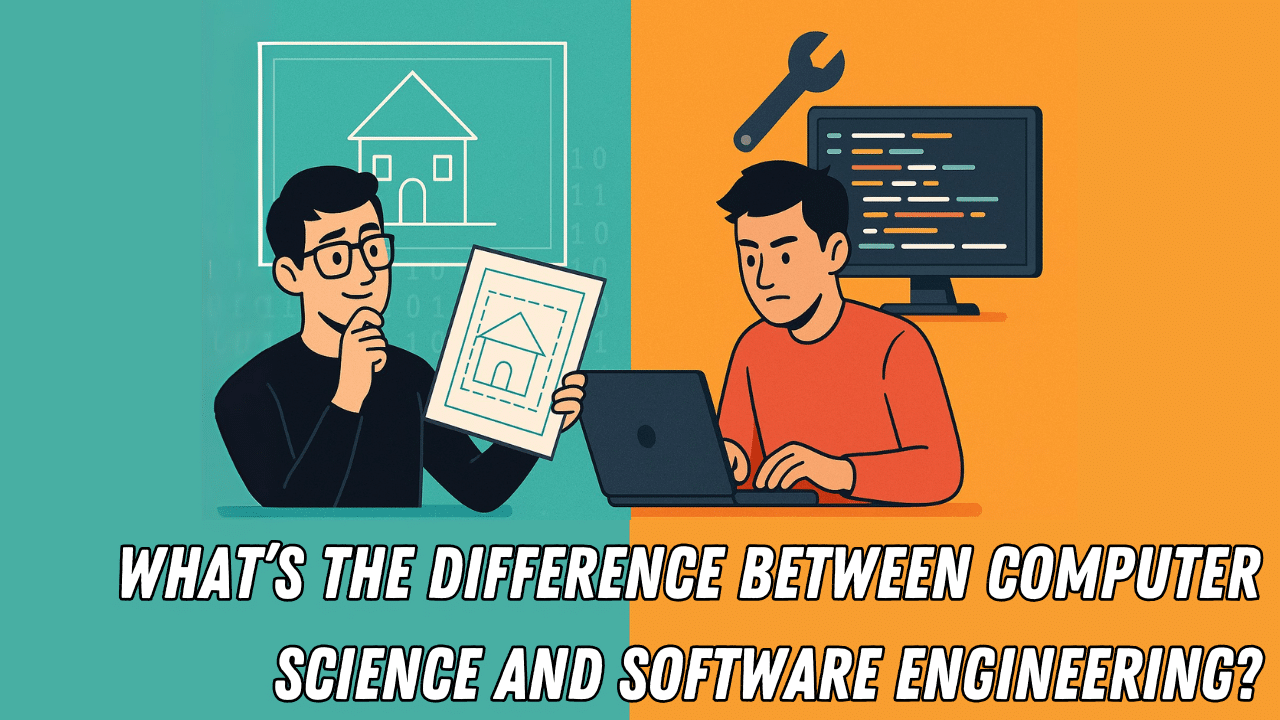
Computer Science: Designing the Blueprint

Imagine you’re building a house. Computer Science is like being the architect. You’ll be designing the overall structure, figuring out how things should work on paper, and making theoretical blueprints. Computer scientists dive deep into algorithms, data structures, and the core principles behind how computers work. They think about optimisation, theory, and logic.

A computer science major might spend years perfecting an algorithm that makes sorting a million numbers 0.0001 seconds faster. They focus on the mathematical and theoretical aspects of computing, designing elegant, optimal solutions to complex problems.

Software Engineering: Turning Theory Into Reality

On the flip side, Software Engineering is more hands-on. If computer science is the architect, software engineering is the construction worker. Software engineers take those carefully crafted blueprints—whether from computer scientists or other designers—and bring them to life. They write the code, debug issues, and ensure the system works smoothly for users.

While CS might focus on the ‘why’ of how things work, software engineers focus on the ‘how’. They are tasked with building functional, reliable software, often facing real-world challenges like fixing bugs and meeting deadlines. Think of them as the ones making sure the system doesn’t fall apart when the user clicks the wrong button.

The Role of Computer Engineering

There’s also Computer Engineering (CE), a field that blends aspects of both computer science and electrical engineering. If CS is the architect and SE is the builder, CE is the person actually manufacturing the physical components that power the systems. They design and build the hardware that runs the software.

So, Which One Should You Choose?

When choosing between Computer Science and Software Engineering, it all comes down to your interests and goals. Do you prefer designing theoretical systems and algorithms (CS), or are you more interested in bringing these ideas to life and solving practical issues in real-world applications (SE)?

Both paths are rewarding and essential to the tech ecosystem, but understanding the difference will help you decide which role best suits your skills and passions.

Want to learn more about the fascinating world of computer science and software engineering? Watch the full video to get more insights into these fields.

For more Lesson Hacker Videos, check out the CraignDave YouTube playlist HERE.

Visit our website to explore more cutting-edge tech-transforming news in the computer science world!
 

Related posts

The biggest curriculum shake-up in a decade – Part 3

Discover what the new Progress 8 and Attainment 8 changes really mean for curriculum planning — and why computing still sits in a tricky spot.
In part three of our CAR breakdown, we unpack the shifts, the challenges, and what they might mean for your department.

28 November 2025

Meet the Team Behind Craig’n’Dave

At Craig’n’Dave, we believe that every mission needs its explorers, problem-solvers, and visionaries. Behind the scenes, our team is working […]

26 November 2025

The biggest curriculum shake-up in a decade – PART 2

From shrinking teaching time to a brand-new GCSE, the latest curriculum review sets the stage for the biggest shake-up in computing education in a decade.

21 November 2025

The biggest curriculum shake-up in a decade

The biggest curriculum shake-up in a decade is here — and computing is right at the centre of it. From a brand-new GCSE to talk of AI qualifications, Craig and Dave break down what it all means for teachers and students.

14 November 2025

Smart Revise Wins Teach Secondary Award for Curriculum Improvement 2025

We are thrilled to announce that Smart Revise has been recognised with the Teach Secondary Award for Curriculum Improvement 2025! […]

10 November 2025

Student kicking a ball into a goal

Introducing Goals: smarter revision, clearer direction

The new Goals feature brings a powerful upgrade to Smart Revise, helping students not only understand their progress but also […]

8 November 2025

High expectations from the first minute

In Computing, every minute counts. Setting high expectations isn’t about demanding work or creating unnecessary pressure—it’s about clarity. It means […]

7 November 2025

High expectations and homework: A culture worth building 

High expectations are often spoken about in education but rarely unpacked in a way that feels practical and actionable. We […]

1 November 2025

What is a code pointer?

Demystifying stars, ampersands and memory mishaps. Pointers in programming can be baffling — all those stars and ampersands, but what do they actually mean?
We break down code pointers using sandwiches, and sticky notes, to make sense of it all.

28 October 2025

Back

What is AI?

AI: Just fast maths pretending to be smart

12 August 2025

AI. It’s a term that gets thrown around everywhere—from science fiction films to social media posts and school corridors. But what actually is artificial intelligence, and why is it so important to understand?

At its core, AI doesn’t actually think—it just predicts. It’s essentially super-fast maths, rapidly analysing patterns to guess what should come next in a sequence. Imagine that friend who always finishes your sentences… except AI does it with slightly better accuracy.

How do transformers power AI?

No, we’re not talking about giant robots (although that would be cool). In AI, transformers are a type of deep learning model that helps machines generate human-like text. Here’s how they do it:

  • Word magic: AI doesn’t see words—it sees numbers. It converts text into numerical values that represent meaning. Kind of like the Matrix, but without the leather trench coats.
  • Attention, please! Transformers scan every word in a sentence and decide which ones are important. It’s a bit like pretending to listen in a meeting but only perking up when you hear “free snacks.”
  • Prediction time: AI makes an educated guess about the next word, refines it, and repeats the process until the sentence sounds human. The result? AI-generated essays, jokes, and sometimes suspiciously accurate emails.

How does AI learn??

Behind the scenes, AI is powered by huge datasets and clever algorithms. These systems “learn” patterns from data, meaning they can improve their performance over time without being explicitly programmed to do so. This process is called machine learning, and it’s how many of today’s most exciting AI tools work.

AI and you

AI is already influencing your daily life, whether you realise it or not. It shapes the content you see online, helps doctors spot diseases faster, supports businesses with automation, and could even play a role in your future career. Understanding how it works is more than just useful—it’s essential.

Why AI isn’t taking over (yet)

Despite its clever tricks, AI isn’t sentient—it’s just playing a game of supercharged fill-in-the-blank. While it’s brilliant for generating text and answering questions, it still lacks genuine understanding or creativity. So, would you trust it to run the world? probably not. But to help you write a convincing email? absolutely.

Want to learn more?

Want to know more? Check out The Lesson Hacker’s YouTube video HERE.

For more Lesson Hacker Videos check out the CraignDave YouTube playlist HERE.

Visit our website to explore more cutting-edge tech-transforming news in the computer science world!
 

Related posts

The biggest curriculum shake-up in a decade – Part 3

Discover what the new Progress 8 and Attainment 8 changes really mean for curriculum planning — and why computing still sits in a tricky spot.
In part three of our CAR breakdown, we unpack the shifts, the challenges, and what they might mean for your department.

28 November 2025

Meet the Team Behind Craig’n’Dave

At Craig’n’Dave, we believe that every mission needs its explorers, problem-solvers, and visionaries. Behind the scenes, our team is working […]

26 November 2025

The biggest curriculum shake-up in a decade – PART 2

From shrinking teaching time to a brand-new GCSE, the latest curriculum review sets the stage for the biggest shake-up in computing education in a decade.

21 November 2025

The biggest curriculum shake-up in a decade

The biggest curriculum shake-up in a decade is here — and computing is right at the centre of it. From a brand-new GCSE to talk of AI qualifications, Craig and Dave break down what it all means for teachers and students.

14 November 2025

Smart Revise Wins Teach Secondary Award for Curriculum Improvement 2025

We are thrilled to announce that Smart Revise has been recognised with the Teach Secondary Award for Curriculum Improvement 2025! […]

10 November 2025

Student kicking a ball into a goal

Introducing Goals: smarter revision, clearer direction

The new Goals feature brings a powerful upgrade to Smart Revise, helping students not only understand their progress but also […]

8 November 2025

High expectations from the first minute

In Computing, every minute counts. Setting high expectations isn’t about demanding work or creating unnecessary pressure—it’s about clarity. It means […]

7 November 2025

High expectations and homework: A culture worth building 

High expectations are often spoken about in education but rarely unpacked in a way that feels practical and actionable. We […]

1 November 2025

What is a code pointer?

Demystifying stars, ampersands and memory mishaps. Pointers in programming can be baffling — all those stars and ampersands, but what do they actually mean?
We break down code pointers using sandwiches, and sticky notes, to make sense of it all.

28 October 2025

Back

How do computers generate random numbers?

29 July 2025

Ah, randomness! It’s everywhere in nature—think dice rolls, quantum physics, or even your cat’s indecision. But when it comes to computers, randomness doesn’t come naturally. Why? Because computers are logical machines, designed to follow precise instructions. So, when we ask for a “random” number, they can’t just pluck one from thin air. Instead, they rely on something called a pseudo-random number generator (PRNG)—essentially, randomness with a script.

How does a pseudo-random number generator work?

Here’s how computers fake randomness step by step:

  1. The magic seed
    The process begins with a “seed” number. This seed could be almost anything—like the exact millisecond from the system clock, the temperature of your CPU, or even the quirky motion of a lava lamp (a trick famously used by Cloudflare for added unpredictability).
  2. Math happens
    Once the seed is set, it’s run through a complex mathematical formula designed to churn out seemingly random results. Picture a blender spinning at full speed, tossing numbers into a chaotic whirl.
  3. Voilà! fake randomness
    Out comes a number that looks completely random. However, if someone knows the original seed and the formula, they can predict the outcome—like a magician pulling the same rabbit from their hat every time.

Can computers create true randomness?

When it comes to security, like encrypting sensitive data, fake randomness isn’t enough. For truly unpredictable results, computers turn to nature for help. They measure chaotic phenomena like radioactive decay, electrical noise, or even the small, unpredictable quirks of daily life. This kind of randomness, called “true randomness,” is far more secure and impossible to predict.

So, while computers don’t naturally do random, they’ve mastered the art of faking it with clever algorithms. But when we need something truly unpredictable, we can rely on the chaos of the natural world. Or, as a simpler alternative, just watch a cat trying to decide whether to go outside.

Want to learn more?

Want to know more, check out The Lesson Hacker’s YouTube video HERE.

For more Lesson Hacker Videos check out the CraignDave YouTube playlist HERE.

Visit our website to explore more cutting-edge tech-transforming news in the computer science world!
Related posts

The biggest curriculum shake-up in a decade – Part 3

Discover what the new Progress 8 and Attainment 8 changes really mean for curriculum planning — and why computing still sits in a tricky spot.
In part three of our CAR breakdown, we unpack the shifts, the challenges, and what they might mean for your department.

28 November 2025

Meet the Team Behind Craig’n’Dave

At Craig’n’Dave, we believe that every mission needs its explorers, problem-solvers, and visionaries. Behind the scenes, our team is working […]

26 November 2025

The biggest curriculum shake-up in a decade – PART 2

From shrinking teaching time to a brand-new GCSE, the latest curriculum review sets the stage for the biggest shake-up in computing education in a decade.

21 November 2025

The biggest curriculum shake-up in a decade

The biggest curriculum shake-up in a decade is here — and computing is right at the centre of it. From a brand-new GCSE to talk of AI qualifications, Craig and Dave break down what it all means for teachers and students.

14 November 2025

Smart Revise Wins Teach Secondary Award for Curriculum Improvement 2025

We are thrilled to announce that Smart Revise has been recognised with the Teach Secondary Award for Curriculum Improvement 2025! […]

10 November 2025

Student kicking a ball into a goal

Introducing Goals: smarter revision, clearer direction

The new Goals feature brings a powerful upgrade to Smart Revise, helping students not only understand their progress but also […]

8 November 2025

High expectations from the first minute

In Computing, every minute counts. Setting high expectations isn’t about demanding work or creating unnecessary pressure—it’s about clarity. It means […]

7 November 2025

High expectations and homework: A culture worth building 

High expectations are often spoken about in education but rarely unpacked in a way that feels practical and actionable. We […]

1 November 2025

What is a code pointer?

Demystifying stars, ampersands and memory mishaps. Pointers in programming can be baffling — all those stars and ampersands, but what do they actually mean?
We break down code pointers using sandwiches, and sticky notes, to make sense of it all.

28 October 2025

Back

Can We Tell the Difference Between High Frame Rates?

22 July 2025

Ever heard gamers argue about frame rates? One insists 60 FPS is perfectly fine, another declares anything below 240 FPS is unplayable, and then there’s that one person who swears they can see the difference between 999 and 1000 FPS—probably while wearing a pair of ancient glasses. But what’s the truth behind these claims?

How the human eye processes motion

Let’s clear something up first: the human eye doesn’t see in frames per second. It’s not a digital monitor but a complex biological system. Our eyes take in continuous information, and our brains process motion at speeds that matter—but only to a point.

At frame rates below 30 FPS, motion starts to look disjointed, like an old puppet show. Jump to 60 FPS, and things feel smoother, though many gamers will still find room to complain. Push it up to 120 FPS, and you’ll notice things feel even “snappier”—but now we’re entering a realm where perception begins to blur with personal preference.

The limits of perception

What about 240 FPS? At this stage, individual frames become almost imperceptible, but some people—especially competitive gamers—may notice the increased smoothness in fast-paced scenarios. Beyond that? Unless you’re a fighter pilot, a mantis shrimp, or bluffing, the benefits become negligible.

It’s not just about frame rate

Frame rate is only one piece of the puzzle. Motion blur, screen technology, and input lag also influence how smooth gameplay feels. So, if you’re investing heavily in a high-performance monitor, remember this: at some point, you’re not just paying for a better gaming experience—you’re paying for bragging rights.

Does it really matter?

While high frame rates can enhance gaming for certain scenarios, they’re not always necessary for a great experience. Understanding the science of perception can help you decide when to upgrade—and when to save your money.

Want to dive deeper into the science of frame rates?

Check out Dave The Lesson Hacker’s YouTube video HERE.

For more Lesson Hacker videos check out the CraignDave YouTube playlist HERE.

Visit our website to explore more cutting-edge tech-transforming news in the computer science world!
 

Related posts

The biggest curriculum shake-up in a decade – Part 3

Discover what the new Progress 8 and Attainment 8 changes really mean for curriculum planning — and why computing still sits in a tricky spot.
In part three of our CAR breakdown, we unpack the shifts, the challenges, and what they might mean for your department.

28 November 2025

Meet the Team Behind Craig’n’Dave

At Craig’n’Dave, we believe that every mission needs its explorers, problem-solvers, and visionaries. Behind the scenes, our team is working […]

26 November 2025

The biggest curriculum shake-up in a decade – PART 2

From shrinking teaching time to a brand-new GCSE, the latest curriculum review sets the stage for the biggest shake-up in computing education in a decade.

21 November 2025

The biggest curriculum shake-up in a decade

The biggest curriculum shake-up in a decade is here — and computing is right at the centre of it. From a brand-new GCSE to talk of AI qualifications, Craig and Dave break down what it all means for teachers and students.

14 November 2025

Smart Revise Wins Teach Secondary Award for Curriculum Improvement 2025

We are thrilled to announce that Smart Revise has been recognised with the Teach Secondary Award for Curriculum Improvement 2025! […]

10 November 2025

Student kicking a ball into a goal

Introducing Goals: smarter revision, clearer direction

The new Goals feature brings a powerful upgrade to Smart Revise, helping students not only understand their progress but also […]

8 November 2025

High expectations from the first minute

In Computing, every minute counts. Setting high expectations isn’t about demanding work or creating unnecessary pressure—it’s about clarity. It means […]

7 November 2025

High expectations and homework: A culture worth building 

High expectations are often spoken about in education but rarely unpacked in a way that feels practical and actionable. We […]

1 November 2025

What is a code pointer?

Demystifying stars, ampersands and memory mishaps. Pointers in programming can be baffling — all those stars and ampersands, but what do they actually mean?
We break down code pointers using sandwiches, and sticky notes, to make sense of it all.

28 October 2025

Back

Why do arrays start at zero?

15 July 2025

If you’ve ever dived into programming, you’ve probably asked yourself: why on earth do arrays start at zero instead of one? At first glance, it seems counterintuitive, but the answer lies in efficiency and logic.

Visualising arrays: the row of lockers analogy

Think of an array as a row of lockers. Each locker has a position, starting at the very beginning of the row. The first locker is zero steps from the start, the second locker is one step away, and so on. If you want to access the third locker, you count two steps from the beginning: 0, 1, 2. This is the essence of zero-based indexing—it measures the offset from the starting point.

The link between arrays and memory

Arrays in programming map directly to how memory works in a computer. When an array is created, it’s stored as a block of memory. Accessing an element at array[i] involves the computer locating the base address of the array in memory and adding i to it. Starting at zero simplifies this calculation, making it faster and more efficient. In essence, zero-based indexing aligns perfectly with how hardware is designed to operate.

Why not start at one?

While starting at one might feel more intuitive, it’s not practical. Zero-based indexing is baked into the very foundation of programming languages, compilers, and hardware logic. Switching to one-based indexing would introduce unnecessary complexity and inefficiency. That’s why programmers worldwide have embraced zero-based indexing as the universal standard.

It’s not weird—it’s smart!

So, the next time you see array[0], remember it’s not just a quirk of programming. It’s a smart, efficient design choice that keeps your code running smoothly.

Want to learn more?

Want to know more? Check out The Lesson Hacker’s YouTube video HERE.

For more Lesson Hacker Videos, check out the CraignDave YouTube playlist HERE.

Visit our website to explore more cutting-edge tech-transforming news in the computer science world!

Related posts

The biggest curriculum shake-up in a decade – Part 3

Discover what the new Progress 8 and Attainment 8 changes really mean for curriculum planning — and why computing still sits in a tricky spot.
In part three of our CAR breakdown, we unpack the shifts, the challenges, and what they might mean for your department.

28 November 2025

Meet the Team Behind Craig’n’Dave

At Craig’n’Dave, we believe that every mission needs its explorers, problem-solvers, and visionaries. Behind the scenes, our team is working […]

26 November 2025

The biggest curriculum shake-up in a decade – PART 2

From shrinking teaching time to a brand-new GCSE, the latest curriculum review sets the stage for the biggest shake-up in computing education in a decade.

21 November 2025

The biggest curriculum shake-up in a decade

The biggest curriculum shake-up in a decade is here — and computing is right at the centre of it. From a brand-new GCSE to talk of AI qualifications, Craig and Dave break down what it all means for teachers and students.

14 November 2025

Smart Revise Wins Teach Secondary Award for Curriculum Improvement 2025

We are thrilled to announce that Smart Revise has been recognised with the Teach Secondary Award for Curriculum Improvement 2025! […]

10 November 2025

Student kicking a ball into a goal

Introducing Goals: smarter revision, clearer direction

The new Goals feature brings a powerful upgrade to Smart Revise, helping students not only understand their progress but also […]

8 November 2025

High expectations from the first minute

In Computing, every minute counts. Setting high expectations isn’t about demanding work or creating unnecessary pressure—it’s about clarity. It means […]

7 November 2025

High expectations and homework: A culture worth building 

High expectations are often spoken about in education but rarely unpacked in a way that feels practical and actionable. We […]

1 November 2025

What is a code pointer?

Demystifying stars, ampersands and memory mishaps. Pointers in programming can be baffling — all those stars and ampersands, but what do they actually mean?
We break down code pointers using sandwiches, and sticky notes, to make sense of it all.

28 October 2025

Back

Why DPI matters: The difference between screen & print quality

8 July 2025

Understanding DPI: What does it actually mean?

DPI (dots per inch) is exactly what it sounds like—it’s a measure of how many tiny dots (or pixels) fit into one inch of space. The more dots you have, the more detail your image retains.

For digital screens, 72 DPI is the standard because it keeps file sizes small and looks crisp at a normal viewing distance. But when it comes to printing, things change dramatically.

Think of it like wearing pyjamas. At home, wearing 72 DPI is fine—relaxed, comfortable, and good enough for what you need. But taking that same look to a first date? Suddenly, the details matter a lot more.

Why does print need 300 dpi (or more)

When you print something, you’re holding it much closer to your eyes than a screen. Your brain expects more detail because it’s used to seeing sharp, high-resolution objects up close. If your image is only 72 DPI, it won’t have enough detail to look crisp—it will appear soft, pixelated, and blurry, like a sun-faded potato chip.

That’s why 300 DPI is the magic number for print. At this resolution, images retain their sharpness even when viewed up close. The higher dot density makes lines and textures look clean, rather than jagged or smudged.

Imagine a giant poster—when viewed from 10 feet away, a few blurry dots don’t matter. But now think about a business card. You hold it right up to your face, and if it’s not printed at high resolution, it’ll look like it was drawn in MS Paint by a four-year-old with a potato.

The simple rule: screen vs print

If you only remember one thing, make it this:

  • 72 DPI is fine for screens. It’s optimised for digital displays, loads quickly, and keeps file sizes manageable.
  • 300 DPI (or higher) is essential for print. It preserves fine details, ensuring your artwork looks as sharp on paper as it does on screen.

What happens if you use the wrong DPI?

  • If you use 72 DPI for print, your artwork will look blurry and pixelated.
  • If you use 300 DPI for digital, your file sizes will be unnecessarily large, and it won’t look any better than a 72 DPI image.

So, always think about where your image will be seen before choosing the right DPI. If it’s just for a website or social media, 72 DPI is fine. But if it’s going to a printer, crank it up to 300 DPI to avoid a pixelated disaster.

Want to learn more about getting the best quality out of your designs? 

Check out Dave The Lesson Hacker’s YouTube video HERE

For more Lesson Hacker videos, check out the CraignDave YouTube playlist HERE.

Visit our website to explore more cutting-edge tech-transforming news in the computer science world!

Related posts

The biggest curriculum shake-up in a decade – Part 3

Discover what the new Progress 8 and Attainment 8 changes really mean for curriculum planning — and why computing still sits in a tricky spot.
In part three of our CAR breakdown, we unpack the shifts, the challenges, and what they might mean for your department.

28 November 2025

Meet the Team Behind Craig’n’Dave

At Craig’n’Dave, we believe that every mission needs its explorers, problem-solvers, and visionaries. Behind the scenes, our team is working […]

26 November 2025

The biggest curriculum shake-up in a decade – PART 2

From shrinking teaching time to a brand-new GCSE, the latest curriculum review sets the stage for the biggest shake-up in computing education in a decade.

21 November 2025

The biggest curriculum shake-up in a decade

The biggest curriculum shake-up in a decade is here — and computing is right at the centre of it. From a brand-new GCSE to talk of AI qualifications, Craig and Dave break down what it all means for teachers and students.

14 November 2025

Smart Revise Wins Teach Secondary Award for Curriculum Improvement 2025

We are thrilled to announce that Smart Revise has been recognised with the Teach Secondary Award for Curriculum Improvement 2025! […]

10 November 2025

Student kicking a ball into a goal

Introducing Goals: smarter revision, clearer direction

The new Goals feature brings a powerful upgrade to Smart Revise, helping students not only understand their progress but also […]

8 November 2025

High expectations from the first minute

In Computing, every minute counts. Setting high expectations isn’t about demanding work or creating unnecessary pressure—it’s about clarity. It means […]

7 November 2025

High expectations and homework: A culture worth building 

High expectations are often spoken about in education but rarely unpacked in a way that feels practical and actionable. We […]

1 November 2025

What is a code pointer?

Demystifying stars, ampersands and memory mishaps. Pointers in programming can be baffling — all those stars and ampersands, but what do they actually mean?
We break down code pointers using sandwiches, and sticky notes, to make sense of it all.

28 October 2025

Back

Why do GPUs get so hot?

10 June 2025

GPUs are the powerhouses of modern computing, handling everything from gaming to video editing and complex 3D rendering. But with great power comes great heat. Ever wondered why your graphics card runs so hot? Let’s break it down.

The science behind GPU heat

Think of your GPU like a busy chef in a restaurant, constantly preparing thousands of meals at once. Each dish represents a calculation, and just like in a real kitchen, all that activity generates heat.

At the heart of it all is electricity. Every time your GPU processes data, tiny electrical signals rush through billions of transistors. But electricity is never 100% efficient—some of that energy gets lost as heat. With so many calculations happening at lightning speed, things heat up quickly.

Why GPUs run hotter than other components

Unlike your CPU, which gets short breaks between tasks, GPUs are designed for continuous heavy lifting. Whether you’re gaming, rendering 3D models, or watching high-definition videos, your GPU is working flat out, pushing itself to the limit.

To make things even trickier, modern GPUs are built with incredible density, packing more transistors into smaller spaces than ever before. It’s like squeezing too many commuters onto a packed Monday morning train; there’s no room to breathe, and the heat has nowhere to escape.

How GPUs keep their cool

This is where cooling solutions come in. Your computer’s fans work hard to move hot air away from the GPU, while heatsinks help absorb and disperse excess warmth. High-performance gaming setups even use liquid cooling to keep temperatures under control.

If your GPU ever gets too hot, it can throttle its performance to prevent damage, but ideally, you want to avoid this from happening. Keeping your PC well-ventilated and dust-free can go a long way in helping your GPU stay cool and efficient.


Next time you hear your computer fans whirring into action, just remember: your GPU is working hard to deliver stunning graphics and smooth performance. Looking after it will keep your system running at its best.

Want to dive deeper into how GPUs work? Watch the full video here

Want to learn more about computer science and the latest tech trends? Visit our website Craig’n’Dave for all the latest resources and insights.


Related posts

The biggest curriculum shake-up in a decade – Part 3

Discover what the new Progress 8 and Attainment 8 changes really mean for curriculum planning — and why computing still sits in a tricky spot.
In part three of our CAR breakdown, we unpack the shifts, the challenges, and what they might mean for your department.

28 November 2025

Meet the Team Behind Craig’n’Dave

At Craig’n’Dave, we believe that every mission needs its explorers, problem-solvers, and visionaries. Behind the scenes, our team is working […]

26 November 2025

The biggest curriculum shake-up in a decade – PART 2

From shrinking teaching time to a brand-new GCSE, the latest curriculum review sets the stage for the biggest shake-up in computing education in a decade.

21 November 2025

The biggest curriculum shake-up in a decade

The biggest curriculum shake-up in a decade is here — and computing is right at the centre of it. From a brand-new GCSE to talk of AI qualifications, Craig and Dave break down what it all means for teachers and students.

14 November 2025

Smart Revise Wins Teach Secondary Award for Curriculum Improvement 2025

We are thrilled to announce that Smart Revise has been recognised with the Teach Secondary Award for Curriculum Improvement 2025! […]

10 November 2025

Student kicking a ball into a goal

Introducing Goals: smarter revision, clearer direction

The new Goals feature brings a powerful upgrade to Smart Revise, helping students not only understand their progress but also […]

8 November 2025

High expectations from the first minute

In Computing, every minute counts. Setting high expectations isn’t about demanding work or creating unnecessary pressure—it’s about clarity. It means […]

7 November 2025

High expectations and homework: A culture worth building 

High expectations are often spoken about in education but rarely unpacked in a way that feels practical and actionable. We […]

1 November 2025

What is a code pointer?

Demystifying stars, ampersands and memory mishaps. Pointers in programming can be baffling — all those stars and ampersands, but what do they actually mean?
We break down code pointers using sandwiches, and sticky notes, to make sense of it all.

28 October 2025

Back

What is the Dark Web?

Understanding the Dark Web: What You Need to Know

3 June 2025

What is the Dark Web? A Look Into Its Mysteries

When you hear about the Dark Web, it’s easy to imagine a place full of criminals, illegal activities, and shady dealings. But is that the whole picture? Let’s take a closer look at what the Dark Web really is, how it works, and why some people use it.

What Exactly is the Dark Web?

To understand the Dark Web, imagine the internet as a massive city. The regular web—the part of the internet where you shop, search for information, and watch videos—is like the lively downtown area. Everyone knows you’re there, from your internet provider to the websites you visit. Now, picture the Dark Web as the quieter, hidden alleyways. It’s a part of the internet where your online activities are harder to track, and you need special tools to access it—like the TOR browser (The Onion Router). When you use TOR, you’re essentially putting on an invisibility cloak, hiding your digital footprint from prying eyes.

Is the Dark Web Dangerous?

It’s not as sinister as it may sound at first. Simply visiting the Dark Web isn’t illegal or dangerous, as it’s just another layer of the internet. However, much like any other part of the internet, there are areas of the Dark Web where illegal activities occur—such as the buying and selling of illicit items. But, that’s not all. The Dark Web is also used for good. It provides a safe space for people like journalists, government agents and whistleblowers, who need to communicate securely without the risk of surveillance or hackers.

While it’s often associated with criminal activity, not everyone who visits the Dark Web is up to no good. It’s a tool for anonymity and security in an otherwise open internet, and its uses extend far beyond shady dealings.

Stay Safe and Informed

So, is the Dark Web a dangerous place? Not if you’re careful. It’s a bit like wandering into an unfamiliar neighbourhood—there are good parts and bad parts. As long as you steer clear of the illegal corners, the Dark Web can serve as a valuable tool for privacy and secure communication.

For a deeper dive into the world of the Dark Web, check out our video here

Want to learn more about computer science and the latest tech trends? Visit our website Craig’n’Dave for all the latest resources and insights.

Related posts

The biggest curriculum shake-up in a decade – Part 3

Discover what the new Progress 8 and Attainment 8 changes really mean for curriculum planning — and why computing still sits in a tricky spot.
In part three of our CAR breakdown, we unpack the shifts, the challenges, and what they might mean for your department.

28 November 2025

Meet the Team Behind Craig’n’Dave

At Craig’n’Dave, we believe that every mission needs its explorers, problem-solvers, and visionaries. Behind the scenes, our team is working […]

26 November 2025

The biggest curriculum shake-up in a decade – PART 2

From shrinking teaching time to a brand-new GCSE, the latest curriculum review sets the stage for the biggest shake-up in computing education in a decade.

21 November 2025

The biggest curriculum shake-up in a decade

The biggest curriculum shake-up in a decade is here — and computing is right at the centre of it. From a brand-new GCSE to talk of AI qualifications, Craig and Dave break down what it all means for teachers and students.

14 November 2025

Smart Revise Wins Teach Secondary Award for Curriculum Improvement 2025

We are thrilled to announce that Smart Revise has been recognised with the Teach Secondary Award for Curriculum Improvement 2025! […]

10 November 2025

Student kicking a ball into a goal

Introducing Goals: smarter revision, clearer direction

The new Goals feature brings a powerful upgrade to Smart Revise, helping students not only understand their progress but also […]

8 November 2025

High expectations from the first minute

In Computing, every minute counts. Setting high expectations isn’t about demanding work or creating unnecessary pressure—it’s about clarity. It means […]

7 November 2025

High expectations and homework: A culture worth building 

High expectations are often spoken about in education but rarely unpacked in a way that feels practical and actionable. We […]

1 November 2025

What is a code pointer?

Demystifying stars, ampersands and memory mishaps. Pointers in programming can be baffling — all those stars and ampersands, but what do they actually mean?
We break down code pointers using sandwiches, and sticky notes, to make sense of it all.

28 October 2025

Back

Why you should attend the Festival of Computing 2025

The UK’s biggest CPD event for computing teachers just got even better

29 May 2025

If you’re a computing teacher passionate about your subject and always looking to improve your classroom impact, the Festival of Computing 2025, sponsored by Craig’n’Dave and OCR, at Bromsgrove School on 2nd July, is unmissable.

Evolved from the successful Craig’n’Dave & Friends conference, this event is your one-stop shop for fresh ideas, practical CPD, brilliant networking and real-world insight from leading voices in computing education — all wrapped up in one inspirational day.


A power-packed agenda awaits

The day kicks off with breakfast and early networking before the official welcome in the spectacular Routh Concert Hall. 

The keynotes are where it gets really exciting:

  • Jill Duffy, Chief Executive of OCR, takes the stage in the afternoon with a keynote focused on the future of computing qualifications and curriculum development — a must-hear for every teacher navigating changes in assessment and pedagogy.
  • Alan O’Donohoe returns with “Relight My Fire” — an inspiring and energising talk about the power of computing education.
  • Craig and Dave share the latest from their world and what’s next for classroom computing.

Get hands-on demos during the Fringe event, and don’t miss CPD sessions from a wide range of guest speakers, updates from Raspberry Pi Foundation, CAS, Pearson, West Midlands Regional Cyber Crime Unit and AQA, to name a few.

To see the full list of who’s speaking and what their talks will focus on HERE.


So, what makes this year different?

We’ve taken your feedback and upgraded everything:

  • More CPD sessions – You asked, we listened. Now enjoy three 45-minute sessions, packed with classroom-ready ideas.
  • Bigger marketplace – A dedicated marquee space for you to browse the latest in computing education tools and resources.
  • More coffee stations – Because teachers run on caffeine!
  • A new Fringe stage – Hear punchy, engaging ideas from exhibitors and guest speakers in short bursts.
  • On-site accommodation – Stay the night before with limited rooms available.
  • Pre-event socialCurry Supper & Social on 1st July, If you live locally or are staying overnight at Bromsgrove School or a nearby hotel, join us for a curry and a drink! The pre-event social is a ticketed event. Get your spot at the table here


Why it matters

This isn’t just another CPD day. It’s a genuine celebration of computing education — and a chance to feel part of a bigger, supportive, and forward-thinking community. 

Held at the historic Bromsgrove School, with its stunning grounds and modern facilities, the Festival of Computing 2025 offers the perfect mix of substance, setting, and shared passion.

We hope to see you there!


🎟️ Ready to book your ticket?
Secure your place now (fully refundable if you attend or cancel in good time)

🌐 Want to see more from Craig’n’Dave?
Visit craigndave.org for free teaching resources, classroom videos and community updates.

Related posts

The biggest curriculum shake-up in a decade – Part 3

Discover what the new Progress 8 and Attainment 8 changes really mean for curriculum planning — and why computing still sits in a tricky spot.
In part three of our CAR breakdown, we unpack the shifts, the challenges, and what they might mean for your department.

28 November 2025

Meet the Team Behind Craig’n’Dave

At Craig’n’Dave, we believe that every mission needs its explorers, problem-solvers, and visionaries. Behind the scenes, our team is working […]

26 November 2025

The biggest curriculum shake-up in a decade – PART 2

From shrinking teaching time to a brand-new GCSE, the latest curriculum review sets the stage for the biggest shake-up in computing education in a decade.

21 November 2025

The biggest curriculum shake-up in a decade

The biggest curriculum shake-up in a decade is here — and computing is right at the centre of it. From a brand-new GCSE to talk of AI qualifications, Craig and Dave break down what it all means for teachers and students.

14 November 2025

Smart Revise Wins Teach Secondary Award for Curriculum Improvement 2025

We are thrilled to announce that Smart Revise has been recognised with the Teach Secondary Award for Curriculum Improvement 2025! […]

10 November 2025

Student kicking a ball into a goal

Introducing Goals: smarter revision, clearer direction

The new Goals feature brings a powerful upgrade to Smart Revise, helping students not only understand their progress but also […]

8 November 2025

High expectations from the first minute

In Computing, every minute counts. Setting high expectations isn’t about demanding work or creating unnecessary pressure—it’s about clarity. It means […]

7 November 2025

High expectations and homework: A culture worth building 

High expectations are often spoken about in education but rarely unpacked in a way that feels practical and actionable. We […]

1 November 2025

What is a code pointer?

Demystifying stars, ampersands and memory mishaps. Pointers in programming can be baffling — all those stars and ampersands, but what do they actually mean?
We break down code pointers using sandwiches, and sticky notes, to make sense of it all.

28 October 2025

Back

How much does it cost to build a CPU?

27 May 2025

Building a CPU isn’t just complicated; it’s an engineering marvel that demands staggering resources. 

Imagine creating the most intricate pancake in the world, where every ingredient is microscopic, precision matters, and the price tag is astronomical. 

Let’s break it down to understand what goes into making these high-tech powerhouses. 

Silicon wafers: the foundation of a CPU. 

At the heart of every CPU is a silicon wafer. While the raw materials themselves are relatively cheap, turning them into a usable wafer is an entirely different story. The process involves cutting-edge technology and precision, with costs starting at £8,000 or more per wafer. And that’s just the beginning. The factories where CPUs are made, known as fabs, are extraordinary facilities. 

Building a state-of-the-art fab capable of producing today’s 3nm or smaller transistors can set you back over £16 billion. Why so much? Because these fabs operate on an atomic scale, even the tiniest mistake can render entire batches unusable. 

The level of cleanliness, precision, and technological advancement required is unmatched. 

Research and development: the hidden cost. 

Designing a CPU isn’t a quick or cheap process. Teams of engineers spend years creating, testing, and refining each design. Simulations, prototypes, and endless troubleshooting are part of the journey, with research and development costs reaching millions of pounds for a single chip. 

It’s an investment of time, money, and expertise to push the boundaries of what’s possible. 

Why CPUs are worth every penny. 

When you consider the monumental effort and expense behind each CPU, it’s easier to understand their price. 

Every chip is a piece of technology more complex than most buildings, packed into a form factor small enough to fit in your hand. CPUs power everything from our laptops to supercomputers, making them one of the most essential inventions of our time. 

Curious to learn more about the fascinating world of CPUs? 

Watch the full video on our YouTube channel for an in-depth explanation. 

For more insights into computer science and to explore our resources, visit the Craig’n’Dave website today.

Related posts

The biggest curriculum shake-up in a decade – Part 3

Discover what the new Progress 8 and Attainment 8 changes really mean for curriculum planning — and why computing still sits in a tricky spot.
In part three of our CAR breakdown, we unpack the shifts, the challenges, and what they might mean for your department.

28 November 2025

Meet the Team Behind Craig’n’Dave

At Craig’n’Dave, we believe that every mission needs its explorers, problem-solvers, and visionaries. Behind the scenes, our team is working […]

26 November 2025

The biggest curriculum shake-up in a decade – PART 2

From shrinking teaching time to a brand-new GCSE, the latest curriculum review sets the stage for the biggest shake-up in computing education in a decade.

21 November 2025

The biggest curriculum shake-up in a decade

The biggest curriculum shake-up in a decade is here — and computing is right at the centre of it. From a brand-new GCSE to talk of AI qualifications, Craig and Dave break down what it all means for teachers and students.

14 November 2025

Smart Revise Wins Teach Secondary Award for Curriculum Improvement 2025

We are thrilled to announce that Smart Revise has been recognised with the Teach Secondary Award for Curriculum Improvement 2025! […]

10 November 2025

Student kicking a ball into a goal

Introducing Goals: smarter revision, clearer direction

The new Goals feature brings a powerful upgrade to Smart Revise, helping students not only understand their progress but also […]

8 November 2025

High expectations from the first minute

In Computing, every minute counts. Setting high expectations isn’t about demanding work or creating unnecessary pressure—it’s about clarity. It means […]

7 November 2025

High expectations and homework: A culture worth building 

High expectations are often spoken about in education but rarely unpacked in a way that feels practical and actionable. We […]

1 November 2025

What is a code pointer?

Demystifying stars, ampersands and memory mishaps. Pointers in programming can be baffling — all those stars and ampersands, but what do they actually mean?
We break down code pointers using sandwiches, and sticky notes, to make sense of it all.

28 October 2025

Back

Are Graphics cards cheating now?

13 May 2025

In the ever-evolving world of gaming and computing, Nvidia’s latest RTX 5000 series has sparked an interesting debate: are graphics cards actually improving, or is AI doing all the heavy lifting? 

With the launch of DLSS 4 and some mind-blowing specs, we’re diving into what’s real, what’s AI-generated, and whether any of it really matters.

Are GPUs really getting better?

Nvidia’s new flagship, the RTX 5090, is an absolute beast. With 92 billion transistors, 32GB of GDDR7 VRAM, and memory bandwidth that defies belief, it’s designed to dominate 4K gaming, dabble in 8K, and obliterate your wallet at $1,999. But who is this really for? While gamers will appreciate the power, this kind of hardware is also aimed at content creators, developers, and professionals pushing the limits of rendering and AI-driven applications.

The evolution of DLSS

One of the biggest advancements in recent years has been DLSS (deep learning super sampling). When it first launched in 2018, it was a bit underwhelming—think blurry, pixelated mess. But Nvidia kept improving it, and today, DLSS 4 is a game-changer. Using transformer-based AI models, it enhances graphics, generates frames, and makes gameplay smoother than ever.

DLSS 4 includes three major features:

  • Super resolution – upscales lower-resolution images to 4K or even 8K.
  • Ray reconstruction – improves ray tracing quality using AI rather than traditional methods.
  • Multi-frame generation – creates new frames in real-time, making gameplay ultra-smooth.

This means you can enjoy high-end visuals without needing a ridiculously expensive GPU every year.

Is AI ‘cheating’ in gaming?

Some critics argue that AI-generated frames aren’t ‘real’ pixels, but does it actually matter? If a game looks stunning, runs at 120fps, and feels seamless, is it important whether every frame was painstakingly rendered or if AI stepped in to assist?

It’s a bit like baking a cake—whether the icing was handmade or piped by a machine, the end result is still delicious. For most gamers, AI-powered enhancements are a blessing, allowing them to enjoy top-tier performance without breaking the bank.

The future of GPUs and gaming

One thing is clear: AI is no longer just a sidekick in gaming—it’s taking centre stage. DLSS 4 is proof that Nvidia is leaning heavily into AI-driven enhancements. But there’s a catch: multi-frame generation is exclusive to the RTX 5000 series, meaning older GPUs are slowly being left behind.

For those still clinging to older hardware, the choice is clear: embrace the upgrade cycle or accept a future as a retro gamer. Either way, gaming technology is moving faster than ever, and Nvidia’s latest advancements are redefining what’s possible.

Want to see the tech in action? Check out our full breakdown of the RTX 5000 series and DLSS 4 in our Lesson Hacker video.


Be sure to visit our website for more insights into the world of technology and the best teaching resources for computer science and business studies.

Stay informed, stay curious!

Related posts

The biggest curriculum shake-up in a decade – Part 3

Discover what the new Progress 8 and Attainment 8 changes really mean for curriculum planning — and why computing still sits in a tricky spot.
In part three of our CAR breakdown, we unpack the shifts, the challenges, and what they might mean for your department.

28 November 2025

Meet the Team Behind Craig’n’Dave

At Craig’n’Dave, we believe that every mission needs its explorers, problem-solvers, and visionaries. Behind the scenes, our team is working […]

26 November 2025

The biggest curriculum shake-up in a decade – PART 2

From shrinking teaching time to a brand-new GCSE, the latest curriculum review sets the stage for the biggest shake-up in computing education in a decade.

21 November 2025

The biggest curriculum shake-up in a decade

The biggest curriculum shake-up in a decade is here — and computing is right at the centre of it. From a brand-new GCSE to talk of AI qualifications, Craig and Dave break down what it all means for teachers and students.

14 November 2025

Smart Revise Wins Teach Secondary Award for Curriculum Improvement 2025

We are thrilled to announce that Smart Revise has been recognised with the Teach Secondary Award for Curriculum Improvement 2025! […]

10 November 2025

Student kicking a ball into a goal

Introducing Goals: smarter revision, clearer direction

The new Goals feature brings a powerful upgrade to Smart Revise, helping students not only understand their progress but also […]

8 November 2025

High expectations from the first minute

In Computing, every minute counts. Setting high expectations isn’t about demanding work or creating unnecessary pressure—it’s about clarity. It means […]

7 November 2025

High expectations and homework: A culture worth building 

High expectations are often spoken about in education but rarely unpacked in a way that feels practical and actionable. We […]

1 November 2025

What is a code pointer?

Demystifying stars, ampersands and memory mishaps. Pointers in programming can be baffling — all those stars and ampersands, but what do they actually mean?
We break down code pointers using sandwiches, and sticky notes, to make sense of it all.

28 October 2025

Back

Meet the speakers inspiring change at the Festival of Computing 2025

6 May 2025

Get ready to be inspired! The Festival of Computing 2025 is bringing together some of the most experienced, forward-thinking minds in education and computing. Whether you’re an experienced teacher, a school leader, or someone passionate about the future of digital learning, our keynote sessions are not to be missed.

Let’s take a look at who’s taking to the stage to kick off the day and drive the conversation forward.

The Keynote speakers

Craig Sargent & David Hillyard – Co-founders, CEOs, and Conference Organisers, Craig’n’Dave

Craig and Dave aren’t just the minds behind the Festival of Computing – they’re the driving force behind one of the most recognised names in computing education.

Together, Craig and Dave will lead two unmissable sessions:

 🎤 Session 1: Changes to the national curriculum and new opportunities

 “The National Curriculum is rapidly approaching 15 years of age. The government is already undertaking a massive review of all subjects and all key stages. With this comes challenges and opportunities. Join us while we let you know what we are already doing to plan for the future.”

 🎤 Session 2: Meet the Smart Revise Team

 “A chance to meet the team behind Smart Revise, including our developers. Get early insight into features coming down the pipeline and give us your feedback!”

Jill Duffy – Chief Executive, OCR
🎓 OCR: Headline sponsor and the UK’s leading exam board for Computer Science

We’re thrilled to welcome Jill Duffy as a keynote speaker at this year’s event.

Jill is the Chief Executive of OCR and brings with her a wealth of experience in qualifications, assessment, and educational leadership. She’s worked across both UK and international education sectors, from primary through to vocational, and has a track record of delivering strategic growth and outstanding customer experience.

Her keynote is an important moment in the day – an opportunity to hear directly from the leader of the UK’s foremost exam board for Computer Science on where the subject is headed, and what that means for educators on the ground.

Alan O’Donohoe – Specialist Leader in Education, The Exa Foundation
“Relight My Fire”

Alan is one of the most inspiring voices in UK computing education. With over 20 years of teaching experience and now leading The Exa Foundation’s nationwide STEM enrichment work, Alan’s energy is contagious.

He’s known for creating engaging, inclusive experiences that spark curiosity in learners of all ages. Expect a dynamic session filled with insight and encouragement for teachers looking to reignite their passion for computing.

“Relight My Fire” promises to be a motivating, memorable talk that sets the tone for the rest of the day.


Session speakers bringing the Festival to life

The diverse range of sessions and passionate educators who bring the Festival of Computing to life throughout the day. Whether you’re exploring assessment, curriculum, pedagogy, or digital futures, these sessions offer something for everyone.

Here’s your guide to just some of the brilliant minds taking the stage this year.


🎓  John Palmer, Host & Conference Organiser & Michael Punt, Headmaster

A warm welcome from Bromsgrove School

We begin the day with a warm welcome from the host venue. John Palmer and Headmaster Michael Punt will officially open the Festival and share the school’s enthusiasm for hosting an event that brings together innovation, teaching excellence and a passion for computing.


Ceredig Cattanach-Chell – Subject Advisor for Computing, OCR

Ceredig brings an academic and practical edge to OCR’s computing offer. With experience as a teacher, assessor, and published author, he’s passionate about balancing digital skills with curriculum demands.

 🧠 Session 1: Striking the balance

 “What does OCR’s striking the balance mean for Schools and Curriculum? How do digital skills fit into an already packed agenda? This session will explore how our Striking the Balance report may impact Computing qualifications – and will specifically dig into how Digital Skills could be incorporated into the curriculum without curriculum overload.”

 🧠 Session 2: Digital Exams

“View the latest developments for OCRs fully digital GCSE. Hear about our progress and journey. Review the platform and see how exams may look in the future. Discuss the implementation of digital exams and how we will maintain our J277 paper-based exams at the same time.”

 🧠 Session 3: Additional Advanced Qualifications (AAQs)

 “Hear about the latest development of AAQs. With the latest round of funding/defunding, this talk will look at how you can use AAQs to support those learners who may not be suitable for either A levels of T levels. Explore OCR’s offer of AAQs: Cambridge Advanced National in Computing: Application Development and Cambridge Advanced National in IT: Data Analytics”

Mark Calleja – Learning Manager for Code Club Projects, Raspberry Pi Foundation (Code Club)

Known as ‘Mr.C’, Mark blends storytelling, gamification, and AI into practical, hands-on sessions that make computing accessible and exciting.

 🎮 Session 1: AI at Code Club

 “A hands on, practical introduction to the AI projects collection from the Raspberry Pi Foundation, showcasing the wide range of easy to manage projects for your club. From facial recognition to decision trees and micro:bit, there is something for everyone!”


DC Adrian Bacon & DC Hannah Link – Regional Cyber Crime Team, West Midlands Regional Cyber Crime Unit

Bringing real-world context to the classroom, Adrian and Hannah’s session is all about ethical computing and prevention. Their work focuses on educating young people before they cross the line into illegal activity.

 🔐 Session 1: Cyber Choices

 “Ade & Hannah have developed a training video to help teachers and communities teach students the Computer Misuse Act. It’s been specifically designed to be delivered by non-technical persons and focuses on the ethical impact on both the offender and victim and the associated consequences.”


Alan Harrison – Director, Harrison Proserv Ltd (How to Teach Computer Science)

Alan’s session offers a reflective, research-informed lens into what it really means to think like a computer scientist — and how understanding “disciplinary knowledge” can change how we teach.

 💡 Session 1: Disciplinary Knowledge in Computing

 “What my Master’s research taught me about the “gaze” of a computer scientist and why it matters to you.”


Simon Johnson – Senior Consultant and AI Specialist, TA Education (Tablet Academy)

Simon brings classroom experience and consultancy insight together in his workshop on artificial intelligence. He’s also the author of 100 Ideas for Secondary Teachers: Outstanding Computing Lessons and the founder of #caschat.

 🤖 Session 1: Using AI to teach computing

 “Unlock the potential of AI in your classroom! Join us for an engaging workshop where you’ll discover how to leverage tools like Microsoft Copilot to enhance your teaching of computing. Learn practical strategies to support students with coding, reduce cognitive load, and to contextualise learning.”


Alex Parry (Senior Learning Manager) & Laura James (Learning Manager), Raspberry Pi Foundation

Alex and Laura share their expertise from the Ada Computer Science team and real classroom experience to demystify A Level web development.

 💻 Session 2: Mastering A-Level web development

 “Exploring core and advanced website projects for the NEA”


Rujeko Moyo (Community Coordinator – England) & Sarah Roberts (Community Manager), Raspberry Pi Foundation (Code Club)

Rujeko and Sarah share their passion for inclusive computing with a guide to setting up and growing your Code Club.

 🌍 Session 2: Code Clubs in Secondary Schools

 “Discover how Code Clubs can ignite learners’ interest in computing, enhance your curriculum and build confidence. This session provides a practical introduction to starting and running a Code Club including free access to facilitation resources, ongoing support for teachers and mentors, and exciting opportunities for recognising and celebrating learners’ progress through the Raspberry Pi Foundation’s annual “Coolest Projects” showcase and “Astro Pi” challenge.”

Ben Garside – Senior Learning Manager – AI Literacy, Raspberry Pi Foundation

Ben will explore how to equip young people to navigate the world of AI responsibly — a must-attend for any teacher tackling digital ethics.

 🧠 Session 2: Adopting AI

 “Empowering young people to safety and responsibly adopt AI tools”


Rebecca Franks (CLO) & Dr Tracy Gardner (CTO), Flip Computing

Rebecca and Tracy are driving innovation and inclusion in tech education. Their session looks at real-world impact from Dudley to your own school.

 🌐 Session 2: Flock XR, the free 3D creation tool

 “How schools in Dudley embraced 3D skills with Flock XR…and how you could too!”


Kat Morgan – Head of Learning, Mindjoy

Kat’s sessions focus on how AI can support both students and teachers in and out of the classroom — from automated feedback to engaging content delivery.

 💡 Sessions 2: AI Tutors and Auto-marking with Mindjoy

 “AI Tutors and automarking for 24/7 learning”

 💡 Sessions 3: Lesson Hacker!

 “Make your theory content enthralling with Lesson Hacker!”


Tim Brady – Subject Advisor, Pearson

With a foot in both industry and education, Tim brings insight into how Pearson is making onscreen assessment work for Computer Science.

 🖥️ Session 3: Onscreen Exams

“Get a closer look at Pearson’s Onscreen Assessment of GCSE Computer Science”


Becci Peters – Computing Subject Lead (Secondary/Tertiary), CAS


With years of classroom and teacher training experience, Becci is a voice of clarity for both new and experienced teachers. She’s now supporting trainees nationally and contributing to assessment standards.

 🎓 Session 3: Supporting students with A-Level OCR essay-style questions

 “In this session we’ll look at the types of questions and briefly look at the generic mark scheme used for these questions and look at how to support your students with writing the answers to this style of question.”


Martyn Colliver – AQA Computer Science Subject Advocate, AQA

As Subject Advocate and a lead moderator, Martyn’s focus is on helping schools navigate both the AQA spec and effective pedagogy. His session combines two passions: functional programming and mathematical thinking.

 🧠 Session 3: Functional Programming

 “Building coding skills for A level – exploring functional programming using simple algorithms in Python and Haskell.”


Chris Calver – UK Education Manager, VEX Robotics

With a decade and a half of STEM engagement under his belt, Chris supports schools across the UK to bring computing to life through robotics.

 ⚙️ Session 3: Blocks to Python

 “Supporting the transition from Block to Python Coding using Hybrid Environments”


Harriet Page (Learning Manager) & Andrew Csizmadia (Bebras Manager), Raspberry Pi Foundation

Engaging and accessible computational thinking is the focus for Harriet and Andrew’s session — ideal for bringing Bebras into your classroom.

 🧩 Session 3: Bebras

 “Bringing Bebras into the classroom: Engaging students with interactive computational thinking tasks.”


🎟️ Book your ticket today

The Festival of Computing 2025 is completely free to attend (the ticket cost is refunded after you attend the event) — all you need to do is secure your ticket now and join us on Wednesday 2nd July at Bromsgrove School.

Don’t miss this opportunity to connect with subject experts, explore the future of computing, and take away classroom-ready resources and ideas.

Hope to see you there! 


Related posts

The biggest curriculum shake-up in a decade – Part 3

Discover what the new Progress 8 and Attainment 8 changes really mean for curriculum planning — and why computing still sits in a tricky spot.
In part three of our CAR breakdown, we unpack the shifts, the challenges, and what they might mean for your department.

28 November 2025

Meet the Team Behind Craig’n’Dave

At Craig’n’Dave, we believe that every mission needs its explorers, problem-solvers, and visionaries. Behind the scenes, our team is working […]

26 November 2025

The biggest curriculum shake-up in a decade – PART 2

From shrinking teaching time to a brand-new GCSE, the latest curriculum review sets the stage for the biggest shake-up in computing education in a decade.

21 November 2025

The biggest curriculum shake-up in a decade

The biggest curriculum shake-up in a decade is here — and computing is right at the centre of it. From a brand-new GCSE to talk of AI qualifications, Craig and Dave break down what it all means for teachers and students.

14 November 2025

Smart Revise Wins Teach Secondary Award for Curriculum Improvement 2025

We are thrilled to announce that Smart Revise has been recognised with the Teach Secondary Award for Curriculum Improvement 2025! […]

10 November 2025

Student kicking a ball into a goal

Introducing Goals: smarter revision, clearer direction

The new Goals feature brings a powerful upgrade to Smart Revise, helping students not only understand their progress but also […]

8 November 2025

High expectations from the first minute

In Computing, every minute counts. Setting high expectations isn’t about demanding work or creating unnecessary pressure—it’s about clarity. It means […]

7 November 2025

High expectations and homework: A culture worth building 

High expectations are often spoken about in education but rarely unpacked in a way that feels practical and actionable. We […]

1 November 2025

What is a code pointer?

Demystifying stars, ampersands and memory mishaps. Pointers in programming can be baffling — all those stars and ampersands, but what do they actually mean?
We break down code pointers using sandwiches, and sticky notes, to make sense of it all.

28 October 2025