Back

Why you should attend the Festival of Computing 2025

The UK’s biggest CPD event for computing teachers just got even better

29 May 2025

If you’re a computing teacher passionate about your subject and always looking to improve your classroom impact, the Festival of Computing 2025, sponsored by Craig’n’Dave and OCR, at Bromsgrove School on 2nd July, is unmissable.

Evolved from the successful Craig’n’Dave & Friends conference, this event is your one-stop shop for fresh ideas, practical CPD, brilliant networking and real-world insight from leading voices in computing education — all wrapped up in one inspirational day.


A power-packed agenda awaits

The day kicks off with breakfast and early networking before the official welcome in the spectacular Routh Concert Hall. 

The keynotes are where it gets really exciting:

  • Jill Duffy, Chief Executive of OCR, takes the stage in the afternoon with a keynote focused on the future of computing qualifications and curriculum development — a must-hear for every teacher navigating changes in assessment and pedagogy.
  • Alan O’Donohoe returns with “Relight My Fire” — an inspiring and energising talk about the power of computing education.
  • Craig and Dave share the latest from their world and what’s next for classroom computing.

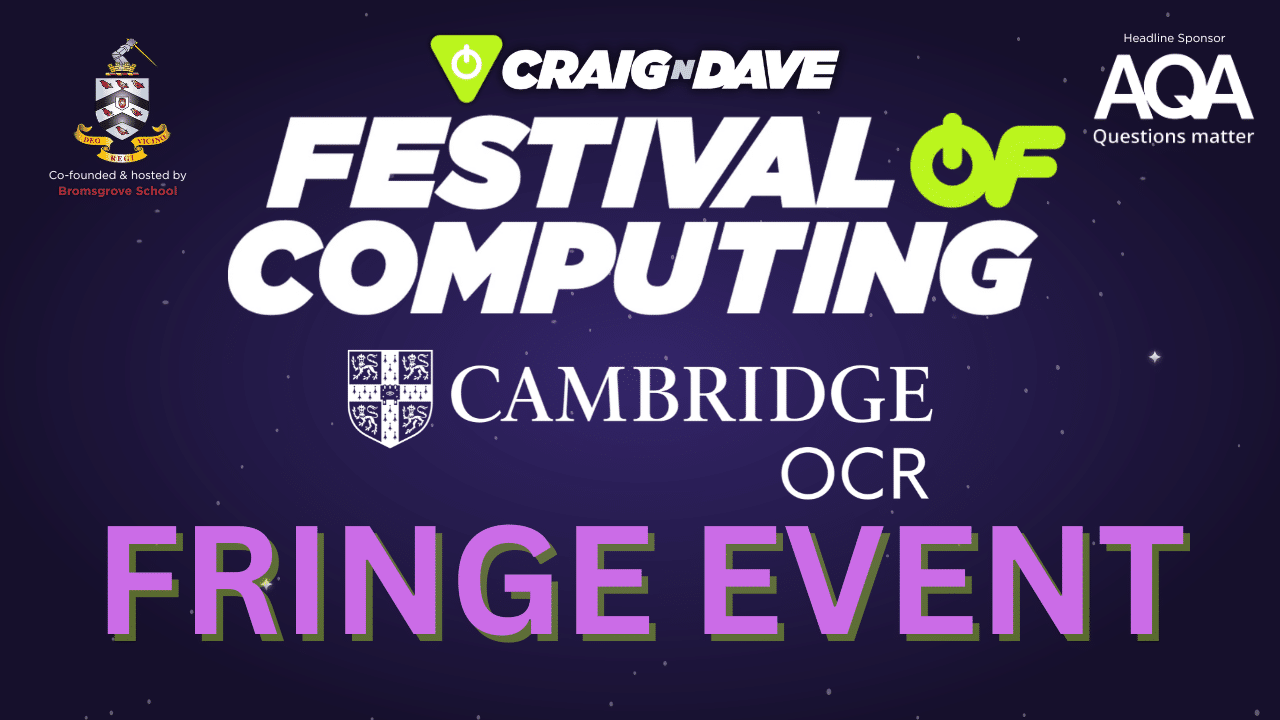
Get hands-on demos during the Fringe event, and don’t miss CPD sessions from a wide range of guest speakers, updates from Raspberry Pi Foundation, CAS, Pearson, West Midlands Regional Cyber Crime Unit and AQA, to name a few.

To see the full list of who’s speaking and what their talks will focus on HERE.


So, what makes this year different?

We’ve taken your feedback and upgraded everything:

  • More CPD sessions – You asked, we listened. Now enjoy three 45-minute sessions, packed with classroom-ready ideas.
  • Bigger marketplace – A dedicated marquee space for you to browse the latest in computing education tools and resources.
  • More coffee stations – Because teachers run on caffeine!
  • A new Fringe stage – Hear punchy, engaging ideas from exhibitors and guest speakers in short bursts.
  • On-site accommodation – Stay the night before with limited rooms available.
  • Pre-event socialCurry Supper & Social on 1st July, If you live locally or are staying overnight at Bromsgrove School or a nearby hotel, join us for a curry and a drink! The pre-event social is a ticketed event. Get your spot at the table here


Why it matters

This isn’t just another CPD day. It’s a genuine celebration of computing education — and a chance to feel part of a bigger, supportive, and forward-thinking community. 

Held at the historic Bromsgrove School, with its stunning grounds and modern facilities, the Festival of Computing 2025 offers the perfect mix of substance, setting, and shared passion.

We hope to see you there!


🎟️ Ready to book your ticket?
Secure your place now (fully refundable if you attend or cancel in good time)

🌐 Want to see more from Craig’n’Dave?
Visit craigndave.org for free teaching resources, classroom videos and community updates.

Related posts

What is Endianness?

Welcome to the quirky world of endianness — a classic computing debate that’s as petty as indenting code with tabs versus spaces or whether ketchup belongs in the fridge.

15 January 2026

Does anyone still use low-level code?

Low-level programming isn’t dead — it quietly powers the devices we rely on every day, from cars to toasters. If you love digging into game engines, compilers, or hardware drivers, your skills are more essential than ever.

14 January 2026

Should AI have morals?

Should AI always agree with us, or tell us when we’re wrong? We explore whether artificial intelligence should be kind, or correct — and why the answer really matters.

13 January 2026

What is vibe coding? Is it the future of programming?

Vibe coding lets you tell an AI what you want in plain English—and it writes the code for you. But is it genius productivity or just a confident intern with a wild imagination?

12 January 2026

Trinket is shutting down in June 2026

Time2Code uses Trinket as its online IDE for Python. Unfortunately, that service is shutting down later this year, probably in […]

9 January 2026

What does a GPU actually do?

A GPU isn’t just a graphics chip—it’s like a room full of toddlers with crayons, all scribbling at once to bring your game to life. While CPUs think carefully, GPUs colour fast.

Fail safeguarding if phone used in school?

Should schools fail an Ofsted safeguarding inspection because of mobile phones? We dig into the headlines claiming schools should fail Ofsted if pupils are seen using phones.

Should beginners use AI to code?

Should beginners use AI to help them code? It might seem like a shortcut—but relying on it too soon could stop you learning the skills you actually need.

8 January 2026

Is the Online Safety Act protecting us, or going too far?

The UK’s new Online Safety Act aims to protect young people online, but its sweeping measures are raising big questions about privacy, freedom, and access to information. Is it safeguarding the vulnerable, or simply going too far?

7 January 2026

Back

Meet the speakers inspiring change at the Festival of Computing 2025

6 May 2025

Get ready to be inspired! The Festival of Computing 2025 is bringing together some of the most experienced, forward-thinking minds in education and computing. Whether you’re an experienced teacher, a school leader, or someone passionate about the future of digital learning, our keynote sessions are not to be missed.

Let’s take a look at who’s taking to the stage to kick off the day and drive the conversation forward.

The Keynote speakers

Craig Sargent & David Hillyard – Co-founders, CEOs, and Conference Organisers, Craig’n’Dave

Craig and Dave aren’t just the minds behind the Festival of Computing – they’re the driving force behind one of the most recognised names in computing education.

Together, Craig and Dave will lead two unmissable sessions:

 🎤 Session 1: Changes to the national curriculum and new opportunities

 “The National Curriculum is rapidly approaching 15 years of age. The government is already undertaking a massive review of all subjects and all key stages. With this comes challenges and opportunities. Join us while we let you know what we are already doing to plan for the future.”

 🎤 Session 2: Meet the Smart Revise Team

 “A chance to meet the team behind Smart Revise, including our developers. Get early insight into features coming down the pipeline and give us your feedback!”

Jill Duffy – Chief Executive, OCR
🎓 OCR: Headline sponsor and the UK’s leading exam board for Computer Science

We’re thrilled to welcome Jill Duffy as a keynote speaker at this year’s event.

Jill is the Chief Executive of OCR and brings with her a wealth of experience in qualifications, assessment, and educational leadership. She’s worked across both UK and international education sectors, from primary through to vocational, and has a track record of delivering strategic growth and outstanding customer experience.

Her keynote is an important moment in the day – an opportunity to hear directly from the leader of the UK’s foremost exam board for Computer Science on where the subject is headed, and what that means for educators on the ground.

Alan O’Donohoe – Specialist Leader in Education, The Exa Foundation
“Relight My Fire”

Alan is one of the most inspiring voices in UK computing education. With over 20 years of teaching experience and now leading The Exa Foundation’s nationwide STEM enrichment work, Alan’s energy is contagious.

He’s known for creating engaging, inclusive experiences that spark curiosity in learners of all ages. Expect a dynamic session filled with insight and encouragement for teachers looking to reignite their passion for computing.

“Relight My Fire” promises to be a motivating, memorable talk that sets the tone for the rest of the day.


Session speakers bringing the Festival to life

The diverse range of sessions and passionate educators who bring the Festival of Computing to life throughout the day. Whether you’re exploring assessment, curriculum, pedagogy, or digital futures, these sessions offer something for everyone.

Here’s your guide to just some of the brilliant minds taking the stage this year.


🎓  John Palmer, Host & Conference Organiser & Michael Punt, Headmaster

A warm welcome from Bromsgrove School

We begin the day with a warm welcome from the host venue. John Palmer and Headmaster Michael Punt will officially open the Festival and share the school’s enthusiasm for hosting an event that brings together innovation, teaching excellence and a passion for computing.


Ceredig Cattanach-Chell – Subject Advisor for Computing, OCR

Ceredig brings an academic and practical edge to OCR’s computing offer. With experience as a teacher, assessor, and published author, he’s passionate about balancing digital skills with curriculum demands.

 🧠 Session 1: Striking the balance

 “What does OCR’s striking the balance mean for Schools and Curriculum? How do digital skills fit into an already packed agenda? This session will explore how our Striking the Balance report may impact Computing qualifications – and will specifically dig into how Digital Skills could be incorporated into the curriculum without curriculum overload.”

 🧠 Session 2: Digital Exams

“View the latest developments for OCRs fully digital GCSE. Hear about our progress and journey. Review the platform and see how exams may look in the future. Discuss the implementation of digital exams and how we will maintain our J277 paper-based exams at the same time.”

 🧠 Session 3: Additional Advanced Qualifications (AAQs)

 “Hear about the latest development of AAQs. With the latest round of funding/defunding, this talk will look at how you can use AAQs to support those learners who may not be suitable for either A levels of T levels. Explore OCR’s offer of AAQs: Cambridge Advanced National in Computing: Application Development and Cambridge Advanced National in IT: Data Analytics”

Mark Calleja – Learning Manager for Code Club Projects, Raspberry Pi Foundation (Code Club)

Known as ‘Mr.C’, Mark blends storytelling, gamification, and AI into practical, hands-on sessions that make computing accessible and exciting.

 🎮 Session 1: AI at Code Club

 “A hands on, practical introduction to the AI projects collection from the Raspberry Pi Foundation, showcasing the wide range of easy to manage projects for your club. From facial recognition to decision trees and micro:bit, there is something for everyone!”


DC Adrian Bacon & DC Hannah Link – Regional Cyber Crime Team, West Midlands Regional Cyber Crime Unit

Bringing real-world context to the classroom, Adrian and Hannah’s session is all about ethical computing and prevention. Their work focuses on educating young people before they cross the line into illegal activity.

 🔐 Session 1: Cyber Choices

 “Ade & Hannah have developed a training video to help teachers and communities teach students the Computer Misuse Act. It’s been specifically designed to be delivered by non-technical persons and focuses on the ethical impact on both the offender and victim and the associated consequences.”


Alan Harrison – Director, Harrison Proserv Ltd (How to Teach Computer Science)

Alan’s session offers a reflective, research-informed lens into what it really means to think like a computer scientist — and how understanding “disciplinary knowledge” can change how we teach.

 💡 Session 1: Disciplinary Knowledge in Computing

 “What my Master’s research taught me about the “gaze” of a computer scientist and why it matters to you.”


Simon Johnson – Senior Consultant and AI Specialist, TA Education (Tablet Academy)

Simon brings classroom experience and consultancy insight together in his workshop on artificial intelligence. He’s also the author of 100 Ideas for Secondary Teachers: Outstanding Computing Lessons and the founder of #caschat.

 🤖 Session 1: Using AI to teach computing

 “Unlock the potential of AI in your classroom! Join us for an engaging workshop where you’ll discover how to leverage tools like Microsoft Copilot to enhance your teaching of computing. Learn practical strategies to support students with coding, reduce cognitive load, and to contextualise learning.”


Alex Parry (Senior Learning Manager) & Laura James (Learning Manager), Raspberry Pi Foundation

Alex and Laura share their expertise from the Ada Computer Science team and real classroom experience to demystify A Level web development.

 💻 Session 2: Mastering A-Level web development

 “Exploring core and advanced website projects for the NEA”


Rujeko Moyo (Community Coordinator – England) & Sarah Roberts (Community Manager), Raspberry Pi Foundation (Code Club)

Rujeko and Sarah share their passion for inclusive computing with a guide to setting up and growing your Code Club.

 🌍 Session 2: Code Clubs in Secondary Schools

 “Discover how Code Clubs can ignite learners’ interest in computing, enhance your curriculum and build confidence. This session provides a practical introduction to starting and running a Code Club including free access to facilitation resources, ongoing support for teachers and mentors, and exciting opportunities for recognising and celebrating learners’ progress through the Raspberry Pi Foundation’s annual “Coolest Projects” showcase and “Astro Pi” challenge.”

Ben Garside – Senior Learning Manager – AI Literacy, Raspberry Pi Foundation

Ben will explore how to equip young people to navigate the world of AI responsibly — a must-attend for any teacher tackling digital ethics.

 🧠 Session 2: Adopting AI

 “Empowering young people to safety and responsibly adopt AI tools”


Rebecca Franks (CLO) & Dr Tracy Gardner (CTO), Flip Computing

Rebecca and Tracy are driving innovation and inclusion in tech education. Their session looks at real-world impact from Dudley to your own school.

 🌐 Session 2: Flock XR, the free 3D creation tool

 “How schools in Dudley embraced 3D skills with Flock XR…and how you could too!”


Kat Morgan – Head of Learning, Mindjoy

Kat’s sessions focus on how AI can support both students and teachers in and out of the classroom — from automated feedback to engaging content delivery.

 💡 Sessions 2: AI Tutors and Auto-marking with Mindjoy

 “AI Tutors and automarking for 24/7 learning”

 💡 Sessions 3: Lesson Hacker!

 “Make your theory content enthralling with Lesson Hacker!”


Tim Brady – Subject Advisor, Pearson

With a foot in both industry and education, Tim brings insight into how Pearson is making onscreen assessment work for Computer Science.

 🖥️ Session 3: Onscreen Exams

“Get a closer look at Pearson’s Onscreen Assessment of GCSE Computer Science”


Becci Peters – Computing Subject Lead (Secondary/Tertiary), CAS


With years of classroom and teacher training experience, Becci is a voice of clarity for both new and experienced teachers. She’s now supporting trainees nationally and contributing to assessment standards.

 🎓 Session 3: Supporting students with A-Level OCR essay-style questions

 “In this session we’ll look at the types of questions and briefly look at the generic mark scheme used for these questions and look at how to support your students with writing the answers to this style of question.”


Martyn Colliver – AQA Computer Science Subject Advocate, AQA

As Subject Advocate and a lead moderator, Martyn’s focus is on helping schools navigate both the AQA spec and effective pedagogy. His session combines two passions: functional programming and mathematical thinking.

 🧠 Session 3: Functional Programming

 “Building coding skills for A level – exploring functional programming using simple algorithms in Python and Haskell.”


Chris Calver – UK Education Manager, VEX Robotics

With a decade and a half of STEM engagement under his belt, Chris supports schools across the UK to bring computing to life through robotics.

 ⚙️ Session 3: Blocks to Python

 “Supporting the transition from Block to Python Coding using Hybrid Environments”


Harriet Page (Learning Manager) & Andrew Csizmadia (Bebras Manager), Raspberry Pi Foundation

Engaging and accessible computational thinking is the focus for Harriet and Andrew’s session — ideal for bringing Bebras into your classroom.

 🧩 Session 3: Bebras

 “Bringing Bebras into the classroom: Engaging students with interactive computational thinking tasks.”


🎟️ Book your ticket today

The Festival of Computing 2025 is completely free to attend (the ticket cost is refunded after you attend the event) — all you need to do is secure your ticket now and join us on Wednesday 2nd July at Bromsgrove School.

Don’t miss this opportunity to connect with subject experts, explore the future of computing, and take away classroom-ready resources and ideas.

Hope to see you there! 
 

Related posts

What is Endianness?

Welcome to the quirky world of endianness — a classic computing debate that’s as petty as indenting code with tabs versus spaces or whether ketchup belongs in the fridge.

15 January 2026

Does anyone still use low-level code?

Low-level programming isn’t dead — it quietly powers the devices we rely on every day, from cars to toasters. If you love digging into game engines, compilers, or hardware drivers, your skills are more essential than ever.

14 January 2026

Should AI have morals?

Should AI always agree with us, or tell us when we’re wrong? We explore whether artificial intelligence should be kind, or correct — and why the answer really matters.

13 January 2026

What is vibe coding? Is it the future of programming?

Vibe coding lets you tell an AI what you want in plain English—and it writes the code for you. But is it genius productivity or just a confident intern with a wild imagination?

12 January 2026

Trinket is shutting down in June 2026

Time2Code uses Trinket as its online IDE for Python. Unfortunately, that service is shutting down later this year, probably in […]

9 January 2026

What does a GPU actually do?

A GPU isn’t just a graphics chip—it’s like a room full of toddlers with crayons, all scribbling at once to bring your game to life. While CPUs think carefully, GPUs colour fast.

Fail safeguarding if phone used in school?

Should schools fail an Ofsted safeguarding inspection because of mobile phones? We dig into the headlines claiming schools should fail Ofsted if pupils are seen using phones.

Should beginners use AI to code?

Should beginners use AI to help them code? It might seem like a shortcut—but relying on it too soon could stop you learning the skills you actually need.

8 January 2026

Is the Online Safety Act protecting us, or going too far?

The UK’s new Online Safety Act aims to protect young people online, but its sweeping measures are raising big questions about privacy, freedom, and access to information. Is it safeguarding the vulnerable, or simply going too far?

7 January 2026

Back

The Festival of Computing 2025: The ultimate event for computer science teachers

1 April 2025

If you’re a secondary school computing teacher looking for cutting-edge CPD, inspiring speakers, and the chance to connect with like-minded educators, the Festival of Computing 2025 is an event you can’t afford to miss. This year is sponsored by Craig’n’Dave, Bromsgrove School and OCR.

After the success of last year, this year’s event is bigger and better, packed with more sessions, a larger marketplace, and plenty of coffee to keep you fuelled throughout the day.

What is the festival of computing?

The Festival of Computing is the evolution of the hugely popular Craig’n’Dave & Friends conference. Taking place on 2nd July 2025 at Bromsgrove School, it’s a full day of collaboration, learning, and innovation for computing teachers.

Expect hands-on CPD sessions, keynote talks from top industry experts, and plenty of opportunities to share ideas with fellow educators. Whether you’re refining your teaching methods or exploring the latest tools in computing education, this event is designed to inform, inspire, and energise.

What’s new for 2025?

We’ve listened to your feedback from last year and made some exciting upgrades:

  • New fringe event: A fresh addition where market stall holders will pitch their ideas on teaching and learning in computing.
  • Bigger marketplace: We’re moving the marketplace to a large, dedicated marquee on Gordon Green, offering more space and a better experience.
  • More coffee stations: You asked, and we delivered. Expect plenty of coffee to keep you going throughout the day.
  • More CPD sessions: This year, we’re switching from two 1-hour sessions to three 45-minute sessions, giving you more variety and flexibility.
  • On-site accommodation: Stay on-site the night before to make the most of the event (limited availability, book HERE).
  • Pre-event ticketed social: If you’re local or staying overnight, join us for a curry and drinks social on 1st July—perfect for networking in a relaxed setting. *Please note there are limited tickets for the curry and drinks event available. Please book HERE

Want a sneak peek at the full agenda? Click here.


The location: Bromsgrove School

We’re thrilled to be hosting the Festival of Computing at the prestigious Bromsgrove School.

Bromsgrove School, with its 500-year history, is one of Britain’s leading boarding and day schools. Set over 100 acres of stunning grounds, it offers world-class facilities and a first-rate academic environment, making it the perfect setting for a day of innovation and inspiration.

Secure your place today!

Don’t miss out on the must-attend computing education event of 2025

Secure your spot at the Festival of Computing and join hundreds of passionate educators for a day of learning, networking, and fun.

👉 Get your ticket here.

🌐 Visit Craig’n’Dave.org for more

Related posts

What is Endianness?

Welcome to the quirky world of endianness — a classic computing debate that’s as petty as indenting code with tabs versus spaces or whether ketchup belongs in the fridge.

15 January 2026

Does anyone still use low-level code?

Low-level programming isn’t dead — it quietly powers the devices we rely on every day, from cars to toasters. If you love digging into game engines, compilers, or hardware drivers, your skills are more essential than ever.

14 January 2026

Should AI have morals?

Should AI always agree with us, or tell us when we’re wrong? We explore whether artificial intelligence should be kind, or correct — and why the answer really matters.

13 January 2026

What is vibe coding? Is it the future of programming?

Vibe coding lets you tell an AI what you want in plain English—and it writes the code for you. But is it genius productivity or just a confident intern with a wild imagination?

12 January 2026

Trinket is shutting down in June 2026

Time2Code uses Trinket as its online IDE for Python. Unfortunately, that service is shutting down later this year, probably in […]

9 January 2026

What does a GPU actually do?

A GPU isn’t just a graphics chip—it’s like a room full of toddlers with crayons, all scribbling at once to bring your game to life. While CPUs think carefully, GPUs colour fast.

Fail safeguarding if phone used in school?

Should schools fail an Ofsted safeguarding inspection because of mobile phones? We dig into the headlines claiming schools should fail Ofsted if pupils are seen using phones.

Should beginners use AI to code?

Should beginners use AI to help them code? It might seem like a shortcut—but relying on it too soon could stop you learning the skills you actually need.

8 January 2026

Is the Online Safety Act protecting us, or going too far?

The UK’s new Online Safety Act aims to protect young people online, but its sweeping measures are raising big questions about privacy, freedom, and access to information. Is it safeguarding the vulnerable, or simply going too far?

7 January 2026